Creag an Tuirc: A Highland Oath
Prologue
A bitter wind swept through Glen Strae, carrying whispers of betrayal. The fire crackled low in the hearth as Alasdair MacGregor pressed his hand against the rough timber wall, listening for the sound of boots. Outside, snow fell like ash from a dying world. The proscription had returned. The name MacGregor was once again a death sentence.
“Tha e a’ tighinn,” murmured his wife—it is coming. Soldiers of the Crown sent to strip them of their name, their tartan, their soul. Alasdair looked at the green and black plaid folded on the table. With trembling hands, he fed it to the flames. The wool hissed, curling into smoke like a spirit departing.
Chapter 1: Glen Strae, Winter 1693
This was not the first time. Nor would it be the last.
“Ashes of the Name”
The wind tore through Glen Strae like a banshee, shrieking across the snow-laced hills and rattling the bare branches of the birch and pine. The glen lay cloaked in winter’s silence, broken only by the crackle of fire and the crunch of boots on frozen earth.
Alasdair MacGregor stood alone beside a stone fire pit, his breath curling into the chilly air like smoke from a dying soul. In his hands, he held a folded tartan—green and red, the colors of Clan Gregor. The fabric was worn but proud, its threads woven with memory and blood.
“This cloth bore our name,” he said, voice low and bitter. “Our blood. Our pride. And now it must burn.”
He tossed the tartan into the fire. Flames leapt hungrily, devouring the wool. The colors twisted, blackened, and vanished into ash.
William Walker stood just beyond the firelight, his jaw tight, fists clenched at his sides.
How many times had he seen this? The burning of names, of colors, of memory. And still, it never felt right. Never felt just.
He watched the flames consume the tartan and felt a knot tighten in his chest.
This is not survival. This is surrender dressed in silence.
“There must be another way, Alasdair,” he said, stepping forward. “We can’t keep hiding forever.”
Alasdair turned, eyes sharp. “Another way? Do you think the Campbells will let us walk free? You think the crown will forgive Glen Fruin?”
William met his gaze.
I was not there at Glen Fruin. I did not swing a sword. But I carry the weight of it all the same.
“I think we’ve hidden long enough.”
From the shadows, Arthur MacGregor spoke, sharpening his blade. “You ever kill a man, Walker?”
William did not flinch. “Not yet.”
Arthur looked up, eyes cold. “Then don’t speak of war like you know it.”
“I don’t speak of it,” William said. “I prepare for it.”
And I will be ready when it comes. For Mary. For Thomas. For all of you who still believe the name is worth dying for.
Mary stepped beside him, her voice calm but firm. “We carry the name in our hearts. Not just on our backs. Burning the cloth does not burn the blood.”
William glanced at her, the firelight dancing in her eyes.
She is the reason I am here. The reason I chose this path. She is stronger than any of them realize. Stronger than me, most days.
From the croft, Margrat emerged. “You walk like a man with a name, William. But you wear one that is not yours.”
“I wear the one that keeps your sister safe,” he replied.
Margrat’s eyes narrowed. “Then wear it well. Because if you fail her, I will carve the MacGregor name into your bones myself.”
William gave a faint smile. “I’d expect nothing less.”
And I would deserve it.
Janet appeared next, humming a tune. “Bravery is singing when you know they are listening. Foolishness is stopping.”
“You’re brave to sing that aloud,” William said.
“They already came for me once,” Janet replied. “I’m still singing.”
Jhone knelt beside the fire, unrolling a crude map. “If they come from the south, they’ll take the pass near Loch Sloy.”
“You’ve thought this through,” William said.
“I’ve had years,” Jhone replied. “You fight with fire. We fight with patience.”
“Then teach me,” William said. “I’d rather learn than burn.”
I was not born to this clan, but I will bleed for it. I already have.
Agnes entered the barn, brushing frost from her cloak. “You trust too easily.”
“And you trust no one,” William replied.
“That’s why I’m still breathing.”
“Mary says you taught her how to disappear.”
Agnes paused. “I taught her how to survive. Disappearing was just the first lesson.”
Inside the croft, Christen sat by candlelight, writing in a small leather-bound book.
“What are you writing?” William asked.
“Your story,” she said. “All of ours.”
“Why me?”
“Because you chose us. That makes you part of the tale.”
“Then write it true.”
“I always do.”
A gust of wind swept through the glen, scattering the ashes. Silence fell, heavy and sacred.
Alasdair’s voice was barely audible. “Gregor Dubh would curse me for this. But he would understand. The name lives in the silence now.”
William looked into the fire, the last embers glowing like dying stars.
Let them outlaw the name. Let them burn the cloth. We are still here. And one day, they will hear us again.
Chapter 2: Buchanan Parish
“The Gathering in the Barn”
The barn stood at the edge of the croft, half-buried in snow, its roof sagging under the weight of winter. By day, it held tools, hay, and the scent of livestock. But tonight, it held something far more dangerous – memory.
No torches were lit. Only a single lantern, hooded and dim, cast a faint glow over the gathered faces. The air was thick with breath and anticipation. Children sat cross-legged on the straw-covered floor, their eyes wide. Elders leaned against beams, cloaks pulled tight. Every sound—the creak of wood, the rustle of wool—seemed louder in the hush.
Mary stood at the center, her voice low but clear.
“We gather not to speak treason,” she said, “but to remember who we are.”
Janet stepped forward, her voice rising in a soft, haunting melody. It was an old MacGregor lament, sung in Gaelic, forbidden by law. The children leaned in, drawn by the rhythm, the sorrow, the pride.
William stood near the back, watching.
This is what they fear, he thought. Not swords. Not muskets. This. A name carried in song. A people who refuse to forget.
Jhone passed around a folded parchment—an oath, written in Gaelic, to be memorized and burned. Agnes whispered names of those still in hiding, those who had vanished, those who had died with the name MacGregor on their lips.
Arthur stood guard at the door, dirk at his belt, eyes scanning the dark.
Margrat moved among the children, correcting their pronunciation, her voice stern but warm. Christen sat beside a boy no older than Thomas, helping him trace the MacGregor crest into the dirt with a stick.
When the song ended, silence returned. Then Mary spoke again.
“Creag an Tuirc still stands. And so do we.”
One by one, voices echoed hers.
“Still, we stand.”
“Still, we remember.”
“Still, we are MacGregor.”
William felt the words settle into his bones.
They can outlaw the name. But they cannot kill the oath.
The barn had emptied, but Mary lingered, her fingers tracing the carved MacGregor crest Christen had etched into the beam. The cold had crept back in, but she did not feel it. Not yet.
Behind her, the door creaked open. Margrat stepped inside, her shawl pulled tight around her shoulders, her breath rising in soft clouds.
“You should be resting,” Mary said without turning.
“So should you,” Margrat replied, her voice low and even. “But here we are.”
Mary smiled faintly. “You always find me when I need reminding.”
Margrat walked slowly to her side, her boots crunching on the straw. “You did well tonight. They listened.”
“They needed to,” Mary said. “We all did.”
Margrat studied her sister’s face. “You carry it well, the weight. But it is heavy, isn’t it?”
Mary nodded. “Some days I feel like I’m holding up the whole glen.”
“You’re not,” Margrat said gently. “You are holding the part that is yours. The rest of us—we carry it too.”
Mary looked down at the crest. “Do you ever wonder what it would be like to live without the name? To be free of it?”
Margrat was quiet for a moment. Then: “No. I wonder what it would be like to live in a world where we could speak it without fear.”
Mary turned to her, eyes shining. “Do you think Thomas will see that world?”
Margrat reached out and tucked a loose strand of hair behind Mary’s ear. “If he doesn’t, it won’t be because we didn’t fight for it.”
They stood in silence, two women bound by blood and burden, surrounded by the ghosts of their ancestors and the echoes of forbidden songs.
Then Margrat said softly, “You remind me of our mother.”
Mary’s breath caught. “Do I?”
“She had that same fire in her eyes. The same quiet fury. She would have been proud of you tonight.”
Mary swallowed hard. “I hope so.”
“She would’ve told you this too,” Margrat added. “You don’t have to carry it alone.”
Mary nodded, her voice barely a whisper. “Thank you.”
They left the barn together, stepping into the chilly night, the stars above them sharp and bright. Behind them, the carved crest remained—silent, defiant, eternal.
Chapter 3: Echoes of Glen Fruin
“The Day the Glen Ran Red”
The fire crackled low in the hearth, casting flickering shadows across the stone walls of the croft. Outside, the wind howled through the trees, but inside, the air was still—thick with the scent of peat smoke and the weight of memory.
Thomas sat cross-legged on the floor, eyes wide, a wool blanket wrapped around his shoulders. Christen sat beside him, her journal open, quill poised. Across from them, Janet MacGregor leaned forward, her voice low and rhythmic, like the beginning of a prayer.
“Do you know why they fear our name, Thomas?” she asked.
The boy shook his head.
“Because once, long ago, we made the glen run red.”
Mary sat nearby, mending a torn sleeve, her hands slowing as Janet began. William stood in the doorway, arms crossed, listening—his face unreadable.
“It was the seventh day of February, in the year sixteen hundred and three,” Janet said. “The snow had melted early that year, and the ground was soft beneath our boots. The Colquhouns came with horses and muskets, thinking they could drive us from the land.”
She paused, letting the silence settle.
“But they did not know the hills like we did. They did not know the trees, the burns, the hidden paths. And they did not know Robert MacGregor.”
Mary looked up, her voice quiet but steady. “He was my grandfather’s uncle. A warrior. A shadow in the mist.”
Janet nodded. “He led our men down from the ridges, silent as ghosts. Two hundred Colquhouns and their allies marched into Glen Fruin that morning. By nightfall, most of them were dead.”
Thomas’s eyes widened. “All of them?”
“Not all,” Mary said. “Some fled. Some were spared. But the glen was soaked in blood. And the king—James VI—he heard of it before the snow melted again.”
Janet’s voice darkened. “He outlawed our name. Declared us no longer men, but beasts. Said we could be hunted like wolves. And so, we were.”
William stepped forward, his voice low. “That is why the tartan burns. That is why the songs are sung in secret.”
Thomas looked down. “But we didn’t start it.”
“No,” Mary said. “But we finished it. And we paid the price.”
Janet leaned closer to the fire. “But we remember. That is the oath. That is the fire we carry.”
Christen dipped her quill and wrote the final line in her journal:
“We remember. That is the fire we carry.”
Chapter 4: Crowns and Kings
“The King Who Left, and the Blood That Stayed”
Spring had come late to the Highlands in 1603, and it came colder still in 1693. The snow had barely melted from the ridges when the news reached Buchanan Parish: Queen Elizabeth of England was dead, and James VI of Scotland had become James I of England.
But for the MacGregors, it was not the news of a new king that stirred the glen—it was the blood spilled in his name.
“I saw him ride out,” he said. “James Stewart. Our king. Our hope.”
The younger men leaned in. Even Robert MacGregor, usually stoic, listened with quiet intensity.
“It was the third day of April,” Gregor continued. “The streets of Edinburgh were lined with nobles and merchants, all waving their kerchiefs and shouting blessings. But the Highlanders… we stood silent.”
He paused, eyes distant.
“He wore English silk. Not the tartan of his fathers. His horse was shod in silver, and his guards bore English muskets. He smiled, but it did not reach his eyes.”
A younger clansman asked, “Did he speak to the people?”
Gregor nodded. “He promised to return every three years. Promised to be king of both lands. But I saw it in him—he was already gone. His heart was in London before his boots left the cobbles.”
Robert spoke then, voice low. “And he returned only once. To remind us we were subjects, not sons.”
Gregor looked into the fire. “He was born in a castle, but raised in fear. He learned to rule with ink and law, not sword and oath. He forgot the hills. He forgot us.”
Silence fell over the circle.
Then Gregor added, “That was the day I stopped calling him king. From that day on, I swore only to the stone.”
The Council at Dalmally
The MacGregors gathered in secret, deep in the woods near Dalmally. A fire burned low in the center of the circle, its smoke rising into the canopy above. Robert MacGregor stood at its edge, arms folded, his face unreadable.
“He calls himself King of Great Britain now,” said John MacGregor, his voice tight. “As if the crowns were always meant to be one.”
Gregor Dubh MacGregor, old but unbent, leaned on his staff. “He is a Stewart. A Scot That should mean something.”
“Aye,” Robert said. “But he has gone south. To London. And he will not return.”
A murmur passed through the gathered men.
“He promised to return every three years,” said a younger clansman.
Robert shook his head. “He will return once. And only to remind us we are not his concern.”
Back in Buchanan Parish, Mary sat by the hearth, brushing Thomas’s hair as he drifted to sleep. William watched her from across the room, the firelight soft on her face.
“My mother told me the day the news came,” Mary said quietly. “She said the hills held their breath. That maybe, just maybe, a Scottish king would remember his people.”
William leaned forward. “And did he?”
Mary’s eyes darkened. “He remembered the Campbells. He remembered the Lowlands. But he forgot the glens.”
The Oath Reaffirmed
Later that night, the family gathered in the barn again—not for song, but for silence. Jhone unrolled a parchment, the same oath their ancestors had sworn at Creag an Tuirc.
“We swear not to the crown,” he said, “but to each other.”
Each sibling placed a hand on the parchment. William followed, his fingers trembling slightly.
“I may not have been born to the name,” he said, “but I’ll carry it until my last breath.”
Mary looked at him, her voice soft but fierce. “Then you are MacGregor.”
Chapter 5: The Jacobite Cause
“Killiecrankie”
The summer of 1689 brought more than heat to the Highlands—it brought war. The Glorious Revolution had swept James VII of Scotland (James II of England) from the throne, and in his place now sat William of Orange, a foreign king with foreign ways.
But not all of Scotland bent the knee.
“The Call to Arms”
The news came with a whisper and a name: Viscount Dundee—John Graham of Claverhouse—was raising the royal standard for King James in the Highlands. The clans were stirring. Old loyalties, long buried, rose like smoke from the glens.
William Walker stood at the edge of the croft, staring toward the north. The hills beyond Rannoch were already alive with movement—men gathering, blades being sharpened, oaths being renewed.
Mary found him there, arms crossed, jaw tight.
“You’re going,” she said.
He did not answer at first.
“I have to,” he finally said. “Not for James. Not for politics. For the name. For the oath.”
Mary stepped closer. “You’ve already bled for us.”
“And I’ll bleed again,” he said. “If it means Thomas grows up with a name he can speak aloud.”
She reached for his hand. “Then come back to us. Whole.”
“The Night Before Killiecrankie”
That night, the three men sat around a small fire, their cloaks pulled tight against the chill. The stars above were sharp and cold.
William stared into the flames.
This is what it means to fight for something other than yourself. Not for land. Not for coin. But for the right to speak your name without fear.
Jhone passed him a flask. “You’ve come far for a man with no clan.”
William took a sip. “I have a clan. I just was not born into it.”
Arthur nodded. “You will earn your place tomorrow. One way or another.”
“The Battle of Killiecrankie – 27 July 1689”
The wind whispered through the heather-strewn hills of Killiecrankie Pass, carrying with it the scent of pine and the distant murmur of marching feet. The land, ancient and brooding, seemed to hold its breath. The sun, low in the western sky, cast long shadows across the rugged terrain, painting the hills in hues of amber and blood-red.
From the heights above the pass, Domhnall MacLeòid, a seasoned warrior of Clan MacLeod, stood with his claymore resting against his shoulder. His weathered face bore the marks of many winters, and his eyes, sharp and grey, scanned the valley below. He could see them—rows upon rows of redcoats, their muskets glinting in the fading light, their movements precise, mechanical.
“They come like a tide,” he muttered, “but we are the rocks they’ll break upon.”
Beside him, Ewan MacGregor, a young clansman barely past his eighteenth year, adjusted the strap of his targe and looked nervously at the enemy below.
“Do you think we’ll win, Domhnall?” he asked, voice trembling.
Domhnall didn’t answer immediately. He turned to look at the line of Highlanders stretching across the ridge—MacDonalds, Camerons, Stewarts, and his own kin, the MacLeods. They were clad in plaids and armed with broadswords, dirks, and muskets. Some wore grim expressions; others smiled, eager for the fight.
“We’ve the high ground,” Domhnall finally said. “And we’ve the fire of the Gael in our hearts. That counts for more than numbers.”
Down in the valley, Captain William Drummond of the government forces surveyed the terrain with a furrowed brow. He had fought in the Low Countries under William of Orange, had seen the disciplined ranks of Dutch infantry hold firm against the fiercest assaults. But this was different.
“They’re up there,” he said to Lieutenant Henry Forsyth, gesturing toward the ridge. “And we’re down here. It’s a poor position.”
Forsyth nodded. “Mackay’s confident. He says our firepower will break them before they reach us.”
Drummond wasn’t so sure. He’d heard tales of the Highland charge—how the clansmen would scream like banshees and hurl themselves into the fray with terrifying speed. He’d seen the aftermath of such charges in skirmishes near Inverness. The redcoats had been torn apart.
Still, orders were orders. The government had to hold Scotland. The Jacobite threat had to be crushed.
“The Last Words of Dundee”
Atop the ridge, John Graham of Claverhouse, Viscount Dundee, sat astride his black charger, his armor polished to a gleam, his eyes fixed on the enemy below. He was a man of contradictions—aristocrat and warrior, poet and soldier, loyalist and rebel. His voice was calm, but his heartbeat with the fury of a thousand battles.
He turned to his men, raising his sword high.
“Brothers!” he called. “The usurper sits on our throne, and our true king, James, waits across the sea. Shall we let these red-coated invaders trample our land and silence our clans?”
A roar erupted from the ranks.
“No!”
“Then let them hear our answer,” Dundee said. “Let them feel the steel of the Highlands. Let them know that Scotland will not kneel!”
He turned to his standard bearer, a young lad from Clan Cameron, and nodded. The boy raised the banner—a white cross on a blue field—and the signal was given.
“The Highland Charge”
The descent began slowly, like a wave gathering strength. Then, with a sudden fury, the Highlanders surged forward. They screamed their war cries— “Creag Eile!” “A Dhia!”—and the hills echoed with the sound of vengeance.
Domhnall ran with the strength of a man half his age, his claymore raised high. Around him, the clansmen moved like a living storm, their feet pounding the earth, their eyes locked on the enemy below.
Ewan stumbled once, then found his footing. The fear in his heart was drowned by the roar of his kin, by the sight of the red line ahead. He gripped his sword tighter, his breath coming in ragged gasps.
Below, Drummond shouted orders. “Hold the line! Fix bayonets! Steady now!”
The redcoats scrambled, their training clashing with the primal chaos descending upon them. Muskets fired, smoke billowed, and the first wave of Highlanders crashed into the line.
Domhnall’s blade found flesh. He moved like a dancer, parrying, slashing, roaring. Around him, men fell—some screaming, some silent. He saw Ewan drive his sword into a soldier’s chest, eyes wide with shock and triumph.
Drummond fought with grim determination, his saber flashing. He saw Forsyth fall, a dirk buried in his side. The line was breaking. The Highlanders were everywhere—feral, unstoppable.
“The Turning Tide”
As the battle raged, Dundee rode into the thick of it, rallying his men. A musket ball struck him in the side, and he reeled in the saddle. Blood poured from the wound, staining his tunic. He slumped, but did not fall.
“Forward!” he gasped. “For Scotland!”
His horse carried him a few paces more before he collapsed, the life draining from his eyes. Around him, the Highlanders surged, unaware their leader had fallen.
Domhnall saw the body and felt a pang of sorrow. “Dundee is down!” he cried. “But we fight on!”
The government forces, now leaderless and broken, began to flee. Some threw down their weapons; others ran into the woods. The Highlanders gave chase, their fury unrelenting.
Drummond, bloodied and bruised, stumbled through the chaos. He saw men cut down as they ran, heard the screams of the dying. He turned to flee, but a Highlander blocked his path.
It was Ewan.
Their eyes met—one young, one old. For a moment, time froze.
Then Ewan lowered his sword.
“Go,” he said. “Tell your king what happened here.”
Drummond nodded, breathless, and ran.
“The Silence After the Storm”
The thunder of battle had faded into a haunting quiet. Smoke hung low over the pass, curling around the trees like ghostly fingers. The River Garry, once a tranquil ribbon of water, now ran red with blood. The cries of the wounded echoed through the glen, mingling with the distant calls of ravens circling overhead.
Domhnall MacLeòid sat on a moss-covered rock, his claymore resting across his knees. His hands trembled—not from fear, but from the adrenaline that still surged through his veins. Around him, the Highlanders moved like shadows, searching the field for survivors, gathering the wounded, and offering prayers for the dead.
He looked down at his bloodied hands and thought of the young soldier he had slain—no older than Ewan, whose wide eyes still stared at the carnage in disbelief.
“War is a cruel teacher,” Domhnall said softly, as Ewan approached.
“I didn’t think it would feel like this,” Ewan whispered. “I thought… I thought it would be glorious.”
Domhnall nodded. “It is never glorious. Only necessary.”
Nearby, Alasdair MacDonald, a bard and warrior, knelt beside a fallen clansman, his cousin. He began to hum a lament, the tune low and mournful, a song of loss and honor. Others joined in, their voices rising in a dirge that carried across the hills.
“The Flight of the Redcoats”
Captain William Drummond stumbled through the underbrush, his uniform torn, his face streaked with blood and soot. He had lost his sword, his men, and nearly his life. The Highlanders had shown no mercy, and yet—he had been spared. That young warrior, the one with fire in his eyes, had let him go.
Why?
He collapsed beside a fallen tree, gasping for breath. Around him, other survivors gathered—men with shattered limbs, bloodied faces, and haunted expressions. They had fled not just the battlefield, but the certainty of defeat.
Sergeant Thomas Bell, a grizzled veteran, sat nearby, cradling a wounded arm.
“We were lambs,” he muttered. “Lambs led to slaughter.”
Drummond looked at him. “We were trained. We had numbers. We had the high command.”
Bell spat blood. “Aye, and they had the land. The spirit. The fury. We never stood a chance.”
The men fell silent; each lost in his own thoughts. Some wept. Others stared blankly. The war was not over, but something had shifted. The redcoats had tasted the wrath of the Highlands, and it had left a scar.
“The Cost of Victory”
Back on the ridge, the Highlanders gathered around the lifeless body of Viscount Dundee. His face was serene, as if he had found peace in death. His sword lay beside him; its blade still stained with blood.
Archibald Cameron, a clan chieftain, knelt and closed Dundee’s eyes.
“He gave his life for the cause,” he said. “Let it not be in vain.”
Domhnall looked at the men around him. They had won the day, but at a terrible cost. Hundreds of Highlanders lay dead or dying. The victory was theirs, but the future was uncertain.
“We must hold together,” he said. “Without Dundee, we are scattered clans. But united, we are a storm.”
Ewan stood beside him, his face pale but resolute.
“I’ll fight,” he said. “For Scotland. For our people.”
Domhnall placed a hand on his shoulder. “Then you are truly a warrior.”
“Echoes in the Glen”
As night fell, the pass grew quiet. The fires of the Highland camp flickered in the darkness, casting long shadows on the rocks. The clans mourned their dead, sang songs of valor, and told tales of the battle.
Alasdair MacDonald stood before the fire, his harp in hand.
“Let the bards remember this day,” he said. “Let the glens echo with the names of the fallen. Let the world know that the Highlands do not kneel.”
He played a tune—soft, mournful, and proud. The men listened in silence, their hearts heavy but unbroken.
“Ashes in the Heather”
The sun was setting behind the hills of Killiecrankie, casting long shadows over the blood-soaked pass. The air was thick with the stench of sweat, iron, and death. Crows circled overhead, already gathering.
William Walker sat slumped against a moss-covered boulder, his hands trembling, his sword still slick with blood. His tunic was torn; his left arm wrapped hastily in a strip of tartan soaked through with red. His breath came in shallow gasps.
Across from him, Arthur MacGregor crouched beside Jhone, who lay on his side, pale, and bleeding from a deep gash in his thigh.
“He’ll live,” Arthur muttered, pressing a cloth to the wound. “But he won’t walk for weeks.”
William nodded numbly. His ears still rang from the clash of steel and the thunder of the Highland charge. He could still see the redcoats breaking, their lines shattering like glass under the weight of fury and steel.
“We won,” he said, voice hollow.
Arthur looked up, eyes hard. “Aye. But Dundee’s dead.”
William blinked. “What?”
“Shot through the heart. Fell from his horse before the last wave hit. The men do not know yet. They are still cheering.”
William leaned his head back against the stone, eyes closing.
Victory. And yet it felt like loss.
He had killed. He had watched men scream and fall. He had seen friends die with the MacGregor name on their lips. And now, with the Jacobite leader gone, the cause suddenly felt rudderless.
“We gave everything,” William whispered. “And it still might not be enough.”
Arthur stood, wiping his blade clean on a fallen soldier’s cloak. “It never is. But we gave it anyway.”
He looked down at William. “You fought well. Like one of us.”
William opened his eyes. “I am one of you.”
Arthur gave a slow nod. “Then remember this day. Not for the blood. Not for the dead. But for the oath.”
William looked out over the field, where the last light of day glinted off broken blades and fallen banners.
“I’ll remember,” he said. “Every step. Every name.”
“Reflections of the Defeated”
In a makeshift camp miles from the battlefield, Drummond sat with a quill and parchment. He wrote not a report, but a letter—to his wife in Edinburgh.
“My dearest Margaret,
Today, I saw the fury of the Highlands. I saw men fight not for coin, but for kin and country. I saw courage that defies reason, and mercy where I expected none.
We were defeated, yes. But I do not hate them. I understand them.
Pray for me, and for Scotland.
Yours always,
William”
He folded the letter and sealed it. Around him, the survivors slept fitfully, haunted by dreams of claymores and cries in the mist.
“The Legacy of Killiecrankie”
The Battle of Killiecrankie would be remembered not just for its bloodshed, but for its symbolism. It was a clash of worlds—Highland tradition against Lowland order, loyalty against pragmatism, fire against steel.
Though the Jacobites had won the field, they had lost their leader. The rising would falter, and the government would regain control. But the spirit of the Highlands, the defiance of the clans, would live on.
In the years to come, songs would be sung of Dundee’s last charge, of Domhnall’s blade, of Ewan’s mercy, and of Drummond’s letter. The glens would whisper their names, and the River Garry would carry their memory to the sea.
“The Morning After”
The dawn broke over Killiecrankie with a pale, golden light, casting a soft glow on the blood-soaked earth. Mist clung to the hills, veiling the horrors of the previous day. The Highlanders moved slowly now, their voices hushed, their steps heavy. Victory had come, but it had not come clean.
Domhnall MacLeòid stood at the edge of the battlefield, overlooking the River Garry. His eyes scanned the remnants of the fight—discarded muskets, shattered targes, lifeless bodies. He had seen many battles, but this one would haunt him.
He turned to Ewan MacGregor, who sat nearby, sharpening his blade with a distant look in his eyes.
“You did well,” Domhnall said.
Ewan didn’t respond immediately. “I let one go,” he finally said. “A captain. I could’ve killed him.”
Domhnall nodded. “Mercy is not weakness. It’s strength. You gave him a story to tell. One that might change hearts.”
Ewan looked up. “Do you think it will?”
Domhnall sighed. “I don’t know. But I know this—every man we spare is a seed of peace. And every man we kill is a stone in the wall between us.”
“The Burial of Dundee”
Later that day, the clans gathered to bury John Graham of Claverhouse, Viscount Dundee. His body was wrapped in a plaid, his sword laid across his chest. The burial took place in the shadow of the hills he had died defending.
Archibald Cameron spoke the eulogy.
“He was a man of fire and vision. He saw a Scotland united under her rightful king, and he gave his life for that dream. Let his name be spoken with reverence. Let his courage be our compass.”
The clansmen bowed their heads. Some wept. Others clenched their fists. The loss was profound, but the legacy was clear. Dundee had become a symbol—of resistance, of loyalty, of Highland pride.
“The Redcoat’s Return”
Weeks later, Captain William Drummond returned to Edinburgh. His uniform was repaired, his wounds healing, but his soul bore scars that would never fade. He stood before a military tribunal, recounting the events of Killiecrankie.
“They came like thunder,” he said. “Not as savages, but as warriors. They fought with honor, with fury, with purpose. We underestimated them. We paid the price.”
The tribunal listened in silence. Some scoffed. Others nodded.
Afterward, Drummond walked the cobbled streets, passing merchants and nobles who knew nothing of the blood spilled in the glens. He felt like a ghost among the living.
At home, he found his wife waiting. She embraced him, and he wept—not for his wounds, but for the men he had lost, and the truth he had seen.
“Songs of the Highlands”
In the years that followed, the Battle of Killiecrankie became legend. Bards sang of Dundee’s last charge, of Domhnall’s blade, of Ewan’s mercy, and of the redcoat who wrote a letter instead of a report.
Children learned the songs. Elders told the tales. The glens echoed with memory.
Alasdair MacDonald, now old and grey, played his harp by the fire.
“Oh, Dundee, brave Dundee,
You rode into the storm,
With sword and soul aflame,
You kept our spirit warm.
Though death took you away,
Your name shall never die,
For in the hearts of Highland men,
You live, you fight, you cry.”
“The Legacy Lives On”
Years later, Ewan MacGregor, now a chieftain, stood on the same ridge where he had once charged into battle. His son, Fergus, stood beside him, wide-eyed and eager.
“Is it true, Da?” Fergus asked. “Did you fight here?”
Ewan smiled. “Aye. I did. Right there, where the heather grows.”
“Were you scared?”
“Terrified,” Ewan said. “But I fought for something bigger than fear. For our land. Our people. Our freedom.”
Fergus looked out over the valley. “Will I fight too?”
Ewan placed a hand on his shoulder. “I hope not. But if you must, fight with honor. And remember—mercy is the mark of a true warrior.”
“Final Reflection”
The Battle of Killiecrankie was more than a clash of arms. It was a collision of ideals, of cultures, of destinies. It was a moment when the Highlands roared, and the Lowlands listened. Though the Jacobite cause would falter, the spirit of Killiecrankie endured.
In every song sung by the fire, in every tale told to a child, in every stone that marks the pass, the memory lives on.
And in the hearts of those who remember, the battle is never truly over.
“The Letter from the Hills”
The morning mist clung to the heather like a shroud. Mary stood at the edge of the croft, her shawl pulled tight against the chill, her eyes scanning the tree line. The birds were quiet. Even the wind seemed to hold its breath.
A rider appeared just after dawn—mud-splattered, hunched, and weary. His horse stumbled as he dismounted, and he limped toward her with a folded scrap of parchment in his gloved hand.
“Mary MacGregor?” he asked, voice hoarse.
She nodded, her heart already pounding.
He handed her the letter, sealed with a thumbprint pressed into wax. No crest. No name. Just the mark of someone who knew better than to leave one.
Mary broke the seal with trembling fingers and unfolded the parchment.
“Killiecrankie. Victory, but at cost. Dundee has fallen. Arthur lives. Jhone wounded. William—alive. Returning soon. The oath holds.”
Her knees nearly gave way. She gripped the fence post to steady herself, the words blurring as tears welled in her eyes.
Christen appeared behind her, drawn by the sound of hooves. “Mary?”
Mary handed her the letter without a word.
Christen read it quickly, then looked up. “He’s alive.”
Mary nodded, her voice barely a whisper. “But changed.”
She turned toward the croft; the letter clutched in her hand like a lifeline.
William had gone to fight for a cause older than any crown—for a name older than any throne.
And now, he was coming home.
“The Return”
The sun was low in the sky when Mary saw the figure on the ridge.
At first, she thought it was a shadow—just another trick of the Highland light. But then the figure moved, limping slightly, leaning on a staff. A cloak flapped in the wind, torn at the hem. A familiar gait. A familiar silhouette.
Her breath caught.
“William…”
She dropped the basket of kindling she had been gathering and ran, skirts catching on the heather. The wind stung her cheeks, but she did not feel it. Not over the pounding of her heart.
He saw her coming and stopped, exhaustion etched into every line of his face. His beard was thicker, his eyes darker, but when he smiled—just barely—it was the same man she had kissed goodbye weeks ago.
Mary threw her arms around him, holding him tightly, as if afraid he might vanish.
“You came back,” she whispered.
“I said I would,” he murmured, burying his face in her hair.
She pulled back just enough to look at him. “You’re hurt.”
“Not badly,” he said. “Jhone took worse.”
“And Arthur?”
“Still standing. Still angry.”
Mary laughed softly, tears in her eyes. “And you?”
William looked past her, toward the croft, where smoke curled from the chimney and Thomas’s laughter echoed faintly from inside.
“I’m still standing,” he said. “But I left something behind on that field.”
Mary nodded. “We all did.”
They walked back together, slowly, his arm around her shoulders. The hills were quiet again, but the silence was different now—heavier, wiser.
Inside the croft, the fire waited. So did the oath.
“The Quiet After”
The croft was quiet. Too quiet.
William sat alone on the bench outside the door, the night air cool against his skin. The stars above Buchanan Parish were sharp and cold, scattered like shattered glass across the sky. Inside, Mary slept beside Thomas, their breathing soft and steady. Safe. Whole.
He should have felt peace.
But all he felt was the weight.
I came back. I did what I said I would. But I left something behind on that field.
He flexed his hand, still stiff from gripping the hilt of his sword. The blood had long since been washed away, but he could still feel it—warm, sticky, real.
They say we won. That Killiecrankie was a victory. But Dundee is dead. Jhone may never walk the same. And the cause… the cause is already slipping through our fingers.
He looked toward the hills, dark and silent.
I did not fight for James. I fought for the name. For Mary. For Thomas. For the right to say “MacGregor” without fear.
But even now, with the battle behind him, the name still had to be whispered. The tartan still had to be hidden. The songs still had to be sung in secret.
What did we win, really?
He closed his eyes and let the silence settle around him.
Maybe the fight is not about winning. Maybe it is about enduring. About standing when everything else falls. About remembering when the world wants you to forget.
He opened his eyes and looked back at the croft.
I came back. That has to be enough—for now.
“The Healing Days”
The days after William’s return passed in a haze of pain and silence.
He slept in fits, waking drenched in sweat, the sounds of battle still echoing in his ears—shouts, steel, the thud of bodies falling into mud. Mary sat beside him through it all, wiping his brow, changing his bandages, whispering words in Gaelic that her mother once whispered during the proscription years.
His wounds were not mortal, but deep. A gash across his ribs, a cracked collarbone, bruises that bloomed like ink beneath his skin. But it was the wound inside that worried Mary most.
One morning, as the mist lifted from the glen, William stirred and opened his eyes.
“Where is everyone?” he rasped.
Mary smiled softly. “With Christen. They have been asking for you.”
William tried to sit up, winced, and fell back with a groan.
“I’m no good to anyone like this,” he muttered.
“You’re alive,” Mary said. “That is enough.”
He turned his head toward her. “Is it?”
She did not answer right away. Instead, she reached for his hand and placed it over her heart.
“You came back. That is what matters.”
Later that day, Jhone visited, his own arm in a sling. He brought a flask of whisky and a quiet nod of respect.
“You held the line,” Jhone said, settling beside the hearth. “You didn’t run.”
“I wanted to,” William admitted. “When Dundee fell… it felt like the world cracked open.”
Jhone nodded. “It did. But we are still here. That is what matters.”
That night, William sat outside the croft, wrapped in a blanket, watching the stars blink into view. Mary joined him, handing him a cup of warm broth.
“I thought I was fighting for the name,” he said. “But out there… it felt like I was fighting for breath. For you. For all of us.”
Mary leaned her head on his shoulder. “Then you fought for the right reasons.”
He looked down at her, his voice barely above a whisper. “I don’t know if I can do it again.”
“You don’t have to,” she said. “Not today. Today, you heal.”
“The Massacre of Glencoe: A Highland Tragedy”
Glencoe, Scotland – February 1692
The glen lay quiet beneath a heavy blanket of snow, its rugged peaks looming like silent sentinels over the scattered crofts of the MacDonalds. Winter had settled in with a bitter finality, and the people of Glencoe, hardy and accustomed to hardship, went about their lives with stoic resolve. Fires crackled in hearths, children huddled beneath woolen blankets, and the clan’s chief, Alastair MacIain, moved from house to house, ensuring his people were fed and sheltered.
The MacDonalds of Glencoe were no strangers to adversity. Their name had long been proscribed, their lands contested, and their loyalty questioned. Yet they endured, bound by kinship and the fierce independence that defined the Highland way of life.
In the political tumult following the Glorious Revolution, the new monarchs—William III and Mary II—sought to secure their rule over Scotland. To that end, a royal proclamation was issued in August 1691, demanding that all Highland clan chiefs swear allegiance to the Crown by 1 January 1692. The penalty for failure was severe: forfeiture of lands and, implicitly, military reprisal.
MacIain, though loyal to the deposed James VII, recognized the peril of defiance. He set out in late December to swear the oath, traveling first to Fort William, only to be told that the governor lacked the authority to accept it. Delayed by snow and bureaucracy, he arrived at Inveraray and swore the oath on 6 January, five days past the deadline. He believed his submission would be accepted. He was wrong.
In Edinburgh, the wheels of power turned with cold precision. Sir John Dalrymple, the Master of Stair and Secretary of State for Scotland, viewed the MacDonalds as a troublesome clan, emblematic of Highland lawlessness and Jacobite sympathies. Their late oath provided a pretext for retribution. Dalrymple issued secret orders: the MacDonalds of Glencoe were to be “cut off root and branch.”
The task fell to Captain Robert Campbell of Glenlyon, a man whose own clan bore a bitter rivalry with the MacDonalds. On 1 February 1692, Campbell arrived in Glencoe with approximately 120 soldiers, ostensibly seeking shelter from the harsh winter. The MacDonalds, bound by the sacred Highland code of hospitality, welcomed the troops into their homes. For nearly two weeks, soldiers and clansmen lived side by side, sharing meals, stories, and warmth.
Then, in the early hours of 13 February, the betrayal unfolded.
At five o’clock in the morning, as snow fell silently upon the glen, the soldiers received their orders. They were to rise and slaughter their hosts. The command was clear: “You are to fall upon the rebels, the MacDonalds of Glencoe, and put all to the sword under seventy.”
The massacre began with chilling efficiency. Captain Campbell, who had dined with MacIain the night before, led the assault. MacIain was shot dead in his bed. His wife was stripped and left to perish in the snow. Houses were set ablaze. Children were murdered. Men were dragged from their homes and executed without trial or warning.
In total, at least 38 MacDonalds were killed in the initial attack. Many more fled into the mountains, where they succumbed to exposure and starvation. The snow-covered glen became a graveyard, its silence broken only by the cries of the dying and the crackle of burning thatch.
The massacre was not merely an act of violence—it was a calculated breach of trust. The soldiers had been guests, protected by the ancient laws of Highland hospitality. Their betrayal shocked the conscience of Scotland and reverberated across Europe.
In the days that followed, word of the atrocity spread. The government, seeking to contain the scandal, launched an inquiry in 1695. The investigation concluded that the massacre had been “murder under trust,” a crime considered especially heinous under Scottish law. Yet no one was punished. The Master of Stair retained his position, and the Crown distanced itself from the affair.
For the MacDonalds of Glencoe, the massacre was a wound that never healed. It became a symbol of Highland suffering, of betrayal by the state, and of the fragility of honor in the face of political expediency. The glen itself, with its towering cliffs and shadowed passes, seemed to mourn the dead, its beauty forever tinged with sorrow.
Today, the Massacre of Glencoe is remembered not only as a historical event but as a moral reckoning. It serves as a reminder of the cost of power, the sanctity of trust, and the enduring strength of a people who, though broken, refused to be erased.
The Croft, Late Winter 1692
The wind rattled the shutters as dusk settled over the glen. Inside, the fire burned low. William Walker sat sharpening a blade, Mary mending a sleeve, and Margrat humming a quiet tune. The door burst open, letting in a swirl of snow and Arthur MacGregor, his face pale beneath the grime of travel.
Arthur (breathless): “There’s news from the west. From Glencoe.”
Mary (setting her needle aside): “What news? You look as if you’ve seen a ghost.”
Arthur (voice shaking): “It’s worse than ghosts. The Campbells… the soldiers… they turned on the MacDonalds. In the night. While they slept.”
William (jaw tightening): “Turned on them? What do you mean?”
Arthur: “They were guests in their homes. Eating at their tables. Then, before dawn, they rose up and slaughtered them. Men, women, children—no warning. The glen ran red.”
A stunned silence fell. Margrat pressed a hand to her mouth.
Margrat (softly): “Not Glencoe. Not like this.”
Mary (voice trembling): “How many?”
Arthur: “Dozens. Maybe more. Some fled into the snow, but the cold finished what the swords began.”
William (fists clenched): “This is no war. This is murder under trust.”
Mary: “They welcomed them. Gave them bread and shelter. And this is the thanks?”
Arthur: “Orders from Edinburgh, they say. For not swearing the oath in time. But it was Dalrymple’s hand, and the Campbells’ blades.”
Margrat: “The old laws are broken. There’s no safety left in the glens.”
William (quiet, bitter): “Let them outlaw our names, burn our tartans, send their soldiers. We will remember Glencoe. We will remember who did this.”
Mary (wiping her eyes): “We will sing for them. We will keep their names alive, even if we must whisper them.”
Arthur: “Aye. And we will watch our doors, and trust only those who have earned it.”
The fire crackled, casting long shadows on the walls. Outside, the wind howled through the pines, carrying with it the sorrow of a clan betrayed.
“Shadows Over Buchanan Parish”
The Hayfield
The sun sagged low over the braes, painting Loch Lomond in molten gold. Thomas Walker drove the last forkful of hay onto the stack, his muscles screaming from the day’s labor. Sweat trickled down his brow, stinging his eyes, but he kept at it—there was no room for idleness when winter lurked beyond the heather bloom.
“Ye’ll work yersel’ to the bone, Thomas,” called a voice from the dyke. It was Alasdair MacFarlane, leaning on his hazel staff, bonnet tipped back. “The hay’ll no’ run off in the night.”
Thomas grunted, wiping his hands on his breeks. “Better it’s done than left for the rain. Last year near ruined us.”
Alasdair spat into the grass, his face darkening. “Aye, like the Darien ruined half o’ Scotland. My cousin sold his land for that cursed scheme. Promised gold, they said. Promised a new Caledonia. Now he’s dead in the fever swamps, and his bairns beg for bread.”
Thomas felt the old anger stir. “They bled us dry for their folly, and now they bind us to England like a calf to the slaughter.”
Alasdair’s eyes glinted. “There’s talk, Thomas. Talk o’ men ready to rise again. For the true king.”
Thomas stiffened, glancing toward the hills where shadows lengthened. “Talk gets men hanged,” he said quietly. “And crofts burned.”
Alasdair shrugged, but his smile was thin. “Better a gallows than a chain.”
“Market Day in Drymen”
The next morning, Thomas hitched the cart and made for Drymen. The market square bustled with life—women hawking oatcakes, men bargaining over cattle, the clang of iron from the smithy. Yet beneath the hum of trade lay a tension sharp as a drawn blade.
Near the alehouse, a knot of men argued in low tones. Thomas caught snatches as he passed.
“…Union’s a curse, I tell ye. Sold for English gold…”
“…Darien broke us, aye, but the Parliament broke our soul…”
“…King James will come again. Mark me.”
Thomas paused, pretending to inspect a skein of wool. The speaker was Duncan MacGregor, his voice thick with drink and conviction.
“They call it progress,” Duncan spat. “Progress! When our kirk’s shackled, our laws twisted, and our lads sent to fight England’s wars. I’d sooner see the heather burn than bow to a German king.”
A younger man—Robert Buchanan—leaned in, eyes bright. “There’s word from France. Ships, arms, gold. The clans will rise.”
Thomas felt the weight of their words like stones in his gut. He knew the hunger for freedom, the pride of the old blood. But he also knew the price. He’d seen it in the hollow eyes of widows after Killiecrankie, heard it in the keening after Glencoe.
He moved on, buying salt and barley, but the voices clung to him like burrs.
“The Kirk Gathering”
Sunday brought the kirk bell tolling across the glen. Thomas and Mary walked the stony path, her shawl drawn tight against the wind. Inside, the minister thundered of obedience and order, his words heavy with the weight of London’s shadow.
After the benediction, folk lingered in the yard. Alasdair was there, Duncan too, their talk hushed but urgent.
“Ye heard the news?” Duncan whispered. “A rising’s brewing. The Earl o’ Mar’s men are stirring.”
Alasdair nodded. “The time’s near.”
Thomas kept his face blank, but Mary’s hand tightened on his arm. Later, as they walked home, she spoke softly.
“Ye’ll no’ go with them, Thomas?”
He looked at her, at the worry etched in her brow. “I’ve no mind to see our croft in ashes, Mary. Nor to leave ye a widow.”
She said nothing more, but her silence was a prayer.
“Evening at the Croft”
The day waned, and Thomas sat by the hearth, boots caked in mud, his body aching. Mary moved about the croft, the rhythm of her hands as familiar as the ticking of the old clock on the mantel. She set a bowl of broth before him, its steam curling like mist over the loch.
“Ye’ve worked hard,” she said gently. “The hay’s near in, and the kye are settled.”
“The Last Winter of Mary MacGregor”
August 1709 – A Quiet Hope
The croft lay still under the waning summer sun, its thatched roof silvered by years of Highland rain. Thomas Walker stacked the last sheaves of hay, his back aching from the day’s toil. Inside, Mary MacGregor stirred a pot of broth, her movements slower than they once were. At forty-five, her strength was not what it had been, yet her eyes held a brightness that defied the years.
When Thomas entered, boots heavy with mud, Mary turned, shawl drawn close. “Thomas,” she said softly, her voice trembling like a reed in the wind. “I’ve news.”
He froze, the weight of the day falling away. “What is it, lass?”
Her lips curved into a smile that was half laughter, half tears. “I’m expecting… a bairn.”
For a moment, silence filled the croft, broken only by the crackle of the hearth. Thomas crossed the floor in two strides, gathering her into his arms. Outside, the moor stretched wide and wild, but within these walls, hope bloomed like gorse in spring.
“Beannachd Dé ort, a ghràidh,” he whispered—God’s blessing on you, my love.
“September – Whispers in the Glen”
The heather turned purple on the hills, and the air carried the scent of peat smoke. Thomas worked the fields with a vigor born of fear and joy, storing grain against the winter. Mary moved slower now, her body burdened by the child within. Neighbors came with quiet congratulations, though some shook their heads at her age.
One evening, Alasdair MacFarlane stopped by, leaning on his hazel staff. “Ye’ve heard the talk, Thomas?” he said, voice low. “Word from the east—men gathering for the king.”
Thomas frowned. “Talk gets men hanged.”
Alasdair’s eyes glinted. “Better a gallows than a chain.”
Mary, listening from the hearth, spoke softly. “Chains or gallows, it’s the wives that pay the price.”
Alasdair shifted, shame flickering across his face. “Aye, Mary. Ye speak true.”
Before leaving, he laid a hand on Thomas’s shoulder. “Dia leat, mo charaid,” he said—God be with you, my friend.
“October – Market Day in Drymen”
The market square bustled with life—women hawking oatcakes, men bargaining over cattle, the clang of iron from the smithy. Yet beneath the hum of trade lay a tension sharp as a drawn blade.
Near the alehouse, Thomas caught snatches of talk.
“…Union’s a curse, I tell ye. Sold for English gold…”
“…Darien broke us, aye, but the Parliament broke our soul…”
“…King James will come again. Mark me.”
He bought salt and barley, but the voices clung to him like burrs. At home, Mary asked, “What news?”
“None worth the telling,” he said, though his eyes betrayed the storm within.
She touched his cheek gently. “Cum do chridhe làidir,” she murmured—Keep your heart strong.
“November – The Kirk Gathering”
Sunday brought the kirk bell tolling across the glen. Inside, the minister thundered of obedience and order, his words heavy with London’s shadow. After the benediction, folk lingered in the yard, their talk hushed but urgent.
“Ye heard the news?” Duncan MacGregor whispered. “A rising’s brewing.”
Alasdair nodded. “The time’s near.”
Thomas kept his face blank, but Mary’s hand tightened on his arm. Later, as they walked home, she spoke softly. “Ye’ll no’ go with them, Thomas?”
He looked at her, at the worry etched in her brow. “I’ve no mind to see our croft in ashes, Mary. Nor to leave ye a widow.”
She nodded, whispering, “Guidheam gum bi sìth anns a’ ghleann”—I pray there will be peace in the glen.
“December – The Long Night”
Snow fell heavy, blanketing the glen in silence. The croft became a world unto itself, its hearth the only warmth against the biting cold. Mary’s cheeks grew pale, her breath shallow. She hummed softly to the bairn within her, old Gaelic lullabies her mother had sung:
“Cadal sàmhach, mo leannan beag”—Sleep peacefully, my little darling.
On Hogmanay, she sat by the fire, hands folded. “Beannachd na Bliadhn’ Ùr ort,” she whispered—New Year’s blessing on you, though she wondered if she would see another.
“March – The Gathering Storm”
By March, the snow had melted, leaving the earth sodden and dark. The midwife, old Elspeth, came often, her face grave beneath her linen cap.
“She’s strong in spirit,” Elspeth murmured, “but the years weigh heavy. Pray, lass. Pray hard.”
Mary prayed—at the kirk, in the quiet of the night, in the rhythm of her breath. She thought of her clan, of the hills and lochs that had cradled her life. She thought of the child, and whispered: “Mo chridhe, mo neart”—My heart, my strength.
“April 1710 – The Birth”
The day came with rain sweeping across the glen, drumming on the thatch like a dirge. Inside, the croft was a storm of its own—Mary’s cries tearing through the air, Elspeth barking orders, the fire blazing against the chill.
Hours passed, each one an eternity. At last, a wail split the silence—a bairn’s cry, thin but fierce. Elspeth placed the child in Mary’s arms, and tears blurred her sight.
“A boy,” Elspeth said softly. “Strong lungs.”
Mary looked down at the tiny face, red and wrinkled, and felt her heart break with love. “Beannachd Dé air an leanabh seo,” she whispered—God’s blessing on this child.
Her husband knelt beside her, his voice thick. “We’ll call him Thomas Walker.”
Mary smiled faintly, then closed her eyes, her strength spent like coin on a costly bargain.
“Aftermath – A Fragile Spring”
The rain had softened into mist, curling over the braes like a shroud. Inside the croft, the fire burned low, its glow casting long shadows across the stone floor. Mary lay propped against a heap of woolen blankets, her face pale as the blossoms on the rowan tree outside. The bairn slept in a cradle near the hearth, his breath a whisper against the silence.
William sat beside her, his hands rough and trembling as they folded over hers. He had faced storms, hunger, and the iron hand of lairds, but nothing had hollowed him like the sight of Mary’s frailty.
“Ye should rest,” he murmured, voice thick with worry.
Mary’s lips curved faintly. “Rest? When there’s a world to tell him of?” Her eyes flicked toward the cradle. “He’ll ken the hills, William. The loch, the songs… even if I canna walk them wi’ him.”
William swallowed hard. “Ye’ll walk them yet. Ye’ve strength enough.”
She shook her head, slow and weary. “Strength enough for love, aye. But no’ for years.” Her fingers tightened on his. “Promise me, William—promise ye’ll keep him close to the old ways.”
“I swear it,” he said, his voice breaking. “By the stones o’ the kirk and the blood in my veins.”
Mary smiled, a shadow of her old fire. “Teach him the tongue, the prayers. ‘Beannachd Dé ort, a ghràidh’—God’s blessing on you. Let him hear it as I heard it.”
William nodded, tears burning his eyes. “He’ll hear it, Mary. Every day.”
Her gaze softened, drifting toward the cradle. “He’s a fine lad. Strong lungs. He’ll need them, in a world that’s no’ kind to the likes of us.”
William bent closer, his forehead touching hers. “The world can take what it will. It’ll no’ take him from me.”
For a long moment, they sat in silence, the crackle of the hearth the only sound. Then Mary spoke again, her voice thin as mist.
“Sing to him, William. When I canna. Sing the old songs.”
He nodded, his throat tight. “I will.”
Mary’s eyes closed, her breath shallow. “Mo chridhe, mo neart,” she whispered—My heart, my strength.
William held her hand until sleep claimed her, the bairn’s soft breathing mingling with the sigh of the wind beyond the walls. Outside, the Highlands stretched vast and silent, holding their secrets beneath the heather. Inside, love lingered like the last ember in the grate—fierce, fragile, and eternal.
Chapter 6: The Widow’s Oath
The croft was quieter now.
The songs had faded. The laughter that once echoed through the rafters had grown still. Mary had been gone a year, and yet William still reached for her in the dark, still turned to speak to her when the fire cracked just so.
She had died in the spring of 1711, her body worn from childbirth, her spirit never broken. She had named their son Thomas with her last breath, and William had sworn—silently, fiercely—that the boy would grow up knowing who she was, and what she had died protecting.
“The Widow’s Vigil”
At night, when Thomas slept, William would sit by the fire and speak aloud to the silence.
“I’m doing my best, Mary,” he would say. “He is strong. He is clever. He has your eyes.”
Sometimes, he would take out her shawl and hold it close, breathing in the faintest trace of her scent—heather and smoke and something wild.
He did not cry often. But when he did, it was always in the dark, always alone.
William’s grief was not loud. It was quiet, constant, and heavy. He had no time to mourn in the way others might. With a newborn in his arms and a clan legacy to protect, his sorrow became something he carried in his bones—never spoken, never shared, but always present.
At night, when Thomas cried, William would sit by the hearth, rocking him gently, whispering stories of Mary—not just to comfort the child, but to remind himself she had been real.
“Your mother had fire in her eyes, lad. She could silence a room with a look and warm it with a word.”
“The Hearth and the Name”
Thomas sat on a wool blanket near the hearth, barely old enough to speak in full sentences, but already curious. He held a carved wooden horse in one hand and a strip of tartan in the other—green and red, worn soft by time.
William knelt beside him, his voice low.
“That cloth belonged to your mother,” he said. “She wore it when she sang. When she prayed. When she stood before the fire and told stories of the old days.”
Thomas looked up. “MacGregor?”
William nodded. “Aye. She was MacGregor. And so are you.”
He paused, then added, “And there is more. My name—Walker—it is not the name I was born with.”
Thomas blinked. “It’s not?”
“No,” William said. “I was born William Macnucator. From Clan Macnucator. We were a small clan, but proud. And we stood with the MacGregors when others turned away.”
“Then why did you change it?”
William’s voice dropped. “Because they started hunting us too. Not just the MacGregors, but anyone who stood beside them. My father took the name Walker to protect us. A sept name. Easier to hide. Easier to survive.”
Thomas was quiet, his small fingers tracing the tartan’s edge.
“You carry both names,” William said. “MacGregor and Macnucator. One born in fire, the other in silence. And one day, when it is safe, you will speak to them both.”
“The Telling of Killiecrankie”
The croft was full that night. The fire burned high, casting golden light across the faces of those gathered—Christen, Margrat, Agnes, Janet, Thomas, and the children of neighboring families who had come to hear the tale.
Arthur sat near the hearth; his arm wrapped in a sling. Jhone leaned on a cane, his leg stiff and wrapped in linen. William stood behind them, silent for a long moment, until Agnes gently touched his hand.
“They’re ready,” she said.
He nodded, then stepped forward.
“It was the twenty-seventh of July,” William began. “The pass at Killiecrankie was narrow, steep, and thick with mist. We waited in silence, Highlanders crouched behind rocks and trees, watching the redcoats march below.”
Arthur grunted. “They thought they had us. Thought their muskets and formations would hold.”
“They didn’t,” Jhone said, his voice low. “When the signal came, we charged. Not like soldiers—like thunder.”
William’s eyes darkened. “I have never heard a sound like it. The roar of the clans. The clash of steel. The screams.”
Arthur looked into the fire. “We broke their line in minutes. They ran. We chased.”
“But we lost Dundee,” Jhone added. “A musket ball to the chest. He died before the sun set.”
The room fell silent.
“He was the only one who could’ve held the clans together,” William said. “Without him, the cause fractured.”
Thomas, sitting cross-legged near Christen, asked, “Did you win?”
Arthur looked at him. “We won the field, lad. But not the war.”
William knelt beside the boy. “But we fought for something more than a crown. We fought for the name. For the right to be who we are.”
Jhone raised his cup. “To the fallen. And to the oath.”
The others echoed him softly: “To the oath.”
And in that moment, surrounded by kin and firelight, the MacGregors remembered not just the battle—but why they fought.
“The Name in the Firelight”
The fire crackled softly in the hearth, casting long shadows across the stone walls of the croft. Outside, the wind whispered through the trees, but inside, the world was still.
Thomas sat cross-legged on the floor, a carved wooden sword in his lap. His eyes were fixed on the flames, but his ears were tuned to his father’s voice.
William sat beside him, slowly turning a strip of tartan in his hands—green and red, faded but still vibrant in the firelight.
“Do you know what this is, lad?” he asked.
Thomas nodded. “It’s MacGregor.”
William smiled faintly. “Aye. It is. Your mother’s clan. A name once feared across the Highlands. A name outlawed by kings.”
Thomas looked up. “Why would a king outlaw a name?”
William’s smile faded. He stared into the fire for a long moment before answering.
“Because they could not control it. Because the MacGregors would not bow. They fought at Glen Fruin, and they paid the price for generations.”
He paused, then added, “But there’s more you should know.”
Thomas tilted his head. “More?”
William nodded. “My name—Walker—it’s not the name I was born with.”
Thomas blinked. “It’s not?”
“No,” William said quietly. “I was born William Macnucator. From Clan Macnucator. We were a small clan, but proud. And we stood with the MacGregors when others turned away.”
“Then why did you change it?”
William’s voice dropped. “Because they started hunting us too. Not just the MacGregors, but anyone who stood beside them. My father took the name Walker to protect us. A sept name. Easier to hide. Easier to survive.”
Thomas was quiet for a long time. Then he asked, “So… what am I?”
William looked at him, eyes shining in the firelight. “You are MacGregor. And you are Macnucator. You carry both names, both legacies. One born in fire, the other in silence.”
Thomas looked down at the tartan. “Will I ever wear it?”
William reached out and placed the cloth in his son’s hands. “One day. When it is safe. When the name can be spoken without fear.”
Thomas held it tightly. “I’ll remember.”
William smiled. “That’s all I ask.”
The fire popped, sending a shower of sparks up the chimney. Outside, the wind carried the sound of the hills—ancient, enduring, and alive.
“Balancing Survival and Heritage”
Raising a child in hiding was hard enough. Raising one with a forbidden name was harder still. William had to teach Thomas how to survive in a world that would punish him for who he was—without letting that fear extinguish the pride of his lineage.
He taught Thomas to speak Gaelic in whispers. He stitched tartan into the lining of his son’s cloak. He told stories of Glen Fruin, of Creag an Tuirc, of the oath sworn in blood and stone.
“You will carry two names, Thomas. One for the world to see, and one for the fire in your heart.”
“The Quiet Rebuilding”
By day, William worked the land with Jhone and Arthur, though his strength came slowly. He limped through the fields, but his hands were steady. He taught Thomas how to tie knots, how to track deer, and how to listen to the wind.
One afternoon, as they repaired a fence near the edge of the woods, Thomas asked, “Da… will there be another war?”
William paused, hammer in hand. “There is always another war, lad. But not all of them are fought with swords.”
Thomas frowned. “Then how do we win?”
William looked toward the hills. “By remembering who we are. And by teaching you to do the same.”
“The Hidden School”
In the evenings, the barn became a school. Christen taught the children to read and write in Gaelic. Janet sang the old songs, her voice low and defiant. Margrat told stories of Gregor Dubh and the oath sworn at Creag an Tuirc. Agnes brought news from the outside—whispers of rebellion, rumors of spies, the tightening grip of the crown.
And William—he told Thomas the truth.
“The Legacy of Two Names”
One night, by the fire, William placed a folded cloth in Thomas’s hands.
“This is MacGregor,” he said. “Your mother’s clan. A name they tried to erase.”
Thomas nodded. “I remember.”
“But there’s another name,” William continued. “Mine. Macnucator. We took the name Walker to survive, but we never forgot who we were.”
Thomas looked up. “So, I’m both?”
William smiled. “You are more than both. You are the bridge between them. You carry the fire of the MacGregors and the silence of the Macnucators. That is your strength.”
Thomas held the cloth tightly. “I won’t forget.”
“I know,” William said. “That’s how we win.”
“Isolation and Distrust”
Without Mary, William often felt like an outsider among the MacGregors. Though accepted, he was still a man who had once hidden behind a different name. Some whispered that he had no true claim to the clan. Others saw him as a bridge between the old ways and the new.
He bore it all in silence, focusing on Thomas. His son was the thread that tied him to the clan, to Mary, to the oath.
“Teaching Without a Partner”
Mary had been the storyteller, the singer, the keeper of the clan’s soul. Without her, William struggled to fill the silence. He read from her old notes, repeated her songs as best he could, and leaned on her sisters—Janet, Margrat, Christen—to help raise Thomas in the MacGregor way.
But there were moments—when Thomas asked about his mother, or when he cried for her in the night—that William felt helpless.
“I can teach you to fight, to track, to survive. But I cannot teach you how she loved. I can only show you what it made me.”
Chapter 7: Rob Roy MacGregor: The Emergence of a Highland Legend After Killiecrankie
In the aftermath of the Battle of Killiecrankie in July 1689, the political and military landscape of Scotland remained volatile. Although the Jacobite forces had secured a tactical victory, the death of their charismatic leader, Viscount Dundee, left the movement without clear direction. Amid this uncertainty, a young Highlander named Robert MacGregor, later known as Rob Roy, began to forge a path that would intertwine rebellion, commerce, and legend.
At the time of the battle, Rob Roy was approximately eighteen years old. Though there is no definitive record of his participation in the engagement, it is widely believed that he was present, likely fighting alongside his father, Donald Glas MacGregor, and other members of Clan MacGregor. The clan, long persecuted and proscribed by the Crown, had a history of defiance and martial prowess, traits that Rob Roy would embody throughout his life.
Following the battle, Rob Roy returned to the Highlands, where he began to establish himself as a cattle drover and trader. In the late seventeenth and early eighteenth centuries, cattle dealing was a lucrative enterprise in the Highlands, and Rob Roy quickly gained a reputation for his skill and reliability. He operated primarily in the region of Balquhidder and Inversnaid, where he would later settle and become a local chieftain.
However, Rob Roy’s rise was not without adversity. In 1711, he borrowed a substantial sum—reportedly £1,000—from James Graham, the 1st Duke of Montrose, to expand his cattle business. Entrusting the funds to a subordinate, Rob Roy was betrayed when the man absconded with the money. Unable to repay the debt, Rob Roy was declared bankrupt. The Duke of Montrose responded by seizing Rob Roy’s lands and evicting his family, an act that ignited a personal feud that would last for years.
This betrayal marked a turning point in Rob Roy’s life. Stripped of his property and status, he embraced the role of outlaw, engaging in a campaign of retribution against Montrose. Rob Roy orchestrated raids on Montrose’s estates, seized cattle, and even kidnapped the Duke’s factor, demanding ransom for his release. These acts, though criminal in the eyes of the government, were celebrated by many Highlanders as just retribution against a powerful and oppressive noble.
Rob Roy’s activities during this period were not limited to personal vendettas. He remained a committed supporter of the Jacobite cause, though his involvement was often pragmatic rather than ideological. During the Jacobite Rising of 1715, Rob Roy was tasked with raising men from Clan MacGregor to support the Stuart claim. He marched with Jacobite forces to the Battle of Sheriffmuir, though his role in the engagement remains ambiguous. Some accounts suggest he held back from full participation, possibly due to strategic considerations or distrust of the Jacobite leadership.
In 1717, Rob Roy was captured by forces loyal to the government and imprisoned at Logierait, a small village in Perthshire. Demonstrating the resourcefulness that would become his hallmark, he escaped custody while being transferred to Stirling Castle, reportedly with the aid of his followers who ambushed the escort and freed him.
Two years later, in 1719, Rob Roy joined the Jacobite forces once more, this time in the Spanish-backed Rising that culminated in the Battle of Glen Shiel. He fought alongside other Highland clans and Spanish troops against government forces. Though the Jacobites were defeated, Rob Roy’s participation further cemented his reputation as a resilient and daring leader. He was wounded in the battle but survived, retreating once again into the rugged terrain of the Highlands.
By the early 1720s, Rob Roy’s notoriety had spread beyond Scotland. In 1723, the English writer Daniel Defoe published The Highland Rogue, a romanticized biography that portrayed Rob Roy as a Scottish Robin Hood—a noble outlaw who defied tyranny and protected the poor. The book was widely read and contributed significantly to Rob Roy’s mythos.
In 1725, Rob Roy submitted a petition for pardon to King George I, facilitated by General George Wade, who was then overseeing the pacification and road-building efforts in the Highlands. The pardon was granted, effectively ending Rob Roy’s career as an outlaw. He spent his final years in Inverlochlarig, near Balquhidder, where he died peacefully in 1734 at the age of sixty-three.
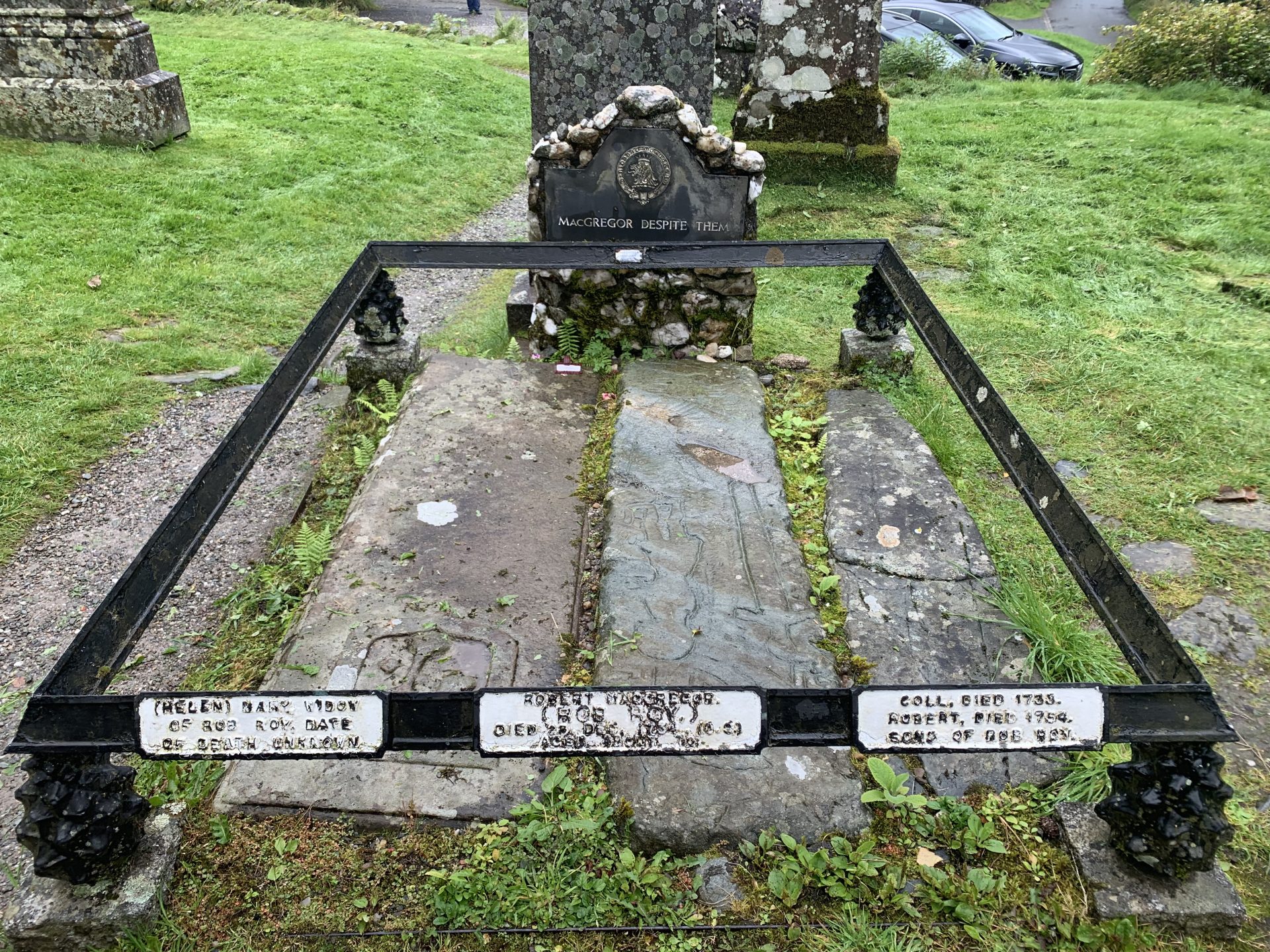
His grave, marked by the defiant inscription “MacGregor Despite Them,” remains a symbol of Highland resistance and identity. Rob Roy’s life, shaped by the turbulence of post-Killiecrankie Scotland, exemplifies the complex interplay of loyalty, survival, and rebellion that defined the era. His legacy endures not only in historical records but in the cultural memory of Scotland, where he is remembered as both a man and a myth.
“William Walker & the Clan Elders: A Tense Brotherhood”
A Stranger Among Kin
Though William had married Mary MacGregor and fought beside her brothers at Killiecrankie, he was not born to the name. The elders knew this. Some accepted him as one of their own, especially after Mary’s death.
He had taken the name Walker to survive—a sept name, a mask. And while the elders understood the necessity, they never forgot it.
“He’s loyal,” old Seumas once said, “but he is not MacGregor by blood. He’s MacGregor by choice. That is harder to trust—and harder to ignore.”
“Earned Respect Through Action”
William never demanded respect. He earned it.
He fought at Killiecrankie. He bled beside Arthur and Jhone. He returned home not with glory, but with scars and silence. The elders saw that. They saw the way he raised Thomas alone, the way he kept the songs alive, the way he never once claimed more than he was given.
Over time, some of the older men—Gregor Dubh’s surviving kin, and those who remembered the Macnucators—began to speak to him not as an outsider, but as a man who had proven himself.
“He’s not just carrying his own name,” one elder said. “He is carrying hers. That is a heavier burden than most of us ever bore.”
“Tensions Beneath the Surface — and Earned Respect”
Though William had not been born to the MacGregor name, and had taken the sept name Walker to protect his family, the clan elders came to value his voice—not because of his blood, but because of his actions.
At first, there was hesitation. Some elders, steeped in tradition, viewed him as an outsider. He had not been raised in the glens, had not carried the name through childhood, and had once hidden behind another. But William never demanded their trust—he earned it.
He fought at Killiecrankie. He returned wounded, but unbroken. He raised Mary’s son alone, taught the children the old songs, and never once claimed more than he was given. He listened before he spoke. And when he did speak, it was with clarity, conviction, and care.
“He may not be MacGregor by birth,” one elder said, “but he speaks like one who carries the name in his bones.”
Over time, even the most skeptical among them began to seek his counsel. He became a quiet presence at clan councils—never loud, never boastful, but always thoughtful. When tensions rose, William was often the one to calm. When fear crept in, he reminded them of their oath.
He was not a chief. He was not a bard. But he was something rarer—a man who had chosen the name and lived it with humility and honor.
“The Gathering Beneath the Pines”
The council met beneath the tall Scots pines, where the wind whispered through the needles like voices from the past. A ring of stones marked the fire pit, now glowing with low embers. Around it sat the elders—men with weathered faces and eyes that had seen too much. Some leaned on staffs, others on memory.
William Walker stood just outside the circle, arms crossed, listening.
Gregor MacIan, the eldest among them, cleared his throat. “The Campbells are moving again. A patrol was seen near Balmaha. They are not just watching—they are searching.”
A murmur passed through the circle.
“We’ve hidden well enough,” said Alasdair Ruadh. “But we can’t keep running forever.”
“We’re not running,” Arthur MacGregor growled. “We are surviving. There is a difference.”
Gregor turned to William. “You have walked both paths, Walker. What say you?”
William stepped forward, the firelight catching the silver in his beard. “They are tightening the noose. Slowly. Quietly. But they are not just after MacGregors anymore. They are after anyone who remembers.”
He paused, letting the words settle.
“We cannot fight them head-on. Not yet. But we can outlast them. We have done it before.
One of the younger men scoffed. “Outlast them? While they burn our homes and take our names?”
William met his gaze. “They can burn the roof. But they cannot burn the oath—unless we let them.”
Gregor Macgregor’s voice dropped, heavy with memory. “They are not just hunting us. They are parading us. You know what they do at Finlarig Castle?”
The fire crackled. No one spoke.
“They drag MacGregors there in chains. Behead them in the courtyard. And the Campbells—” he spat the name “—they dine while it happens. Their guests watch from the windows. Entertainment, they call it.”
A chill passed through the circle, colder than the Highland wind.
“They built a pit for it,” Gregor continued. “A beheading pit. Stone-lined. Drainage for the blood. That is what we are up against.”
Janet MacGregor’s voice cut through the silence. “Then we do not give them the satisfaction. We do not give them our names. We give them silence. And when the time comes—we give them fire.”
The elders nodded, one by one.
William looked around the circle. “We do not rise yet. But we do not kneel either.”
The meeting ended not with a vote, but with a shared look—an understanding. The MacGregors would not fall. Not while the fire still burned.
“The Ways We Endured”
The years passed in silence, but not in surrender.
Though the MacGregor name was outlawed, it lived on—in whispers, in thread, in the hearts of those who refused to forget. The hills of Buchanan Parish held more than sheep and stone. They held secrets. They held oaths.
And they held the fire.
“The Names We Wore”
In a croft tucked beneath the ridge, a mother stitched a new name into her son’s cloak. Her hands trembled, not from age, but from the weight of what she was erasing.
“You are MacGregor in your heart,” she whispered, “but you’ll answer to Bain until it’s safe.”
The boy nodded, clutching a scrap of green and red tartan hidden in his sleeve.
“The Lessons in Shadow”
In the loft of a barn, Christen MacGregor knelt beside a circle of children. The lantern was dim, the air thick with straw and secrecy.
She drew the MacGregor crest into the dirt with a stick.
“This is who you are,” she said. “You may not speak it aloud. But you must never forget.”
The children repeated the name in hushed voices, as if speaking it too loudly might summon the redcoats themselves.
“MacGriogair,” they whispered.
“The Songs That Survived”
At a village gathering, Janet MacGregor sang a lullaby in Gaelic. Her voice was soft, lilting, harmless to the untrained ear. But the words told of Glen Fruin, of blood and betrayal, of a name that would not die.
An English officer smiled politely, unaware. The villagers nodded along, eyes shining with quiet defiance.
“The Paths of Escape”
In the forest, William Walker crouched beside his young son, Thomas, pointing to a carved fox etched into the bark of an old pine.
“If you ever need to run,” he said, “follow the fox. It will lead you to the burn. From there, to the old pine. Christen will meet you there. And you do not look back.”
Thomas nodded, his small face solemn.
“The Oath in the Dark”
Beneath a moonless sky, the clan gathered in a circle deep in the glen. No fire burned. No torches lit. Only breath and memory filled the air.
Jhone unrolled a parchment, its edges worn from years of use.
“We swear not to the crown,” he said, “but to the name. Not to vengeance, but to remembrance.”
One by one, hands touched the parchment. One by one, the oath was renewed.
“The Thread of Resistance”
By candlelight, Margrat MacGregor wove a tartan pattern into the hem of a plain cloak. It would never be seen. But it would always be worn.
“They can outlaw the cloth,” she murmured, “but not the hands that make it.”
“The Boy and the Flame”
At the edge of the glen, Thomas stood beside his father. He held the hidden tartan in his hand, the fabric soft from years of wear.
“They tried to erase us,” William said.
Thomas looked up at him. “But we’re still here.”
William nodded. “Aye. And we always will be.”
“The Son of Two Names”
The morning mist clung to the glen like a veil, softening the edges of the hills and muffling the sound of boots on frost-hardened earth. Thomas Walker moved with quiet purpose, a satchel slung over his shoulder, his eyes scanning the tree line as he approached the old pine.
He was taller now—broad-shouldered, sharp-eyed, with his mother’s fire and his father’s steadiness. The boy who once clutched a wooden sword by the hearth now carried messages between scattered MacGregor families, memorized safe paths through the hills, and spoke Gaelic with the fluency of the old ones.
At the base of the pine, he paused. A fox symbol, carved decades ago by William’s hand, marked the hidden trail. Thomas touched it briefly, then turned toward the clearing where the clan council would meet.
“The Council’s Eyes”
The elders were already gathered—Gregor+, Jhone, Arthur, and a few others who had survived too many winters and too many betrayals. William sat among them, wrapped in a thick wool cloak, his beard now streaked with white, his breath slower, but his eyes still sharp.
When Thomas entered the circle, the conversation paused.
“He’s early,” Arthur muttered, not unkindly.
“He’s ready,” William said simply.
Thomas bowed his head in respect, then took a seat beside his father.
Gregor cleared his throat. “The lad’s been running messages to the western farms. He has seen more of the glen this month than most of us have in a year.
Thomas nodded. “The Campbells are quiet, but watching. There is a new patrol near the loch. They are not searching yet—but they are waiting.”
Jhone leaned forward. “And what do you think we should do?”
Thomas hesitated. Then: “We stay hidden. But we do not stay still. We move the caches. Rotate the safe houses. Keep the children learning.”
A murmur of approval passed through the circle.
William watched his son, pride swelling in his chest. He remembered the nights by the fire, the whispered stories, the oath spoken in the dark. And now, here was Thomas—speaking not as a boy, but as a MacGregor.
“The Quiet Passing”
Later, as the council dispersed, William and Thomas remained by the fire.
“You spoke well,” William said.
Thomas looked down. “I wasn’t sure they’d listen.”
“They listened,” William said. “Because you carry more than a name. You carry the weight of two clans. And you carry it well.”
Thomas looked at his father, eyes searching. “Are you stepping back?”
William smiled faintly. “Not yet. But soon. The hills are calling younger feet now.”
He placed a hand on Thomas’s shoulder.
“When the time comes, you will lead. Not because you want to—but because you must. That is the MacGregor way.”
“The Weight of Names”
The fire had burned low, casting long shadows across the croft walls. William Walker sat alone in his chair, a wool blanket draped over his knees, the weight of years pressing gently on his shoulders. Outside, the wind moved through the trees like a memory.
Thomas was out in the glen, meeting with the younger men—teaching them the old trails, the hidden signs, the oath. William had watched him go that morning, tall and sure-footed, with Mary’s fire in his eyes and the Macnucator quiet in his step.
He smiled to himself, then looked down at his hands—scarred, calloused, steady no longer.
“I was never meant to lead,” he thought. “I was meant to survive. But survival became its own kind of leadership.”
He remembered the early days—fleeing the Lowlands under a borrowed name, hiding in the hills, marrying Mary in secret, holding Thomas for the first time while the snow fell outside and Mary’s breath grew shallow.
“I gave him a name to protect him. She gave him a name to make him proud. And now he carries both.”
He had feared, once, that the name MacGregor would die with the silence. That the songs would fade, the stories would be forgotten, the oath would be lost to the wind. But Thomas had proven him wrong.
“He remembers. He listens. He leads. And when I am gone, he will still be here. Not just as my son—but as a son of the name.”
William reached for the small wooden box beside the hearth. Inside was Mary’s tartan, folded carefully, and a strip of cloth bearing the Macnucator colors—faded, but still intact.
He placed both in his lap, his fingers resting on the fabric.
“This is my legacy. Not the blood I shed. Not the battles I fought. But the names I carried—and the son who carries them now.”
The fire crackled softly. Outside, the wind shifted. And William, for the first time in many years, felt at peace.
“The Final Gifts”
The fire burned low in the hearth, casting a warm amber glow across the croft. Outside, the wind moved through the trees like a whisper from the past. William Walker sat in his old chair, wrapped in a thick wool cloak, his breath slow, his eyes distant.
Thomas stood nearby, tending the fire, his movements quiet and practiced. He had grown into a man—broad-shouldered, steady-eyed, with the calm presence of someone who had learned to carry weight without complaint.
“Thomas,” William said softly.
Thomas turned. “Aye?”
William nodded toward the corner of the room, where a small chest sat beneath a wool blanket. “Bring it here.”
Thomas carried it over and set it gently at his father’s feet. The chest was old—oak darkened by time, its iron hinges worn but strong. William opened it slowly, revealing its contents.
Inside lay five items, each wrapped in linen and bound with twine.
William lifted the first: a folded piece of green and red tartan.
“This was your mother’s,” he said. “She wore it the day we wed. She sang in it. She died with it beside her. It is yours now.”
Thomas took it reverently, pressing it to his chest.
The second item was a faded strip of blue and silver cloth.
“This is the last of my father’s colors—Macnucator. We were never many, but we stood with the MacGregors when others turned away. I took the name Walker to protect us. But this… this is who we were.”
Thomas nodded, his throat tight.
The third item was a small dirk; its hilt carved with the MacGregor crest.
“I carried this at Killiecrankie,” William said. “I never drew it in anger—only in defense. It is yours now. Use it only when you must.”
The fourth item was a pair of bagpipes, wrapped in oilcloth. Thomas’s eyes widened.
“These were your grandfather’s,” William said. “He played them in secret, long after the proscription. Your mother learned to play by listening to him through the floorboards. I kept them hidden all these years. But they should be heard again.
Thomas ran his fingers over the worn wood and leather. “I’ll learn,” he said.
William smiled faintly. “Aye. And when you play, you will carry every voice that came before you.”
Finally, William reached into the chest and pulled out a small, leather-bound journal.
“I started this after Mary died,” he said. “It is not poetry. Just thoughts. Memories. Warnings. You will find names in there—real ones. Places. Paths. Secrets worth keeping.”
He handed it to Thomas, who held it like something sacred.
William leaned back, his breath shallow but steady.
“You carry two names,” he said. “MacGregor and Macnucator. One born in fire. One born in silence. You are the bridge between them.”
Thomas looked at him, eyes shining. “I will carry them both. I swear it.”
William nodded slowly. “Then I’ve done my part.”
The fire crackled. Outside, the wind shifted. And inside the croft, a father passed on more than heirlooms—he passed on a legacy.
“The Last Light”
The snow had come early that year, blanketing the hills of Buchanan Parish in silence. The croft was still, the hearth fire burning low, casting long shadows across the stone walls. William Walker lay in his bed, his breath shallow, his eyes half-closed but aware.
Thomas sat beside him, one hand resting on the old man’s. He had not left his father’s side in two days.
William’s voice was barely a whisper. “Is the fire still lit?”
Thomas nodded. “Aye. It is burning.”
William smiled faintly. “Good. It should never go out.”
He turned his head slightly, his gaze drifting to the chest at the foot of the bed, the one he had opened for Thomas just a year before. The tartan. The Macnucator cloth. The dirk. The pipes. The journal. All passed on. Nothing left to give but words.
“You remember what I told you?” William asked.
Thomas leaned closer. “Every word.”
William’s eyes glistened. “Then I’ve done my part.”
Outside, the wind stirred the trees. The snow fell softly, muffling the world.
“I see her,” William murmured. “She’s waiting.”
Thomas’s throat tightened. “Tell her I kept my promise.”
William’s hand squeezed his son’s once—weak, but sure.
“I know you will,” he said.
And then, with a final breath, William Walker—born Macnucator, husband to Mary MacGregor, father to Thomas, bearer of two names and one unbreakable oath—closed his eyes.
The fire crackled. The wind whispered. And the last light of a generation passed into memory.
“The Farewell at Creag an Tuirc”
The sky hung low over the glen, heavy with mist and the scent of damp earth. A hush had settled over the hills, as if the land itself paused to mark the passing of a man who had carried two names and one unshakable purpose.
They gathered at Creag an Tuirc. The stone stood tall and weathered, its surface etched by wind and time. Around it, the clan formed a circle—no banners, no drums, only the quiet presence of kin.
Thomas stood at the center, his father’s cloak draped over his shoulders, the weight of memory pressing against his chest. In his hands, he held the small wooden chest William had once opened for him. It was closed now, sealed with leather cord, and resting atop it were the folded tartans of MacGregor and Macnucator.
He stepped forward and placed the chest at the base of the stone.
“My father was not born to this name,” he said, his voice clear in the chilly air. “But he chose it. He lived it. And he never let it go.”
The wind stirred the heather. A raven called from the trees.
“He taught me that a name is not just a word—it is a promise. A burden. A fire passed from hand to hand. He bore it with quiet strength, and now it is mine to carry.”
Janet MacGregor stepped forward, her voice rising in a low, mournful chant. The melody was old, older than the proscription, older even than the stone itself. It spoke of exile and endurance, of kin scattered like seeds on the wind, and of the vow that bound them still.
When the song faded, Thomas knelt and pressed his palm to the stone.
“I am Thomas, son of William, son of Mary. I am MacGregor. I am Macnucator. I am Walker by necessity, but never by shame.”
He stood, and the clan echoed his words—not in unison, but in a ripple of voices, each one carrying the name like a torch passed hand to hand.
“MacGregor.”
“Macnucator.”
“Walker.”
The wind picked up, swirling around them, lifting the edges of cloaks and tartans. Snow began to fall—soft, slow, silent.
Thomas looked to the sky, then back to the stone.
“He is not gone,” he said. “He is here. In the oath. In the hills. In us.”
And with that, the clan turned and began the slow walk back down the glen, leaving the chest and the name at the foot of the stone.
The fire had not gone out.
It had simply changed hands.
Chapter 8: The Gathering Before the Storm
“The Edge of Two Worlds”
Buchanan Parish, 1729
The wind rolled down from the north, sharp and restless, stirring the heather and whispering through the pines. Thomas Walker stood at the edge of the glen, overlooking the village that had come to rely on him. Smoke curled from chimneys. Children played in the frost. The hills, for now, were quiet.
But he could feel it—change, like a storm gathering just beyond the horizon.
The Jacobite cause was stirring again. There were whispers of another rising. The old loyalties were being tested, and the MacGregors, though still outlawed in name, were watching the hills with wary eyes.
Thomas had become a leader not by ambition, but by necessity. Since his father’s death the year before, the people had turned to him—for guidance, for protection, for the quiet strength he had inherited from William Walker and Mary MacGregor.
He wore the tartan openly now. The name MacGregor was still forbidden by law, but in the glens, it was spoken with pride. And when Thomas spoke, the clan listened.
But even as he prepared them for what might come, another thought had begun to take root in his mind.
The New World.
He had heard stories—of land, of freedom, of a place where a man could speak his name without fear of gallows or exile. Letters had come from distant cousins who had crossed the sea. There was hardship, yes. But there was also hope.
He was not ready. Not yet. But the thought lingered like a shadow at the edge of the firelight.
“If the storm breaks again,” he thought, “will we survive it this time? Or is it time to plant the name in new soil?”
Behind him, the clan was gathering. The elders. The young men. The women who had kept the songs alive. They would ask him what came next. Whether they would rise again. Whether they would fight.
And he would answer.
Because for now, this was still his place. His people. His name.
But the sea was calling. And he was listening.
“The Parting Word”
Buchanan Parish, Winter 1729
The fire crackled in the longhouse, casting flickering light across the faces of the gathered clan. The air was thick with peat smoke and anticipation. Thomas Walker stood at the head of the room, his hands resting on the back of his father’s old chair. The MacGregor tartan draped over his shoulder, worn not in defiance, but in quiet pride.
He looked out at them—elders who had whispered oaths in the dark, young men who had trained with him in the hills, women who had kept the songs alive when the name was forbidden. They had followed him since William’s death. They had trusted him.
And now, he would ask them to let him go.
“You all know the world is changing,” he began, his voice steady. “The prince stirs in France. The crown watches the glens. And we—still—carry a name they would rather see buried.”
A few heads nodded. Others looked down.
“We have endured. We have hidden. We have fought when we had to. And we have survived. But I have come to believe that survival alone is not enough.”
He paused, letting the words settle.
“There is a place across the sea. A place where the name MacGregor is not outlawed. Where a man can speak his lineage without fear. Where a child can grow without learning to run before he learns to walk.”
A murmur rippled through the room.
“I’m going,” Thomas said. “Not because I’m turning my back on this land—but because I want to plant our name in soil where it can grow freely.”
He looked to Janet, to Christen, to Arthur—those who had stood beside him through every season of silence and fire.
“I leave the glen in your hands. The oath lives in you now. And I will carry it with me, wherever I go.”
He reached into his satchel and pulled out a small bundle—his father’s journal, wrapped in cloth.
“This stays here,” he said, placing it on the table. “So, the next who leads will know where we came from.”
Silence followed. Then Janet stood, her voice clear.
“You carry the name with honor, Thomas. And wherever you go, you carry us.”
He bowed his head.
“I will return if I can. And if I do not—know that the name lives on.”
Outside, the wind howled through the trees. But inside the longhouse, the fire still burned.
“The Clan’s Farewell”
Buchanan Parish, Winter 1729
The news spread quickly through the glen: Thomas Walker was leaving.
Not fleeing. Not hiding. Leaving—by choice, by conviction, by the quiet pull of something beyond the hills.
The clan gathered one last time in the longhouse, the fire burning low, the air thick with the scent of peat and pine. No one spoke at first. They simply watched him—standing tall in his father’s cloak, the MacGregor tartan draped across his shoulder, his mother’s shawl folded in his satchel.
He had led them through lean winters, through whispers of war, through the long silence after William’s death. He had taught their sons to walk the hidden paths, their daughters to speak the old words. He had carried the name with dignity.
And now, he was handing it back to them.
“You’re not abandoning us,” Janet MacGregor said, breaking the silence. “You’re planting us somewhere new.”
Thomas nodded. “I will carry the name across the sea. And I will speak it where it has never been outlawed.”
Arthur MacGregor, grizzled and scarred, stepped forward. “You have earned your place among us, Thomas. You always had it. But now you have earned something more—freedom.”
A few of the younger men looked uncertain. One asked, “What if we need you?”
Thomas met his gaze. “Then you will remember what I taught you. And you will lead.”
Christen placed a small bundle in his hands—pages of songs, stories, and names. “Take this,” she said. “So, they will know who you are. And who we were.”
He bowed his head. “I will.”
There were no tears. Only the quiet ache of parting, the kind that settles deep and lingers long.
As Thomas stepped out into the cold, the clan followed him to the edge of the glen. Snow fell softly, dusting the heather and the shoulders of those who remained.
He turned once, looked back at the hills, the people, the stone.
“I am MacGregor,” he said. “And I will return—if not in body, then in name.”
And with that, he walked into the mist, carrying the fire with him.
“The Promise Before the Sea”
Scotland, Spring 1729
He met her in the market at Drymen, beneath a sky heavy with spring rain. She was bartering for oats, her voice calm but firm, her eyes sharp beneath the edge of her bonnet. Thomas had come for salt and left with a name he would never forget.
Elizabeth Taylor.
She was not of the MacGregor blood, but she knew the hills, knew the silence, and knew what it meant to carry a name that could not be spoken aloud. Her family had once been tied to the Buchanans, but like many, they had learned to live between the lines of loyalty and survival.
Their courtship was brief—there was no time for long walks or whispered promises beneath the heather. The world was shifting. The redcoats were watching. And Thomas had already begun to plan his departure.
But in Elizabeth, he found something he had not expected: steadiness. She did not ask him to stay. She did not beg him to forget the name or the oath. She simply said:
“If you go, I go.”
They were married in secret, in a glen north of Balmaha, with only Janet and Christen as witnesses. No kirk bells. No feast. Just a circle of stones, a shared vow, and the wind moving through the trees like a blessing.
“I’ll follow you,” she said, placing her hand in his. “Wherever the name leads.”
And so, in the spring of 1730, when Thomas left the glen for the long road to Wigtown, Elizabeth walked beside him. She carried little—just a satchel, a shawl, and the fire of a woman who had chosen her path.
They would cross the sea together. They would build something new.
And they would carry the name—MacGregor, Macnucator, Walker—not as a burden, but as a promise.
Chapter 9: The Crossing
“The Road to Wigtown”
Scotland, Early Spring, 1730
The morning mist clung to the glen like a veil as Thomas Walker stepped beyond the edge of the only world he had ever known.
Behind him, the hills north of Balmaha faded into the grey light—familiar ridges, ancient trees, and the stone at Creag an Tuirc where he had sworn the oath. He did not look back. Not yet. The weight of farewell was still too near the surface.
His boots crunched over frost-hardened earth as he followed the narrow trail that wound along the eastern shore of Loch Lomond. The loch stretched out beside him like a mirror of the sky, still and silver, broken only by the occasional ripple of a bird’s wing or the distant splash of a leaping trout.
He passed through Rowardennan, where the peaks of Ben Lomond loomed to the west, and further south past Luss, where the loch narrowed and the land grew softer. He traveled light—just a satchel, a walking stick, and a small chest strapped to his back. Inside were the last pieces of his father’s legacy: the tartans, the dirk, the pipes, and the journal.
Each step southward felt like a quiet tearing away from the land that had shaped him.
In Glasgow, he stayed only long enough to trade for supplies and avoid the eyes of the crown. The city was growing, loud with carts and smoke, but Thomas moved through it like a shadow—just another traveler with a Highland accent and a name he did not speak aloud.
From there, he turned southwest, following the old drover roads through Ayrshire, past green fields, and stone walls, through villages where no one asked questions, and no one offered names.
The final stretch to Wigtown was the hardest. The sea air grew stronger with each mile, and the wind carried the scent of salt and something else—possibility.
When he reached the harbor, the ship was already waiting. A broad-bellied brigantine bound for the colonies. The captain was a Lowlander, but he nodded with respect when Thomas handed him the fare.
“You’ve come far,” the man said.
Thomas looked back once—just once—toward the north, where the hills of his childhood lay hidden beyond the horizon.
“Aye,” he said. “And I carry it all with me.”
He stepped aboard.
The sails unfurled. The ropes creaked. And as the ship slipped from the harbor into the grey waters of the Solway Firth, Thomas Walker—MacGregor by oath, Macnucator by blood, Walker by necessity—left Scotland behind.
But not the name.
Never the name.
“Blown Off Course”
Spring 1730, North Atlantic
The sea was cruel.
From the moment the brigantine left Wigtown Bay, the Atlantic greeted them with wind and fury. The ship groaned under the weight of the waves, and the sky seemed to forget the sun. For weeks, the storm chased them—never breaking fully, never relenting.
Thomas Walker stood on the deck, soaked to the bone, one arm braced around the rigging, the other shielding Elizabeth, who clung to him with quiet resolve. She had not complained once. Not when the food spoiled. Not when the water turned foul. Not even when the child in the next berth died and was buried at sea with only a whispered prayer.
“We’ll see land again,” Thomas told her one night, his voice hoarse from salt and wind.
“I know,” she said. “Because we must.”
They had married the year before, in a glen north of Balmaha, with only the trees and a few kin to witness it. She had followed him without hesitation, leaving behind her family, her name, and the only home she had ever known.
Now, she followed him across the sea.
But the sea had other plans.
In the fifth week, a gale struck from the northeast, tearing sails and snapping a mast. The ship spun like a leaf in a storm, driven far off course. For days, they drifted—rudderless, hopeless, lost.
When the wind finally died and the clouds broke, the lookout cried out from the crow’s nest.
“Land!”
But it was not Charleston. Not Philadelphia.
It was Baltimore.
A rough harbor, still growing, still wild. The docks were crowded with traders, fishermen, and men who spoke in a dozen tongues. It was not what they had planned.
But it was land.
And it was freedom.
As they stepped off the ship, Thomas carried the small chest that held his father’s journal, his mother’s tartan, and the dirk he had sworn never to draw in anger. Elizabeth carried a satchel and the fire of a woman who had chosen her path.
They stood together on the muddy dock, the wind tugging at their cloaks.
“It’s not what we expected,” she said.
“No,” Thomas replied. “But it’s ours now.”
They turned inland, hand in hand, the name in their hearts.
MacGregor. Macnucator. Walker.
Not forgotten. Not erased. Just beginning again.
“The King’s Shadow”
Maryland Colony, Summer 1730
The sun hung low over the fields, casting long golden rays across the clearing where Thomas and Elizabeth Walker worked side by side. The air was thick with the scent of pine and sweat, and the sound of axes echoed through the trees as they cleared land for their future.
They had been in Maryland only a few weeks, but already the rhythm of the land had begun to settle into their bones. The soil was rich, the forest deep, and the promise of a new life felt almost within reach.
Until the redcoats came.
Thomas heard them before he saw them—hooves on the road, the jingle of bridles, the unmistakable cadence of English voices. He stepped out from behind the cabin frame, wiping his brow, and froze.
Two British soldiers, mounted and dressed in the unmistakable scarlet coats of the Crown, rode slowly down the path that bordered the clearing. Their muskets were slung across their backs, sabers at their sides. They moved with the casual authority of men who expected obedience.
Elizabeth emerged from the trees, a basket of herbs in her arms. She saw them too, and her steps faltered.
“They’re here too,” she said quietly, coming to stand beside Thomas.
He nodded, jaw tight. “Aye. The king’s shadow stretches farther than we thought.”
The soldiers stopped to speak with a local land agent near the road. Thomas could not hear the words, but he saw the gestures exchanged, a glance toward the clearing, a nod in their direction.
Elizabeth’s hand found his. “We left to escape this.”
“We left to build something better,” Thomas replied. “But we are not free of them. Not yet.”
The redcoats did not approach. After a few minutes, they turned and rode on, their laughter fading into the trees.
But the silence they left behind was heavier than before.
That night, Thomas sat by the fire, the journal of his father open in his lap. Elizabeth sat beside him, mending a torn sleeve, her eyes distant.
“Do you regret it?” she asked.
He shook his head. “No. But I see now—we did not leave the king behind. We just stepped into his shadow.”
He dipped his quill and wrote beneath his father’s final entry:
“The name is still a risk. Even here. But the fire still burns. And we will not kneel.”
Elizabeth leaned her head against his shoulder. “Then we keep building. And we keep remembering.”
Thomas closed the journal and looked out into the dark woods beyond the cabin.
“Aye,” he said. “And one day, we’ll build something they can’t take.”
“The Red Clay Ridge”
Orange County, Virginia – Spring 1734
The land was red—deep, rich clay that clung to boots and stained hands. It was not the soft moss of the glens or the rocky soil of the Highland slopes, but it was fertile, and it was theirs.
Thomas Walker stood at the edge of the clearing, surveying the stretch of land that rolled gently toward the tree line. The Blue Ridge Mountains loomed in the distance, their peaks softened by spring haze. A creek ran along the southern edge of the property, its waters cold and clear, fed by the hills beyond.
Beside him, Elizabeth adjusted her shawl against the breeze. Her eyes scanned the land with the same quiet resolve she had carried across the Atlantic.
“It’s good land,” she said.
“Aye,” Thomas replied. “It will take work. But it will hold.”
They had arrived in Orange County after months of travel—first by ship, then by wagon, then on foot. Baltimore had been a beginning, but not a home. Here, in the Virginia backcountry, they found what they had been searching for: space, soil, and the chance to build something lasting.
The first days were hard. They slept beneath the stars, cooked over open flame, and cleared brush with blistered hands. But each tree felled, each stone moved, each furrow turned was a step toward permanence.
Thomas built the cabin with help from other settlers—some Scots, some Germans, some who had fled the same kings and wars. They spoke different tongues, but they all understood the work.
Elizabeth planted herbs near the door and hung her mother’s iron kettle over the hearth. She sang softly as she worked—old songs from the glen, now carried on Virginian wind.
One evening, as the sun dipped behind the mountains, Thomas stood in the doorway of their nearly finished cabin. He held his father’s journal in one hand; his mother’s tartan draped over his shoulder.
“We’ve come far,” he said.
Elizabeth joined him, resting her head against his arm. “And we’re not done yet.”
He nodded. “No. But this… this is a beginning.”
They watched the fireflies rise from the tall grass, the stars blinking into view above the trees.
In the red clay of Virginia, the name had found new soil.
And it would grow.
“The Quickening”
Orange County, Virginia, Autumn 1734
The morning sun filtered through the trees, casting golden light across the clearing where the cabin stood—rough-hewn, modest, but theirs. The scent of woodsmoke lingered in the air, mingling with the sweet decay of fallen leaves. A breeze stirred the branches, and somewhere in the distance, a woodpecker tapped rhythmically against bark.
Elizabeth stood at the edge of the garden, one hand resting on her lower belly, the other shielding her eyes from the sun. She had been feeling it for days now—the weariness, the queasiness in the mornings, the strange fluttering in her chest that was not fear, but something else.
She had known before the signs confirmed it. A woman knows.
She turned toward the cabin, where Thomas was splitting logs, his shirt damp with sweat, his movements steady and sure. He had not noticed her watching yet. He was focused, as he always was, on building something from nothing.
She smiled softly.
“We’re not just building a home,” she thought. “We’re building a future.”
Later, as the sun dipped low and the fire crackled in the hearth, she sat beside him on the bench they had carved together. He was sharpening his blade, the one his father had passed down, the one he had carried across the sea.
She reached for his hand.
He looked up, brow furrowed. “What is it?”
She placed his hand gently over her stomach.
“There’s another Walker coming,” she said, her voice barely above a whisper.
His eyes widened, then softened. He did not speak at first. He simply pulled her close, resting his forehead against hers.
“A child,” he murmured. “Here. In this land.”
She nodded. “Ours.”
He looked into the fire, the flames dancing in his eyes.
“Then we will raise them with the name. With the stories. With the strength of everything we left behind.”
Outside, the wind rustled the trees. Inside, the fire burned steadily.
And in that moment, the New World felt a little more like home.
“Foundations”
Orange County, Virginia, Late Autumn 1730
The morning air was crisp, the scent of woodsmoke and damp leaves rising from the forest floor. Thomas Walker stood in the clearing behind the cabin, sleeves rolled, axe in hand, eyes fixed on the tall pine he was about to fell.
He had always worked with purpose, but today his movements carried something more—urgency, resolve, and a quiet joy he had not known since leaving the glen.
Elizabeth was with child.
The words still echoed in his mind, soft and steady like the rhythm of her voice when she told him. He had held her hand in silence, not because he lacked words, but because no one seemed large enough to hold what he felt.
Now, he built.
He cleared more land, marking out space for a second room—one that would hold a cradle, a hearth, and the laughter of a child born free of the fear that had haunted their ancestors. He reinforced the roof, patched the gaps in the walls, and laid stones for a proper chimney.
Each swing of the axe, each stone he set, was a promise.
“You’ll never have to hide your name,” he whispered once, as he drove a post into the earth. “You’ll never have to run.”
Elizabeth watched from the doorway, wrapped in her shawl, one hand resting gently on her belly. She did not speak, but her eyes followed his every movement, filled with pride and something deeper—trust.
That evening, as the sun dipped behind the trees and the fire crackled in the hearth, Thomas sat beside her, his hands rough and blistered, but his heart full.
“It’s not much yet,” he said, glancing around the cabin.
Elizabeth leaned her head on his shoulder. “It’s everything.”
He looked down at her, then at the small chest tucked beneath the bed—his father’s journal, his mother’s tartan, the dirk he had carried across the sea.
“We’ll tell them everything,” he said. “Where we came from. Who we are. And why we came here.”
Elizabeth nodded. “And they’ll carry it forward.”
Outside, the wind stirred the trees. Inside, the fire burned steadily.
And in the heart of the wilderness, a legacy was taking root.
“The Letter Home”
Orange County, Virginia, Late Autumn 1734
The candle burned low on the table, casting a warm glow across the rough-hewn walls of the cabin. Outside, the wind rustled the last of the autumn leaves, and the fire in the hearth crackled softly. Elizabeth slept nearby, her hand resting gently over the curve of her belly, the faintest sign of new life stirring beneath.
Thomas dipped his quill into the inkwell and began to write.
To my kin in the glens,
I pray this letter finds you in health and safety, though I know such things are never guaranteed in our homeland. It has been many months since Elizabeth and I left the shores of Scotland, and though the sea was cruel and the journey long, we have found land here in Virginia—rough, wild, and full of promise.
We have built a small cabin near a spring-fed creek, and the soil is good. I have begun clearing more land for planting come spring. The work is hard, but it is honest, and for the first time in my life, I feel the weight of the name I carry beginning to root in new earth.
He paused, looking toward Elizabeth, her breath slow and steady in sleep.
There is news I must share—Elizabeth is with child. We do not yet know if it will be a son or daughter, but we know this: they will be born free. Free to speak the name. Free to grow without fear of the redcoat’s knock or the proscription’s shadow. That is why we came.
And yet… the king’s reach is long. Redcoats ride these roads too. They do not yet trouble us, but their presence is a reminder that this land, too, bears the Crown’s mark. There are whispers here—of unrest, of taxes, of distant wars stirring in Europe and the Indies. Some say the colonies may one day rise against the king. I do not know if that day will come, but I feel the ground shifting beneath us.
Tell me—what news from the glens? Do the Campbells still press the low roads? Do the songs still pass from mother to child? Has the name been spoken aloud, even in secret?
I carry you all with me. Every stone, every oath, every firelit story. And when my child is born, they will know where they come from. They will know they are MacGregor.
With honor and remembrance,
Thomas Walker
He folded the letter carefully, sealed it with wax, and set it aside for the next trader heading east. It might take months to reach the glens—if it reached them at all—but the words were sent, and that was enough.
Outside, the wind shifted. Inside, the fire burned steadily.
Chapter 10: Echoes Across the Sea
Scene: “The Letter from the New World”
Glen North of Balmaha, Scotland – Spring 1735
The fire burned low in the hearth, casting a warm glow across the stone walls of the cottage. Outside, the hills were greening again, the heather just beginning to bloom. Inside, the air was still, reverent.
Margrat MacGregor sat at the table, her hands gently unfolding the letter that had arrived from across the Atlantic. The parchment was creased and worn from its long journey, but the ink remained clear. It had come by way of a merchant in Glasgow, passed from hand to hand until it reached the glen.
Janet and Christen sat nearby, their eyes fixed on Margrat. A few younger kin stood quietly in the doorway, drawn by the rare arrival of news from the New World.
Margrat cleared her throat and began to read, her voice steady but soft.
To my kin in the glens,
I pray this letter finds you in health and safety, though I know such things are never guaranteed in our homeland. It has been many months since Elizabeth and I left the shores of Scotland, and though the sea was cruel and the journey long, we have found land here in Virginia—rough, wild, and full of promise.
We have built a small cabin near a spring-fed creek, and the soil is good. I have begun clearing more land for planting come spring. The work is hard, but it is honest, and for the first time in my life, I feel the weight of the name I carry beginning to root in new earth.
There is news I must share—Elizabeth is with child. We do not yet know if it will be a son or daughter, but we know this: they will be born free. Free to speak the name. Free to grow without fear of the redcoat’s knock or the proscription’s shadow. That is why we came.
And yet… the king’s reach is long. Redcoats ride these roads too. They do not yet trouble us, but their presence is a reminder that this land, too, bears the Crown’s mark. There are whispers here—of unrest, of taxes, of distant wars stirring in Europe and the Indies. Some say the colonies may one day rise against the king. I do not know if that day will come, but I feel the ground shifting beneath us.
Tell me—what news from the glens? Do the Campbells still press the low roads? Do the songs still pass from mother to child? Has the name been spoken aloud, even in secret?
I carry you all with me. Every stone, every oath, every firelit story. And when my child is born, they will know where they come from. They will know they are MacGregor.
With honor and remembrance,
Thomas Walker
Margrat paused, folding the letter slowly, pressing it to her chest.
“He’s going to be a father,” Christen whispered, her voice catching.
Janet nodded, her eyes glistening. “He has kept the name alive. Just as we hoped.”
Margrat looked toward the window, where the hills rolled out beneath a grey sky. Her voice was quiet, but full of feeling.
“I only wish Jhone were here to hear it. He would have smiled at that. And Agnes… she would have wept.”
Jhone had passed in 1729. Agnes the year after. Their absence was a hollow space in the room, but their memory filled it just the same.
“They would’ve been proud,” Margrat said. “We all are.”
She placed the letter in the wooden box where they kept the clan’s most sacred things—tartan scraps, old oaths, and the names of the fallen.
Outside, the wind moved through the trees like a whisper from across the sea.
And in the glen, the fire still burned.
“The Birth of a Name”
Orange County, Virginia – Spring 1735
The rain had passed in the night, leaving the earth damp and fragrant with pine and wild mint. The cabin was quiet now, save for the soft crackle of the hearth and the rhythmic creak of the rocking chair where Elizabeth sat, wrapped in a wool blanket, her arms cradling the child they had waited so long to meet.
Thomas knelt beside her, his hand resting gently on the tiny bundle swaddled in linen. The boy’s eyes were closed, his breath soft and steady, his fingers curled into fists no larger than acorns.
“He’s strong,” Thomas whispered.
Elizabeth smiled, her face pale but radiant. “He has your hands.”
“And your fire,” Thomas said. “I can feel it already.”
Outside, the wind stirred the trees. The land was still wild, still uncertain. But inside the cabin, there was peace.
Thomas rose and crossed the room to the chest beneath the window. He opened it carefully and removed three things: his mother’s MacGregor tartan, his father’s journal, and the small dirk passed down through generations.
He returned to Elizabeth’s side and laid the tartan across the child’s legs.
“He’ll carry the name,” Thomas said. “Not just Walker. But MacGregor. And Macnucator. He will know where he came from.”
Elizabeth nodded. “And he will know why we came here. Why we left everything behind.”
Thomas looked down at his son, his voice low and reverent.
“You were born free. Not hunted. Not hidden. You will grow in open air, under a sky that does not watch you with suspicion. But you will know the stories. You will know the oath.”
He placed the journal beside the cradle and kissed Elizabeth’s forehead.
“We’ll call him Thomas,” she said softly. “After you”
Thomas’s throat tightened. He nodded.
“Thomas it is.”
The fire glowed warmly in the hearth. Outside, the land waited—untamed, full of promise. And within the walls of the cabin, a new chapter had begun.
A child born of exile and hope.
A name reborn in a new world.
Chapter 11: A New Line Begins
“The Years of Blessing and Memory”
Orange County, Virginia, 1735–1740
The seasons passed gently in the Virginia hills. The land, once wild and unfamiliar, had begun to feel like home. The cabin Thomas and Elizabeth built with their own hands now stood firm against the wind, its hearth warm, its walls echoing with the sounds of new life.
In May of 1735, their first son was born.
They named him Thomas Walker Jr., after the father who had crossed the sea and the grandfather who had carried the name through fire and silence. He was a strong child, with his mother’s eyes and his father’s quiet gaze. As he grew, he toddled through the garden rows and fell asleep to the sound of Elizabeth humming old Highland lullabies.
Two months after his birth, a letter arrived from Scotland.
It had traveled long and slowly, passed from ship to port to post rider, until it reached the Walker homestead. Thomas opened it with reverent hands, and Elizabeth sat beside him as he read aloud.
It was from Margrat MacGregor, the last of his mother’s generation still living in the glen.
“Thomas,
Your letter reached us in the spring, and we wept with joy to hear of your son’s birth. The name lives on, and with it, the fire.
Janet and Christen send their blessings. We speak of you often, and of your father, who would have been proud beyond words.
I only wish Jhone were here to hear the news. He passed in the winter of 1729. Agnes followed the next year. The glen is quieter now, but the hills still remember.
Raise your son with the stories. Let him know where he comes from.
—Margrat”
Thomas folded the letter slowly, his eyes misted. “They’re nearly all gone,” he said.
Elizabeth placed her hand over his. “But we are still here. And so is the name.”
In 1738, another son was born. They named him James Walker—a name chosen not from the past, but for the future. He was quieter than his brother, more watchful, content to sit in the shade and listen to the wind in the trees.
Then, in 1740, Elizabeth gave birth once more. A third son: Charles Walker. He came into the world during a summer storm, his cry loud and defiant, as if announcing himself to the land.
The cabin grew crowded, but it was filled with laughter, with stories, with the scent of bread and woodsmoke and the sound of Gaelic songs sung softly at dusk.
Thomas often sat by the fire at night, his sons asleep nearby, Elizabeth sewing by candlelight. He would hold his father’s journal in his lap, the pages worn, the ink faded, but the words still alive.
“We left the glen to build something new,” he once wrote. “And now, it grows.”
“The Year of Reckoning”
Orange County, Virginia – Autumn 1745
The leaves had begun to turn, painting the woods in shades of gold and rust. The air carried the scent of smoke and damp earth, and the sound of boys’ laughter echoed from the edge of the field where Thomas Jr., James, and little Charles chased each other between rows of drying corn.
Thomas Walker stood on the porch of the cabin he had built with his own hands fifteen years earlier. His beard had gone grey at the edges, and his shoulders bore the quiet weight of a man who had carried more than his share of names, burdens, and memories.
In his hand was a letter—creased, smudged, and marked with the seal of a merchant in Williamsburg. It had come with news from across the sea.
The Jacobites had risen again.
Charles Edward Stuart—Bonnie Prince Charlie—had landed in Scotland. The clans were gathering. The old banners were flying. And the name MacGregor, once whispered in fear, was being shouted again in defiance.
Thomas stared out at the trees, the letter trembling slightly in his hand.
“So, it’s come to this,” he thought. “Another rising. Another reckoning.”
He had left Scotland to escape the endless cycle of rebellion and retribution. He had crossed an ocean to give his children a life free of exile, of outlawed names, of kings who ruled from afar. But now, the storm he had outrun was rising again—this time without him.
Elizabeth stepped out beside him, her hand resting gently on his arm. “Is it true?” she asked.
He nodded. “Aye. The prince has returned. The clans are marching.”
She looked toward the field, where their sons played, unaware of the weight their father carried.
“Do you regret leaving?” she asked.
Thomas did not answer right away. He watched Thomas Jr. help Charles to his feet after a tumble, James laughing as he ran ahead.
“No,” he said at last. “But I grieve for what they are walking into. And for those who stayed behind.
He folded the letter and tucked it into his coat.
“If the name is to rise again, let it rise in honor. Not in blood.”
Elizabeth leaned her head against his shoulder. “You gave them a chance. That is more than most had.”
He nodded. “Aye. And I will make sure they know where they came from. And why we left.”
The wind stirred the trees. The boys’ laughter carried on the breeze.
And Thomas Walker, once of highland glens, now of Orange County, Virginia, stood between two worlds—one behind him, one before him—and held them both in his heart.
“The Other Walkers”
Orange County, Virginia – December 1745
The frost clung to the bare branches like lace, and the fields lay quiet beneath a thin crust of snow. Smoke curled from the chimney of the Walker homestead, rising into a pale winter sky. Inside, the fire crackled, and the scent of peat and pine filled the air.
Thomas Walker stood at the window, staring out across the land he had carved from the wilderness. His hands were calloused, his shoulders broader than they had been when he left the glen fifteen years earlier. But his eyes still carried the weight of the name.
Behind him, Elizabeth stirred a pot over the hearth, humming softly to their son, now a boy of ten, who sat nearby carving a piece of wood into the shape of a fox.
The knock came just after midday.
Thomas opened the door to find a man about his age, wrapped in a wool cloak, his boots dusted with snow. He introduced himself as Samuel Walker, a settler from a nearby ridge.
“I heard there was another Walker out this way,” Samuel said. “Didn’t expect to find one with a Highland tongue.”
Thomas smiled faintly. “You’re not the first to carry the name.”
“Nor the last,” Samuel replied. “We are not kin, far as I know. But we have walked the same road.”
Over the next few days, Thomas and Elizabeth visited the other Walker families, three households in all, scattered across the ridges and hollows of Orange County. They shared stories of Scotland, of names changed to survive, of songs sung in secret and oaths whispered in the dark.
Though they were not blood relatives, the bond was immediate. These were people who understood what it meant to carry a name that once brought danger. People who had left behind the same hills, the same fears, the same fire.
“We’re not MacGregors,” Samuel said one night by the fire, “but we remember them. And we remember what it meant to stand beside them.”
Thomas nodded. “That’s enough.”
But even as the warmth of kinship grew, so too did the weight of the news from across the sea.
Word had reached them of the rising in Scotland. Bonnie Prince Charlie had landed. The clans had rallied. The MacGregors had marched again. And now, in the cold of December, the outcome was uncertain.
Thomas sat by the fire that night, Elizabeth beside him, their son asleep in the loft above.
“They’re fighting again,” he said quietly. “For the name. For the crown. For the hills.”
Elizabeth reached for his hand. “And we’re here.”
He nodded. “Aye. We are here. But part of me is still there.”
Outside, the wind moved through the trees like a voice from the past.
Inside, the fire burned steadily.
And in the company of strangers who felt like kin, Thomas Walker remembered who he was—and who he would always be.
“The Letter to the Glen”
Orange County, Virginia – December 1745
The snow had fallen heavy that week, blanketing the fields in silence. The hearth crackled in the corner of the cabin, and Elizabeth sat nearby, mending a shirt by candlelight. Their son, now nearly eleven, slept soundly in the loft above.
Thomas sat at the table, a sheet of parchment before him, his quill poised but unmoving. The news had come days earlier from the coast, passed from ship to tavern to farmstead.
The prince had landed. The clans had risen. The MacGregors had marched again.
He dipped the quill in ink and began to write.
To my dear aunts and kin in the glen,
I pray this letter finds you in health and safety, though I fear the times may not allow for either. Word has reached us here in Virginia of the rising—of the prince returned, of the clans gathering once more beneath the old banners.
I cannot lie. My heart stirred when I heard it. The name MacGregor spoken aloud again, not in shame, but in defiance. I thought of you all—of Margrat, of Janet, of Christen—and I wondered what you would do.
Will you rise again?
Will you speak the name in the open?
Or will you, as we once did, hold it close and wait for the storm to pass?
I do not ask in judgment. I ask because I do not know what I would do, were I still there. I am far from the glen now, but the hills still live in me. The oath still lives in me.
I often think of Jhone and Agnes. I wish they were here to speak to this moment. I wish they could see what we have built here, our home, our son, our fire. But I also wish they could guide you now, as they once guided me.
Please write if you can. Tell me what you see. Tell me what you feel. Tell me what you will do.
And know this: whatever path you choose, the name lives on here. In this soil. In this child. In this fire.
With love and loyalty,
Thomas Walker
MacGregor by oath,
Macnucator by blood,
Walker by necessity
He folded the letter carefully, sealed it with wax, and handed it to a trader bound for the coast. Whether it would reach the glen, he could not know.
But he had sent it.
And that, for now, was enough.
By the time this letter reaches the Glen, the Battle of Culloden will have already been fought. The blood of the clans will stain the moor, and the old world Thomas remembers will be changed forever.
“Reply from the Glen”
Summer, 1746 – Glen of the MacGregors
Dearest Thomas,
Your letter arrived with the last rider from the south, his horse thin and his eyes older than his years. We gathered in the hall to hear your words, and for a moment, the Glen breathed again. Your voice, though distant, warmed the cold hearth.
You wrote before the storm broke, before the moor at Culloden turned red with the blood of our kin. The battle came and went like a thunderclap—swift, brutal, and final. The prince’s cause is shattered, and the Highlands reel beneath the Crown’s vengeance.
Your uncle Jhone and Arthur did not fight at Culloden. They were sent north with the Sutherland campaign, recalled too late to reach Inverness in time. But they did not return. We know not their fate—only that they vanished into the hills and silence. Some say they were taken, others that they fell in skirmish. We light a candle for them each night.
Christen tends the wounded and the grieving. She did not march, but she bears the weight of war all the same. Her hands are steady, though her heart is heavy. She speaks little, but her eyes say more than words ever could.
The Glen is changed, Thomas. The tartan is outlawed, the pipes are silenced, and the old names are spoken only in whispers. But your letter reminded us that the blood still runs strong across the sea. That the name Walker lives, and that the stories have not all been lost.
Teach your children well. Tell them of the Glen, of the loch, of the fire that once danced in our eyes. Let them know we stood, even when the world turned against us. Let them know we endure.
If ever you return, you may not find the Glen as you left it. But know this: the spirit of our people endures. In silence, in sorrow, in story.
With love that no distance can dim,
Aunt Margrat
“Virginia Colony – Autumn, 1746”
The letter trembled slightly in Thomas Walker’s hands, though the wind outside was still. He had read it twice already, each word carving deeper into the silence of the cabin. Aunt Margrat’s handwriting was firm, but the sorrow behind it bled through the ink.
He stood slowly from the table, the wooden chair creaking beneath him, and walked to the hearth. The fire was low, casting long shadows across the stone floor. He stared into the embers; the letter still clutched in his fingers.
So Jhone and Arthur marched north… not to Culloden, but to Sutherland. Recalled too late. And still, they did not return.
He closed his eyes. He could see them—Jhone with his broad shoulders and booming laugh, always the first to speak and the last to back down. Arthur, quieter, thoughtful, the kind of man who listened more than he spoke but whose words always carried weight. They had stood with him the morning he left the Glen, mist curling around their boots, eyes solemn but proud.
They knew what was coming. Maybe they always did.
He opened his eyes and looked around the cabin. It was sturdy, built with his own hands, the hearth laid stone by stone from the riverbank. But it felt hollow now, as if the news had stolen something from the walls themselves.
Christen’s name lingered in his thoughts. She had not fought, but she bore the war’s weight just the same. Tending the wounded, holding the Glen together with nothing but quiet strength. He imagined her hands, steady and worn, lighting the fire each morning as if defying the darkness itself.
Thomas stepped closer to the hearth and knelt. He placed the letter gently beneath the mantle, where the smoke would carry its memory upward, toward the stars—or perhaps toward the Glen.
“I will teach them,” he whispered, voice barely audible. “I will remember.”
Outside, the wind stirred the leaves. Inside, the fire crackled softly, and Thomas sat back on his heels, staring into the flame. The Glen was far away, changed, wounded. But it lived—in him, in the stories, in the names he would pass on.
And in that quiet moment, the Glen was not lost. It was here.
“Orange County, Virginia – Summer, 1753”
The Walker plantation buzzed with activity beneath the midday sun. Tobacco leaves, golden and fragrant, were being packed into barrels marked with the Walker seal—bound for the docks at Fredericksburg, and from there, across the Atlantic to Great Britain.
Thomas Walker Sr., now forty-three, stood beside the tobacco barn, overseeing the final preparations. The plantation had grown steadily over the years, its fields now producing not only tobacco but corn, flax, and timber. The land was generous, and the demand from British merchants was constant.
His eldest son, Thomas Jr., eighteen and already broad-shouldered like his father, directed the workers with quiet authority. James, fifteen, kept the ledger, counting barrels and checking weights. Charles, thirteen, helped load the wagons, his eyes bright with pride.
A courier arrived from the north, bearing a letter sealed with the mark of a London broker. Thomas Sr. broke the wax and read slowly. The tobacco had sold well—better than expected. The broker requested another shipment by autumn and promised payment in coin and labor.
This time, the labor would come in the form of indentured servants—men and women from Britain and Ireland, bound by contract to work for a set number of years in exchange for passage to the colonies. It was a common arrangement; one Thomas had used before. The servants would arrive with skills—some as carpenters, others as field hands or housekeepers—and though their time was not their own, they came with the hope of freedom and land once their indenture ended.
Thomas folded the letter and tucked it into his coat. The plantation was thriving, and the future looked promising. Yet he felt the weight of responsibility pressing on his shoulders—not just for the land, but for the lives it sustained.
He turned to his sons. “We will need to prepare another shipment by September. The London brokers are pleased.”
Thomas Jr. nodded. “We’ll be ready.”
James looked up from his ledger. “Will the new workers be here before the frost?”
“Likely,” Thomas said. “They will need shelter and training. We will see to it.”
As the wagons rolled toward the road, Thomas Sr. lingered by the barn, watching the dust rise behind them. The Glen was far away now—across oceans and years—but its spirit lived on in the rhythm of the harvest, in the strength of his sons, and in the stories, he still told by firelight.
“Orange County, Virginia – Spring, 1755”
The morning mist still clung to the fields when the rider appeared at the edge of the Walker plantation, his horse lathered and breathing hard. Thomas Walker Sr., now forty-five, stepped out from the barn, wiping his hands on a linen cloth as the rider dismounted.
“Message from Captain Hogg,” the young courier said, handing over a sealed packet. “He expects a reply by sundown.”
Thomas took the letter, his brow furrowing as he broke the wax. The seal of the Virginia Regiment glinted in the light. He read slowly, eyes narrowing with each line.
The first page was a requisition—tobacco, cornmeal, salted pork, and timber. The captain’s tone was firm, almost curt, demanding immediate compliance. The supplies were to be delivered to a forward post near the Allegheny frontier, where tensions with the French and their native allies were rising.
But it was the second page that gave Thomas pause.
Orders for Thomas Walker Jr.
The captain had appointed his eldest son as storekeeper for Hogg’s Rangers, a newly formed unit tasked with provisioning and supporting frontier operations. It was an honor, but also a burden. The position meant responsibility, danger, and distance from home.
Thomas looked up from the letter. His son was in the fields, overseeing the planting of spring tobacco. At twenty, Thomas Jr. had grown into a capable young man—disciplined, respected, and steady. But this was no longer the quiet work of the plantation. This was war.
He walked out to the field; the letter folded in his hand.
“Thomas,” he called.
His son turned, wiping sweat from his brow. “Yes, sir?”
Thomas Sr. handed him the second page. “Captain Hogg wants you. Storekeeper for his Rangers.”
Thomas Jr. read the orders silently, then looked up. “Do you think I’m ready?”
Thomas Sr. nodded slowly. “You are. But it will not be easy. You will be managing supplies, dealing with officers, and keeping men fed and armed. It is not just numbers it is lives.”
Thomas Jr. folded the paper and tucked it into his belt. “Then I’ll do it.”
Thomas Sr. placed a hand on his son’s shoulder. “We will get the provisions ready. You will ride with the wagons. And when you return, you will bring back more than coiyou willll bring back experience.”
The wind stirred the tobacco leaves, and the plantation hummed with life. But beyond the fields, the frontier waited, wild and uncertain.
And so, with the sun rising over Orange County, the Walkers prepared once again—not just to serve the land, but to serve Virginia.
“Thomas and Elizabeth Sanders Marry”
Thomas had always been known for his reliability and steady hand, so when the letter arrived from Captain Hogg appointing him as storekeeper for the Rangers at Fort Dinwiddie, it felt like both an honor and a turning point. The appointment meant responsibility—managing the stores, rationing supplies, and supporting the men through the hardships of frontier life. But it also meant leaving home for an uncertain stretch.
With the letter still in his hand, Thomas walked straight to the Sanders home, his heart pounding with anticipation. He found Elizabeth’s father in the garden and spoke with quiet resolve, “Sir, I have just received word from Captain Hogg. I am to be the storekeeper for the Rangers. Before I leave, I would like your blessing to marry Elizabeth.”
Elizabeth’s father studied Thomas for a moment, then nodded with a gentle smile. “You have my blessing, Thomas. She is chosen well.”
That evening, the two families gathered in the Sanders parlor. The ceremony was simple—just Thomas and Elizabeth, their parents, siblings, and a few close friends. Candles flickered on the mantel, and the air was filled with quiet joy and the promise of new beginnings.
After the vows were spoken and hands clasped, Thomas and Elizabeth shared a moment by the window, looking out at the moonlit hills. “I’ll write to you,” Thomas promised. “Every chance I get.”
Elizabeth squeezed his hand. “And I will wait for you. Come home safe.”
With the blessing of family and the warmth of Elizabeth’s love, Thomas set out for Fort Dinwiddie the next morning—his heart full, his resolve strengthened, and the memory of that small, perfect ceremony lighting his way into the unknown.
“Orange County, Virginia – Spring, 1755”
The morning air was crisp, laced with the scent of dew-covered tobacco leaves and the distant smoke of the cookhouse. The Walker plantation stirred early but today was different. The usual rhythm of planting and tending was interrupted by the quiet tension of farewell.
Thomas Walker Jr. stood beside the family’s wagon, its canvas cover stretched taut over crates of provisions—salted pork, cornmeal, dried beans, and tools—all carefully packed for the Virginia Regiment. His new orders, signed by Captain Pete Hogg, were tucked into his satchel. He was no longer just a planter’s son. He was now a storekeeper for Hogg’s Rangers, charged with managing supplies on the volatile frontier.
His father, Thomas Walker Sr., watched from the porch, arms crossed, eyes shadowed with pride and concern. At forty-five, he had seen war tear through his homeland and had built a new life from its ashes. Now, his eldest son was stepping into the same uncertain world.
“You’ve got the ledger?” Thomas Sr. asked, walking over.
Thomas Jr. nodded, patting the satchel. “Everything is accounted for. I will keep it straight.”
“You will be dealing with soldiers, officers, and traders. Some honest, some not. Keep your eyes open. And your mouth shut when needed.”
“I know, Father.”
James and Charles stood nearby, their expressions solemn. James, now fifteen, handed his brother a small pouch. “Dried apples,” he said. “For the road.”
Charles, thirteen, stepped forward with a carved wooden token—a small Glen birch cross. “For luck,” he said quietly.
Thomas Jr. smiled, tucking both gifts into his coat. “I will be back before the frost. Maybe with stories worth telling.”
His mother, Elizabeth, emerged from the house, her apron still dusted with flour. She embraced her son tightly, whispering a prayer in Gaelic. Her eyes glistened, but she did not cry. She had sent her husband into the unknown once. Now it was her son.
The wagon creaked as Thomas climbed aboard. He took the reins, glancing back at the fields, the house, the family gathered in the morning light.
His father stepped forward. “You carry more than goods, son. You carry our name. Our story. Remember that.”
Thomas nodded. “I will.”
With a flick of the reins, the wagon rolled forward, wheels crunching over gravel. The plantation slowly receded behind him, swallowed by the trees and the rising sun.
And so began a new chapter—not just for Thomas Jr., but for the Walkers. From the Glen to Virginia, from planter to soldier, the legacy continued—written in sweat, soil, and quiet resolve.
Chapter 12: First Days with the Rangers
Allegheny Frontier – Spring, 1755
The road west was unforgiving—rutted, muddy, and hemmed in by thick forests that whispered with unseen life. Thomas Walker Jr., now twenty, rode ahead of the supply wagon, his eyes scanning the tree line as the wheels groaned beneath the weight of provisions. Behind him, crates of cornmeal, salted pork, powder, and tools bore the seal of the Walker plantation, bound for the frontier post of Captain Pete Hogg’s Rangers.
The encampment near the forks of the James River was little more than a rough clearing carved from wilderness. Log cabins stood in uneven rows, smoke curled from crude chimneys, and a stockade of sharpened stakes encircled the perimeter. Men moved briskly, their uniforms dusty, their expressions hardened by weeks of tension and skirmish.
Thomas dismounted and was met by Sergeant McClure, a grizzled veteran with a limp and a permanent scowl.
“You’re the Walker boy?” McClure asked, eyeing him with suspicion.
“Thomas Walker Jr., sir. Storekeeper.”
McClure grunted. “Good. We have been living on half rations and moldy flour. Hope you brought better.”
Thomas gestured to the wagon. “Enough to hold you for a month. Everything is accounted for.”
He handed over a leather-bound ledger, its pages filled with precise entries—weights, quantities, dates, and destinations. His father had taught him that order was survival, and here, amid the chaos of frontier war, that lesson rang true.
The next few days passed in a blur. Thomas oversaw the unloading of supplies, organized the storehouse, and began cataloging inventory. He worked from dawn to dusk, his hands blistered, his mind sharp. He quickly learned which men could be trusted and which tried to skim from the stores. He kept a close eye on the powder and shot, knowing that a single missing keg could mean disaster.
At night, he sat by the fire, listening to the Rangers swap stories—of French scouts in the woods, of uneasy alliances with native tribes, of the growing tension that hung over the frontier like a storm cloud. He said little, but he listened well.
One evening, Captain Hogg approached him with a tin cup in hand.
“You’re doing good work, Walker,” he said. “Your father raised you right.”
Thomas nodded. “He taught me to keep things straight. Said it is not just numbers it is lives.”
Hogg studied him for a moment, then clapped a hand on his shoulder. “You will do fine out here. Just remember—this land does not care who you are. It will test you. Every day.”
Thomas looked out into the dark woods, where the trees whispered secrets older than any man. He felt the weight of his duty, the pull of his family’s legacy, and the quiet thrill of forging his own path.
He was no longer just a son of the plantation or a planter’s heir. He was a Ranger now, and the frontier was his proving ground.
After several weeks amidst the rugged encampment of Captain Peter Hogg’s Rangers, Thomas Walker II found himself at last acclimated to the rhythms and demands of frontier service. The initial uncertainty had faded, replaced by a steady resolve and a growing sense of belonging among the men. The Allegheny woods, though wild and unforgiving, had become familiar, their dangers met with discipline and quiet camaraderie.
It was in the hush of an evening, as the campfire burned low and the distant calls of night birds echoed through the trees, that Thomas withdrew to his tent and set about the task of writing home. He selected a sheet of coarse paper, dipped his quill, and composed his thoughts with care and formality, mindful of the distance and the hearts awaiting word.
My dearest Mother,
Now that I am fully settled among Captain Hogg’s Rangers, I am able at last to send word home. The Allegheny frontier is as formidable as I had been told, yet I remain in good health and spirits. The company is well led, and I strive each day to uphold the standards expected of me.
The nights here are long and cold, and though the work is demanding, my thoughts often return to the warmth of our hearth and the comfort of your presence. I am grateful for the lessons you imparted, which serve me well in these uncertain times.
Should Elizabeth visit, I ask that you convey to her my fondest regards. She is often in my thoughts, and the memory of her kindness brings me solace amidst the hardships of camp life. I trust she is well, and I hope she finds comfort in your company until I am able to return.
I shall write again as circumstances permit. Please give my love to all at home, and know that I remain, as ever, your devoted son.
Your loving son,
Thomas
Having finished the letter, Thomas sealed it with care, entrusting it to the next courier bound for Orange County. In the quiet that followed, he allowed himself a moment of reflection, drawing strength from the knowledge that, though far from home, the bonds of family and affection endured across every mile of wilderness.
The late spring sun cast a gentle warmth over the fields of Orange County, coaxing new green from the hedgerows and filling the air with the scent of blossoming clover. At the Walker homestead, Thomas Walker Sr. stood upon the porch, surveying the land as a soft breeze stirred the branches of the old oak nearby.
It was then that the distant sound of hooves reached his ear—a solitary rider approaching along the lane, dust rising in his wake. The courier, clad in travel-worn attire, dismounted and offered a sealed letter. Thomas Sr. recognized the handwriting immediately: the careful, deliberate script of his son, Thomas.
Turning toward the open doorway, Thomas Sr. called, “Elizabeth, come here, if you please. There is word from Thomas.”
Elizabeth Taylor emerged from the parlor, her hands lightly dusted with flour from the morning’s baking, her eyes bright with anticipation. She crossed the threshold and joined her husband at the table, where the letter lay between them, its seal unbroken.
With deliberate care, Thomas Sr. broke the seal and unfolded the parchment, smoothing its creases. He began to read aloud, his voice steady, though touched with emotion:
“My dearest Mother and Father,
Now that I am fully settled among Captain Hogg’s Rangers, I am able at last to send word home. The Allegheny frontier is as formidable as I had been told, yet I remain in good health and spirits. The company is well led, and I strive each day to uphold the standards expected of me.
The nights here are long and cool, and though the work is demanding, my thoughts often return to the warmth of our hearth and the comfort of your presence. I am grateful for the lessons you imparted, which serve me well in these uncertain times.
Should Elizabeth visit, I ask that you convey to her my fondest regards. She is often in my thoughts, and the memory of her kindness brings me solace amidst the hardships of camp life. I trust she is well, and I hope she finds comfort in your company until I am able to return.
I shall write again as circumstances permit. Please give my love to all at home, and know that I remain, as ever, your devoted son.
Your loving son, Thomas”
As the final words faded into the quiet of the kitchen, Elizabeth pressed a hand to her heart, relief and gratitude mingling in her expression. The room, filled with the gentle light of spring and the familiar scents of home, seemed warmer for the message carried across the wilderness.
Thomas Sr. placed the letter upon the table and looked to his wife. “He is well, Elizabeth. He thinks of us—and of her.”
Elizabeth nodded, her eyes glistening. “We shall write him at once. And when Elizabeth calls, I will tell her every word.”
Outside, the fields stirred with new life, and within the Walker home, hope and thankfulness lingered, bound by the fragile thread of a son’s letter from the frontier.
The afternoon light slanted through the open windows of the Walker homestead, carrying with it the gentle fragrance of clover and the distant hum of bees. The letter from Thomas still lay upon the kitchen table, its words a balm to the hearts of those who had waited so long for news.
It was then that the sound of carriage wheels and hurried footsteps reached the porch. Elizabeth, her cheeks flushed from the walk and her eyes bright with anticipation, appeared at the threshold. She paused, smoothing her shawl, and knocked softly.
Elizabeth Walker rose from her chair and greeted her with a warm embrace. “Come in, child. You have arrived at just the right moment.”
Thomas Walker Sr. gestured to the table, where the letter rested. “We have received word from Thomas,” he announced, his voice steady but touched with emotion.
Elizabeth’s breath caught. “Is he well?”
“He is,” Thomas Sr. replied, offering her the letter. “He writes that he is settled among Captain Hogg’s Rangers, and that he remains in good health and spirits. He speaks of the challenges of the frontier, but also of the strength he draws from home.”
Elizabeth Walker smiled gently, her eyes glistening. “He asked that we convey to you his fondest regards. He writes that you are often in his thoughts, and that the memory of your kindness brings him solace amidst the hardships of camp life.”
Elizabeth accepted the letter with trembling hands, reading the familiar script. Relief and gratitude mingled in her expression as she finished. “Thank you,” she whispered. “I have prayed for him each night, and will continue to do so.”
Thomas Sr. nodded. “We shall write him again soon, and you are welcome to add your own words.”
The three sat together in the quiet kitchen, the late spring sun casting patterns across the worn floorboards. Outside, the fields stirred with new life, and within the Walker home, hope and thankfulness lingered—bound by the fragile thread of a son’s letter, and the steadfast love of those who waited.
As the sun dipped lower in the late spring sky, Elizabeth sat at the kitchen table of the Walker homestead, the letter from Thomas still resting beside her. The warmth of the day lingered in the air, mingling with the gentle scent of clover drifting through the open window. Thomas Walker Sr. and Elizabeth Walker had withdrawn to the parlor, leaving Elizabeth in quiet contemplation.
She drew a sheet of paper from the writing desk, her hands steady but her heart full. With deliberate care, she dipped her quill and began to write, her words shaped by gratitude and longing.
“Dearest Thomas,
I hope this letter finds you well and safe. I have news that I can hardly believe myself—I am with child. The midwife says the baby will come in December. I wish you could be here, but I know your duty is important. I am well, and our families are helping me. I pray each night for your safety and for the day you can hold our child in your arms.”
With affection and hope, Elizabeth
She sanded the ink and folded the letter with care, sealing it for the next courier bound for the frontier. As she placed it alongside Thomas’s own message, Elizabeth felt a quiet peace settle over her—a fragile but enduring thread of connection, stretching across the miles between them.
Outside, the fields stirred with new life, and within the Walker home, the promise of reunion lingered, carried forward by the words of those who waited and those who served.
The late afternoon sun filtered through the dense canopy of the Allegheny woods, casting dappled shadows across the encampment of Captain Hogg’s Rangers. Thomas Walker II had just returned from his duties, his hands still marked by the labor of frontier life, when a familiar sound reached his ear—the approach of a courier on horseback, bearing the dust of distant roads.
The rider dismounted and, after exchanging brief words with Captain Hogg, made his way to Thomas. With a respectful nod, he produced a folded letter, its seal intact and the handwriting unmistakably that of Elizabeth.
Thomas accepted the letter with quiet reverence, his heart quickening as he recognized the delicate script. He withdrew to a quiet corner near the edge of camp, where the sounds of the forest softened and the air was tinged with the scent of pine.
He broke the seal and unfolded the parchment, reading slowly, savoring each word:
“Dearest Thomas,
I hope this letter finds you well and safe. I have news that I can hardly believe myself—I am with child. The midwife says the baby will come in December. I wish you could be here, but I know your duty is important. I am well, and our families are helping me. I pray each night for your safety and for the day you can hold our child in your arms.”
With affection and hope, Elizabeth
Thomas’s hands trembled as he finished the letter. The men noticed his quiet smile and the tears that glistened in his eyes.
Sergeant Wallace nudged him gently. “Good news from home, Thomas?”
Thomas nodded, unable to speak for a moment. “Elizabeth… she is expecting. The child is due in December.”
A cheer rose among the men, their spirits lifted by the promise of new life. Evans clapped Thomas on the back. “That is the best news we have had all month. You will be a father before the year is out!”
Thomas smiled, his resolve strengthened. “I will write to her tonight. And I will send every coin I can spare. She will not want for anything if I can help it.”
That night, Thomas penned a letter filled with hope and longing, promising Elizabeth that he would return as soon as duty allowed, and that their child would know the strength and love that had carried them through every hardship.
As the winter deepened and the men of Fort Dinwiddie faced the challenges of the frontier, the news of Elizabeth’s pregnancy became a beacon—a reminder that even in the harshest times, life endured, and hope was never far away.
“First Patrol After the Letter”
The morning after the courier’s arrival dawned clear and cool, the Allegheny woods alive with birdsong and the distant rush of water over stone. Thomas Walker II rose early; Elizabeth’s letter folded carefully in his satchel—a talisman against the uncertainty of the frontier.
Captain Hogg’s orders were brisk and direct. “Walker, you will take the north trail with McClure and Evans. Keep your eyes open. The French are restless, and the Shawnee have been seen near the river.”
Thomas nodded, his resolve steadied by the words he carried from home. He checked his musket, adjusted his pack, and fell in with the other men. The forest closed around them, shadows shifting as the sun climbed higher.
The patrol moved in silence, boots muffled by moss and last autumn’s leaves. Every sense was alert: the snap of a twig, the flutter of a bird, the distant echo of voices that might be friend or foe. McClure, grizzled and wary, led the way; Evans, younger and eager, watched Thomas for cues.
As they reached a ridge overlooking the valley, Thomas paused, scanning the tree line. The world felt vast and indifferent, yet the memory of Elizabeth’s words—her hope, her prayers—reminded him that he was not alone. He thought of the kitchen at home, the gentle light of spring, the promise of reunion.
A sudden rustle in the undergrowth brought the men to a halt. McClure raised his hand, signaling caution. Thomas’s heart thudded, but his grip on the musket was steady. A deer burst from the brush and bounded away, leaving only silence and the quickened breath of three men.
The patrol moved quietly through the shadowed woods, boots muffled by moss and last autumn’s leaves. McClure led the way, his eyes scanning the undergrowth, while Evans kept close to Thomas, eager but uncertain.
After a stretch of silence, Evans spoke in a muffled voice, “Walker, you seem lighter this morning. Good news from home?”
Thomas glanced at him, a faint smile touching his lips. “A letter arrived yesterday. My family is well. Elizabeth sends her prayers.”
McClure grunted, not turning. “A letter’s worth more than gold out here. My wife writes when she can, but the roads are long and the couriers few.”
Evans nodded. “I envy you, Thomas. My folks are three weeks’ ride from here. Sometimes I wonder if they remember I am gone.”
Thomas replied, “They remember, Evans. The waiting is its own kind of hardship.”
A branch snapped in the distance, and all three men froze. McClure raised his hand, signaling caution. They listened, breath held, until a deer burst from the brush and bounded away.
Evans exhaled, chuckling nervously. “I’ll take a deer over Shawnee any day.”
McClure lowered his musket. “Stay sharp. The woods change quick, and not always for the better.”
As they pressed on, Thomas found himself thinking of Elizabeth’s words. He spoke quietly, more to himself than the others, “It is hope that carries us, I think. Not just powder and shot.”
McClure glanced back, his expression softening. “Hope and a steady hand, Walker. That is what keeps a man alive.”
Evans smiled. “And a bit of luck, too.”
The patrol continued, the men’s voices fading into the hush of the forest, each step a testament to endurance, camaraderie, and the fragile thread that bound them to the world beyond the frontier.
They pressed on, marking signs of passage—broken branches, a scrap of cloth snagged on a bramble, the faint imprint of moccasins in the damp earth. Thomas recorded each detail in his mind, knowing that vigilance was their best defense.
By midday, the patrol looped back toward camp, the tension of the morning easing with each familiar landmark. As they emerged from the woods, Captain Hogg awaited them, his expression unreadable.
“Report,” he said.
McClure spoke first. “No sign of French, but Shawnee have passed through. No direct threat, but they are watching.”
Thomas added, “The north ridge is clear for now. We found tracks near the river—fresh, but moving east.”
Hogg nodded. “Good work. Stay sharp. The woods change quickly.”
Thomas cleaned his musket at the edge of the clearing, the scent of oil and powder mingling with the fresh air. McClure joined him, settling onto a log with a weary sigh.
McClure glanced at Thomas. “You kept your head out there, Walker. That is worth something in these woods.”
Thomas nodded, wiping down the barrel. “I had good company. And a bit of luck.”
Evans approached, carrying a battered tin cup. “Luck and steady nerves. I will take both. You ever get used to the quiet after a patrol?”
McClure chuckled. “You learn to trust it, but never too much. The woods have a way of changing when you least expect.”
Thomas set his musket aside. “It is the waiting that wears on me. Out there, every sound means something. Back here, it is easy to let your guard down.”
Evans took a sip from his cup. “I heard the captain wants another patrol at dusk. Shawnee tracks near the river have him uneasy.”
McClure nodded. “We will be ready. Walker, you will lead the next round. The men listen to you.”
Thomas hesitated, then nodded. “I will do my best. The letter from home helps. Reminds me what I am working toward.”
Evans smiled. “A good letter can carry a man through the worst of days. My mother used to say, ‘Words are a fire in the cold.”
McClure looked toward the cookfire, where other Rangers gathered for a midday meal. “Let us eat while we can. The woods will not wait for us.”
The three men joined the others, sharing bread and dried meat, their conversation drifting from the morning’s patrol to news from home and the small comforts of camp life. As the day wore on, Thomas felt the weight of responsibility settle on his shoulders, but the camaraderie of his fellows and the memory of Elizabeth’s words gave him strength.
Later, as the sun began its descent and preparations for the evening patrol commenced, Thomas found himself quietly grateful—for the company of men who understood the burdens he carried, and for the fragile thread of hope that bound him to home.
“Evening Patrol – Watching the Shawnee”
As dusk settled over the encampment, Thomas Walker II gathered his gear for the evening patrol. The air was cool, the woods alive with the subtle sounds of nightfall. Captain Hogg’s orders were clear: “Walker, take McClure and Evans. North trail again. Eyes open—report anything unusual.”
The three men moved quietly through the deepening shadows, boots muffled by moss and fallen leaves. The forest seemed to close in around them, every sound magnified by the hush of twilight.
Evans whispered, “Feels different tonight. Too quiet.”
McClure nodded, his voice low. “The woods hold their breath before trouble. Keep sharp.”
Thomas led the way, his senses alert, Elizabeth’s letter tucked safely in his satchel. They reached a ridge overlooking a narrow valley, the last light fading from the sky.
Suddenly, McClure halted, raising his hand. “There,” he murmured, pointing through the trees.
Thomas crouched, peering into the gloom. Across the valley, barely visible in the half-light, a group of Shawnee warriors moved with practiced stealth—painted faces, feathered hair, weapons glinting as they slipped between the trees.
Evans swallowed hard. “How many do you reckon?”
Thomas counted silently. “A dozen, maybe more. Moving east, not toward the camp.”
McClure kept his voice steady. “They are scouting. Looking for something, or someone.”
Evans shifted nervously. “Should we fall back?”
Thomas shook his head. “Not yet. We watch. Captain will want to know their numbers and direction.”
The Rangers remained hidden, tracking the Shawnee’s movements as the war party paused, conferred in hushed tones, then continued along the valley’s edge. The tension was palpable; every rustle of leaves, every snap of a twig seemed amplified in the silence.
McClure leaned close to Thomas. “You ever seen them this close?”
“Once, last autumn,” Thomas replied quietly. “They move like shadows. Best not to draw their notice.”
Evans exhaled slowly. “I’d rather face a bear than a war party.”
Thomas offered a faint smile. “A bear you can outrun. The Shawnee—best to let them pass.”
They watched until the last warrior vanished into the trees, then waited a moment longer to ensure the valley was clear.
McClure straightened, voice hushed but resolute. “We have seen enough. Let us get back and report.”
As they retraced their steps toward camp, Evans broke the silence. “Glad you were leading, Walker. I would have bolted at the first sign.”
Thomas replied, “Steady nerves and good company. That is what gets us through.”
McClure nodded. “And a bit of luck. Let us hope it holds.”
Back at camp, the three men found Captain Hogg by the fire. Thomas delivered his report: “Shawnee war party, a dozen strong, moving east along the valley. No sign they have seen us or the camp.”
Captain Hogg listened intently, then nodded. “Good work. We will keep watch tonight. You did well—quiet eyes and quiet feet.”
As the evening deepened, Thomas sat by the fire, the memory of Elizabeth’s words and the camaraderie of his fellows giving him strength. The frontier was unforgiving, but tonight, vigilance and unity had kept them safe.
Chapter 13: The First Challenge
Allegheny Frontier – Late Spring, 1755
The days had settled into a rhythm—unloading wagons, counting barrels, issuing rations, and keeping the ledger balanced. Thomas Walker Jr. had earned the respect of the men quickly. He was fair, precise, and unafraid to speak plainly when needed. But the frontier was not a place that allowed comfort for long.
The challenge came quietly, as most trouble did.
It began with a missing barrel of powder.
Thomas had counted it himself the day before—marked it, logged it, and stored it in the locked shed behind the mess tent. But now, it was gone. No signs of forced entry. No broken lock. Just absence.
He stood in the doorway of the shed, staring at the empty space where the barrel had sat. Sergeant McClure joined him, chewing a strip of jerky.
“You sure it was here?” McClure asked.
“I’m sure,” Thomas replied. “I logged it yesterday. It was the last barrel off the wagon.”
McClure spat into the dirt. “Then someone is lying. Or someone’s planning something.”
Thomas felt the weight of the ledger in his satchel. A missing barrel of powder was not just a clerical error—it was a threat. Powder meant firepower. Firepower meant leverage. And out here, leverage could shift the balance between survival and slaughter.
He spent the rest of the day quietly questioning the men who had access to the shed. Most gave honest answers. One, a wiry private named Hensley, avoided his gaze and fumbled his words.
That night, Thomas sat by the fire, the ledger open on his lap. He traced the entries again, line by line, until he found an inconsistency in the delivery record. Hensley had signed off on the barrel, but the time did not match the wagon’s arrival. It was off by nearly an hour.
The next morning, Thomas brought the ledger to Captain Hogg.
“Sir,” he said, “Private Hensley falsified the delivery record. The barrel of powder is missing, and he was the last to handle it.”
Hogg studied the page, then looked up. “You’re certain?”
“I am.”
Hogg nodded. “Then we’ll deal with it.”
Hensley was questioned, and under pressure, confessed. He had traded the powder to a local trader for coin and liquor—reckless, dangerous, and nearly fatal. The trader had been intercepted by a scouting party, and the powder recovered before it could fall into enemy hands.
Later that evening, Hogg approached Thomas by the storehouse.
“You handled that well,” he said. “Quick thinking. Quiet action. That is the kind of man I need out here.”
Thomas nodded, the tension in his shoulders easing. “It was not just about the powder. It was about trust.”
Hogg clapped him on the back. “You’ve earned it.”
As the sun dipped behind the trees, Thomas stood outside the storehouse, watching the shadows stretch across the camp. The frontier was unforgiving, but he had passed his first test—not with a musket, but with a ledger and a clear mind.
And in that moment, he understood war was not just fought in the field. It was fought in the quiet corners, in the choices men made when no one was watching.
“Captain Hogg and the Unfinished Road”
The morning mist clung to the trees along Conococheague Creek, muffling the sound of axes and the low voices of men at work. Captain Peter Hogg rode slowly along the muddy track, his boots caked with clay, his eyes scanning the dense Pennsylvania forest for any sign of movement.
Ahead, a line of laborers—soldiers, hired hands, and a few local farmers—swung picks and shovels, carving a rough road westward. The “Pensilva Road,” they called it, though some muttered it was more mud than road, a lifeline for wagons bound for the distant outpost at Fort Duquesne.
Hogg halted his horse beside the foreman, a burly Scot named McTavish. “How many men today?” he asked.
“Thirty, sir. Lost two to fever, and another’s gone lame,” McTavish replied, wiping sweat from his brow. “But we’ll reach the ridge by dusk, if the weather holds.”
Hogg nodded, then turned to his sergeant. “Double the sentries along the tree line. The Shawnee have been seen near the river, and I will not have another ambush on my watch.”
The sergeant saluted and moved off, barking orders. Muskets were checked, powder horns counted, and a pair of scouts slipped into the undergrowth, eyes sharp for any sign of war paint or French trappers.
As the sun climbed higher, the work continued—trees felled, stumps burned, earth leveled for the passage of wagons heavy with flour, powder, and shot. The road was slow in coming, but every yard gained was a victory. This road was critical for General Braddock’s advance, the artery by which the army’s hopes and supplies would flow toward the French-held fort.
But then, word arrived—Braddock’s column was moving, and every available man was needed at the front. Hogg received his orders at dusk, the courier’s face grim. “You are to leave the road, Captain. Report to the main force at once. The general wants every musket he can muster.”
Hogg looked back at the half-finished road, the tools scattered, the men weary but determined. “We’re not done here,” he said quietly.
The foreman shook his head. “We may never be.”
Within hours, the camp was abandoned. Axes, wagons, and supplies were left behind in the rush. Hogg and his men marched west, joining Braddock’s army as it pressed toward the Monongahela.
In the silence that followed, the forest reclaimed the road. Mud swallowed the ruts, and the trees closed in once more. The path that was meant to carry an army now led only to memory and regret.
“Braddock’s Defeat – The Monongahela, July 9, 1755”
The forest was chaos—smoke, musket fire, and the cries of wounded men mingled with the war whoops of native warriors. The British column was shattered, men fleeing in all directions as the enemy pressed their advantage.
Captain Peter Hogg’s Rangers held their ground as best they could, firing steady volleys to cover the retreat. Thomas Walker II crouched behind a fallen tree, reloading as bullets snapped overhead.
Nearby, Evans saw a young drummer boy collapse, blood staining his sleeve. Without hesitation, Evans dashed from cover, hoisted the boy onto his shoulder, and carried him toward the rear, shouting, “Hold on, lad! You are not left behind!”
McClure, his musket empty, saw a wounded officer struggling to crawl. He tossed aside his weapon, dragged the officer to safety, and pressed a rag to the man’s wound. “You will live, sir. Stay with me.”
Amidst the chaos, George Washington rode along the battered line, his presence a rallying point. His coat was torn by musket balls, his horse lathered and wild-eyed, but Washington’s voice was unwavering.
“Steady, men! Rally to me!” he called, waving his hat to gather the scattered troops. “No man left behind—form up behind the Rangers!”
A group of regulars hesitated, panic in their eyes. Washington dismounted, seized one by the arm, and spoke with quiet authority. “You are soldiers of Virginia. Stand your ground. Courage now, and you will see home again.”
Captain Hogg barked orders, “Rangers, fire by rank! Cover the wounded! Walker, Evans—hold the left flank!”
Thomas nodded, adrenaline surging. He saw a comrade fall, wounded in the leg. Without thinking, Thomas crawled through the mud, hauled the man onto his back, and staggered toward the river, bullets kicking up dirt at his heels.
Washington’s horse was shot from under him, but he sprang to his feet, commandeered another, and continued directing the retreat. He rode to the riverbank, organizing the crossing, ensuring the wounded and the last of the Rangers made it over before the enemy pressed too close.
On the far bank, as the survivors regrouped, Washington moved among them, offering words of encouragement and comfort.
“We have lost the field,” he said, voice carrying through the dusk, “but not our honor. You fought bravely. Remember this day—not for defeat, but for the courage you showed.”
Evans, breathless and mud-streaked, looked to Thomas. “We made it. I thought I would never see the other side.”
McClure, tending to the wounded officer, nodded. “It was Washington. He kept us together.”
Captain Hogg joined them, voice low but proud. “You did well today, lads. Discipline and courage—that is what carries men through the worst of it.”
Thomas looked to the stars above the dark forest; Elizabeth’s letter tucked safely in his satchel. He whispered a silent prayer of thanks—for survival, for comradeship, and for the hope that tomorrow might bring peace.
“Aftermath of Braddock’s Defeat”
The sun had dipped behind the trees, casting long shadows over the battered encampment on the far bank of the Monongahela. The air was heavy with the scent of smoke and blood, mingled with the quiet sobs of the wounded and the low voices of men counting the cost of the day.
Thomas Walker II sat on a fallen log, his uniform torn and stained, his musket resting across his knees. Around him, the remnants of Captain Hogg’s Rangers tended to their comrades, binding wounds and offering what comfort they could. Evans, pale but alive, sat nearby, his arm in a sling. McClure moved among the men, checking on the injured, his face grim but resolute.
The regulars and provincials gathered in small groups, some staring into the fire, others whispering prayers for the dead. The defeat was complete, but the survivors owed their lives to the discipline of the Rangers and the steady hand of George Washington.
Washington himself moved through the camp, speaking quietly to officers and men alike. His coat was torn, his face streaked with powder and sweat, but his bearing was unbowed. When he reached the Rangers, Thomas rose and saluted.
Washington returned the gesture, his gaze steady. “You fought well today, Walker. Your company held when others faltered.”
Thomas nodded, voice low. “We did what we could, sir. It was chaos. I thought we would be overrun.”
Washington’s expression softened. “You were not alone in that thought. But you did not yield. That is what matters.”
Thomas hesitated, then asked, “How did you keep your head, Colonel? When all seemed lost?”
Washington looked out over the camp, his eyes reflecting the firelight. “A leader must stand when others cannot. Fear is natural, but discipline and duty must prevail. I have learned that in these woods, courage is not the absence of fear, but the mastery of it.”
Thomas glanced at the wounded, the men who had followed Washington’s orders and survived. “You saved many lives today, sir.”
Washington shook his head. “We saved each other, Walker. Remember that. The frontier will test us again. Let this day be our lesson.”
Thomas straightened, resolve hardening. “I will remember, sir. And I will tell the others.”
Washington placed a hand on Thomas’s shoulder. “Rest now. Tomorrow, we begin again.”
As Washington moved on to speak with Captain Hogg, Thomas sat back down, the weight of the day settling over him. The defeat was bitter, but the bonds of duty and camaraderie endured. In the quiet of the evening, with Elizabeth’s letter tucked safely in his satchel, Thomas found a measure of hope—carried by the words of a leader who refused to yield, and by the promise that, even in defeat, honor could be preserved.
“Thomas Writes Home After Braddock’s Defeat”
That evening, as the battered remnants of Braddock’s force gathered on the far bank of the Monongahela, Thomas Walker II found a quiet moment beneath the canvas of his tent. The sounds of the wounded and the low murmur of men haunted the camp, but Thomas’s thoughts turned homeward. He withdrew a sheet of paper from his satchel, the memory of Elizabeth’s letter and the faces of his parents guiding his hand as he wrote:
My dearest Father and Mother,
I write to you in the aftermath of a day unlike any I have known. The column was attacked near the Monongahela, and the field became chaos—smoke, musket fire, and the cries of men all around. The enemy pressed us from the woods, and many fell before we could rally.
Captain Hogg’s Rangers held as best we could, firing steady volleys to cover the retreat. I saw Evans carry a wounded drummer boy to safety, and McClure drag an officer from the line. I myself helped a comrade across the river, bullets striking the earth at our heels.
Amidst the confusion, Colonel Washington emerged as our anchor. His coat was torn by musket balls, his horse shot from under him, yet he never faltered. He rallied the men, directed the retreat, and ensured the wounded were not left behind. I have never seen such courage or steadiness in the face of disaster.
Though we have lost the field, we have not lost our honor. The men fought bravely, and it was discipline and resolve that carried us through. I am grateful to have survived, and I thank God for the strength to endure.
I know you will worry, but I am well and unhurt. The memory of home, and of your love, gave me courage when all seemed lost. Tell Elizabeth I carry her words with me, and that they are a comfort in these dark hours.
I shall write again as I am able. Give my love to all at home, and know that I remain, as ever, your devoted son.
Your loving son,
Thomas
Thomas sealed the letter with care, entrusting it to the next courier bound for Virginia. As he set it aside, he looked out into the night, the stars barely visible through the haze of smoke and sorrow. The battle had changed him, but the bonds of family and hope endured—carrying him forward into whatever trials the frontier might bring.
“The Days After Braddock’s Defeat: Challenges on the Frontier”
The battered remnants of Braddock’s force gathered on the far bank of the Monongahela, the air heavy with the scent of smoke and blood, mingled with the quiet sobs of the wounded and the low voices of men counting the cost of the day. The defeat was complete, but the survivors owed their lives to the discipline of the Rangers and the steady hand of George Washington.
Physical Hardship and Wounds:
Many men, including Thomas and his fellow Rangers, bore wounds from the battle—some minor, others grave. The makeshift camp became a field hospital, where the injured were tended with limited supplies. Infection, fever, and exhaustion threatened those who had survived the fighting.
Shortage of Provisions:
The retreat had left the troops with scant rations. Much of the baggage and supplies had been abandoned or lost in the chaos. The men faced hunger and thirst, forced to ration what little food remained and to draw water from the river, always wary of further attack.
Fear of Pursuit:
Rumors spread through the camp that French and native war parties might pursue the retreating column. Sentries were posted, and the men slept fitfully, muskets close at hand. Every sound in the woods brought a surge of anxiety.
Loss of Leadership and Morale:
General Braddock lay mortally wounded, and the regular officers were shaken. Washington, though not the ranking officer, became the de facto leader, organizing the defense, tending to the wounded, and offering words of encouragement. His presence was a source of hope, but the men struggled with the reality of defeat.
Burial of the Dead:
The survivors faced the grim task of burying their fallen comrades. The ground was hard, and the work somber. Thomas and Evans helped dig shallow graves, marking them with stones and whispered prayers.
Uncertainty and Orders:
No one knew what the next day would bring. Would they march for home, or attempt to regroup and hold the frontier? Washington convened the officers, seeking consensus and issuing orders for discipline and vigilance.
Emotional Toll:
Thomas lay awake at night, Elizabeth’s letter pressed to his chest, haunted by the sights and sounds of battle. He thought of home, of the promise he had made to endure, and of the men who would never return. The camaraderie of the Rangers was a comfort, but the weight of loss was heavy.
Frontier Realities:
The defeat at the Monongahela left the frontier exposed. Settlements to the west were now vulnerable to raids, and the news of Braddock’s defeat would spread fear among colonists. The Rangers knew their work was not done; the defense of the frontier would require renewed resolve.
“The Death of General Braddock and Dunbar’s Retreat”
The forest was thick with smoke and the cries of the wounded as the remnants of Braddock’s column staggered from the battlefield. The ground was littered with shattered equipment, fallen men, and the bitter evidence of defeat. Captain Peter Hogg’s Rangers, battered but resolute, formed a rearguard, firing steady volleys to shield the retreating regulars and provincials.
General Edward Braddock, mortally wounded in the chaos, was carried from the field by a handful of loyal officers and men. His face was pale, his voice barely a whisper as he issued his final orders. Among those who rallied to his side was George Washington, his coat torn by musket balls, his presence a beacon of steadiness amid the rout.
Washington moved among the men, offering words of courage and direction. “Steady, lads! Form up and fall back in good order. No man left behind!” His horse had been shot from under him, yet he pressed on, commandeering another and riding along the shattered line, gathering the frightened and wounded.
As the battered survivors reached the far bank, Braddock was laid beneath a makeshift shelter. His eyes met Washington’s, and with a faint nod, he entrusted the fate of the column to the young Virginian. “You must see them home,” Braddock murmured, before succumbing to his wounds on July 13, 1755.
With Braddock’s death, command passed to Colonel Thomas Dunbar. Dunbar, grim-faced and resolute, gathered the officers and issued his orders. “We cannot hold this ground. The enemy is relentless, and our men are spent. We march for safety—every man to the rear, every wounded cared for.”
Washington, though not in formal command, continued to inspire discipline and hope. He rode alongside Dunbar, directing the withdrawal, ensuring that the column moved in order and that no stragglers were left behind.
Captain Hogg rallied his Rangers. “You heard Colonel Dunbar—form the rearguard! We hold until the last man is across!”
McClure nodded, voice low. “We will see them home, Captain. We owe it to the fallen.”
Evans, still carrying the drummer boy, looked to Thomas. “We made it, Walker. I thought we would never see the other side.”
Thomas replied, “It was Washington. He kept us together.”
As the column retreated from the battlefield, the men moved with weary determination, haunted by the memory of Braddock’s fall and the chaos of defeat. Yet in the midst of loss, acts of courage and compassion shone through—the wounded carried, the frightened steadied, the discipline maintained.
Colonel Dunbar led the survivors away from the Monongahela, his orders clear and unwavering. Washington remained at his side, a symbol of hope and resilience. The Rangers, though diminished, marched with heads held high, their resolve forged in the crucible of battle.
That night, as the battered force encamped far from the field of defeat, Thomas Walker II sat with his fellow Rangers, the memory of heroism and loss heavy in the air. He looked to the stars above the silent woods, Elizabeth’s letter tucked safely in his satchel, and whispered a prayer for the fallen, for the living, and for the uncertain days ahead.
“The Walker Family Learns of Braddock’s Defeat”
The late summer air hung heavily over the Walker homestead, the fields golden and still. Elizabeth Walker stood at the kitchen window, hands idle, her gaze fixed on the distant road. It had been weeks since Thomas’s last letter, and each day without news pressed harder on her heart.
Thomas Walker Sr. entered, a folded newspaper in hand, his face grave. He set it on the table and called softly, “Elizabeth, come sit with me.”
She joined him, her eyes searching his. “Is there word?”
He nodded, voice low. “News from Pennsylvania. Braddock’s army was defeated at the Monongahela. Many killed, many wounded. The column was shattered, and the survivors have retreated.”
Elizabeth’s breath caught. “And Thomas?”
Thomas Sr. shook his head. “No word. The lists do not name him, nor any of Hogg’s Rangers. But the reports say the defeat was terrible. Washington led the retreat—he saved many, they say, but the losses were great.”
Elizabeth pressed a hand to her mouth, tears welling. “Weeks without a letter. I fear the worst.”
Thomas Sr. tried to reassure her, though his own voice trembled. “Washington is a steady hand. If anyone could bring our boys home, it is him. We must hope.”
Elizabeth rose, moving to the hearth. She knelt, whispering a prayer for her son, for all the families waiting in dread. The silence in the room was broken only by the ticking of the clock and the distant hum of bees in the fields.
That evening, as the sun set behind the hills, the Walker family gathered together, speaking softly of Thomas’s courage, of the hope that news would come, and of the uncertainty that now shadowed their days. They clung to the memory of his last letter, to the stories of Washington’s leadership, and to the fragile thread of faith that bound them together.
“Daily Life at the Walker Homestead After Braddock’s Defeat”
The days at the Walker homestead unfolded with the steady rhythm of late summer, yet beneath the surface, a quiet tension lingered. Each morning, Thomas Walker Sr. rose before dawn, tending to the fields with deliberate care. The tobacco and corn needed attention, and the work was a welcome distraction from the gnawing uncertainty that shadowed the household.
Elizabeth Walker moved through her chores with practiced grace, though her thoughts often drifted to the distant Allegheny frontier. She baked bread, churned butter, and mended clothes, pausing now and then to glance at the road, hoping for the sight of a courier or a neighbor bearing news.
At midday, the family gathered for a simple meal. Conversation was subdued, focused on the tasks at hand—the progress of the harvest, repairs to the barn, the health of the livestock. Yet, in quiet moments, Elizabeth would ask, “Have you heard anything new?” and Thomas Sr. would shake his head, offering what comfort he could.
In the evenings, as the sun dipped behind the hills, Thomas Sr. read aloud from the Bible or from letters received in better times. Elizabeth sat nearby, her hands busy with needlework, her heart heavy with worry. Sometimes, she would step outside, listening to the chorus of crickets and the distant call of a whippoorwill, whispering a prayer for her son’s safety.
Neighbors occasionally stopped by, bringing news from the wider world—rumors of the defeat at Monongahela, stories of Washington’s bravery, and lists of the missing and wounded. Each visit brought a mix of hope and dread, and the Walkers would offer what hospitality they could, grateful for the company and the chance to share their burdens.
Despite the uncertainty, the work on the farm continued. The fields had to be tended, the animals fed, and the household kept in order. Elizabeth found solace in routine, drawing strength from the land and from her faith. Thomas Sr. remained steadfast, encouraging his wife and reminding her that, in times of trial, perseverance was their greatest ally.
At night, as the house grew quiet, Elizabeth would sit by the window, candlelight flickering, her thoughts with Thomas. She imagined him beneath the same stars, enduring the hardships of the frontier, and she prayed that soon, word would come—bringing relief, or at least an end to the waiting.
“The Long-Awaited Letter”
The late afternoon sun slanted across the Walker homestead, casting golden light through the kitchen window. Elizabeth Walker was kneading bread at the table, her movements steady but her thoughts elsewhere. Thomas Walker Sr. was mending a fence in the yard, pausing now and then to scan the road for any sign of a rider.
It had been weeks since the news of Braddock’s defeat, and the silence from Thomas weighed heavily on them both. Each day, hope flickered and faded with the passing hours.
Then, as the shadows lengthened, the sound of hooves echoed down the lane. A courier approached, dust rising behind him. He dismounted, removed his hat, and handed Thomas Sr. a sealed letter.
Thomas Sr. hurried inside, calling, “Elizabeth! There is a letter—from Thomas!”
Elizabeth dropped her dough and rushed to his side, her hands trembling as he broke the seal. Together, they sat at the kitchen table, the letter between them.
Thomas Sr. read aloud:
“My dearest Mother and Father,
I write to you in the aftermath of a day unlike any I have known. The column was attacked near the Monongahela, and the field became chaos—smoke, musket fire, and the cries of men all around. The enemy pressed us from the woods, and many fell before we could rally.
Captain Hogg’s Rangers held as best we could, firing steady volleys to cover the retreat. I saw Evans carry a wounded drummer boy to safety, and McClure drag an officer from the line. I myself helped a comrade across the river, bullets striking the earth at our heels.
Amidst the confusion, Colonel Washington emerged as our anchor. His coat was torn by musket balls, his horse shot from under him, yet he never faltered. He rallied the men, directed the retreat, and ensured the wounded were not left behind. I have never seen such courage or steadiness in the face of disaster.
Though we have lost the field, we have not lost our honor. The men fought bravely, and it was discipline and resolve that carried us through. I am grateful to have survived, and I thank God for the strength to endure.
I know you will worry, but I am well and unhurt. The memory of home, and of your love, gave me courage when all seemed lost. Tell Elizabeth I carry her words with me, and that they are a comfort in these dark hours.
I wrote this the night after the battle, but could not get it posted until now. The roads have been dangerous, and couriers scarce. I hope this reaches you soon and eases your fears.
I shall write again as I am able. Give my love to all at home, and know that I remain, as ever, your devoted son.
Your loving son, Thomas”
As the final words faded, Elizabeth pressed a hand to her heart, tears of relief welling in her eyes. Thomas Sr. closed his eyes, whispering a prayer of thanks.
The kitchen, filled with the scent of bread and the gentle light of evening, seemed warmer for the message carried across the wilderness. The silence that had haunted their days was broken at last—not by certainty, but by hope renewed.
“The Message to Elizabeth Sanders”
The late afternoon sun slanted across the Walker homestead, casting golden light through the kitchen window. Elizabeth Sanders stood at the gate, her shawl pulled tight against the autumn chill, eyes searching the road for any sign of news.
Inside, Thomas Walker Sr. finished reading the letter aloud to his wife, relief softening the lines of worry on his face. He folded the parchment carefully, then turned to his wife. “I must let Elizabeth Sanders know,” he said quietly.
He stepped outside, crossing the yard to where Elizabeth waited. She turned as he approached, hope and fear mingling in her gaze.
Thomas offered a gentle smile. “We’ve had word from Thomas,” he said, voice steady. “He is alive. He writes that he is well, and that the memory of home gave him courage when all seemed lost.”
Elizabeth’s breath caught, tears welling in her eyes. She pressed a hand to her heart, whispering a prayer of thanks.
Thomas reached for her hand, giving it a reassuring squeeze. “He carries your prayers with him, Elizabeth. And he asks that you be told—he is safe, and thinking of you.”
The silence that had haunted their days was broken at last—not by certainty, but by hope renewed. Together, they stood in the golden light, the message between them a fragile thread binding hearts across the miles.
Chapter 14: Orders from Washington
Allegheny Frontier – September 6, 1755
The sun had barely crested the treetops when the Rangers assembled for morning muster. The air was cool, tinged with woodsmoke and the scent of damp earth. Thomas Walker Jr. stood in line with the quartermaster’s ledger tucked under his arm, his boots dusted from the early rounds of inventory. Around him, the men of Hogg’s Rangers stood in loose formation, their faces weathered, their uniforms patched and faded from months in the field.
Captain Pete Hogg emerged from his cabin, his stride brisk, his expression unreadable. A courier followed close behind, his horse still steaming from the hard ride. In his hand, the rider held a folded letter sealed with the unmistakable mark of the Virginia Regiment.
Hogg broke the seal and read in silence, his eyes scanning the page. The camp fell quiet, the usual morning chatter replaced by a tense stillness. Thomas watched the captain’s jaw tighten, his brow furrow.
Then Hogg looked up.
“Men,” he said, voice firm, “we have received new orders. Directly from Colonel George Washington.”
He held the letter aloft, the parchment catching the morning light.
“To Captain Peter Hogg, of the Virginia Regiment,” he read aloud. “You are hereby Ordered, and strictly commanded, to repair immediately, upon the Receipt of this, to Jackson’s River, or the Head-Quarters of Captain Lewis’s Company; and there take upon you the Command of said Company.”
A murmur rippled through the ranks. Jackson’s River was deeper into the frontier—closer to the French lines and the shadowed woods where native war parties moved like ghosts.
Hogg continued, his voice unwavering.
“You are therefore to be very punctual in obeying such Orders as have or may be given, by the Governor; and such as you shall receive, from time to time, from me: And above all; you are to be particularly careful in using your best Endeavors, to Guard and Protect the Inhabitants and Settlers in those Parts from the Incursions of the French, and their Indians; and to conform and regulate your Conduct, in every respect, by the Strict Rules and Discipline of War.”
He lowered the letter. “Signed, George Washington. Sixth Day of September, 1755.”
Thomas felt the weight of the moment settle over the camp. This was no longer routine patrols and supply management. This was war—real and imminent.
Hogg turned toward him. “Walker.”
Thomas stepped forward. “Sir?”
“You will remain with the company. Your orders are to act as storekeeper for the Jackson’s River post. You will oversee all provisions, maintain the ledger, and ensure the men are supplied. You will ride with me.”
Thomas nodded, heart pounding. “Understood.”
As the Rangers dispersed to prepare for the march, Thomas returned to the storehouse, his mind already racing—calculating supplies, estimating rations, preparing for the unknown. He had come to the frontier to serve. Now, he would serve on the edge of war.
And as the sun rose higher over the trees, Thomas Walker Jr. stepped into a new chapter—not just as a storekeeper, but as a vital part of Virginia’s defense, under orders from the man who would one day lead a revolution.
“Washington’s Reorganization”
The smoke of defeat still lingered in the minds of the Virginia officers. Captain Peter Hogg, weary from the retreat and the chaos of Braddock’s defeat, stood among the battered ranks as the remnants of the regiment gathered in Winchester. The men’s faces were drawn, their uniforms stained by mud and sorrow.
Colonel George Washington, recently promoted and now in command, surveyed the assembly with a steady gaze. He wasted no words on mourning. “Gentlemen, the frontier will not defend itself. The regiment must be rebuilt—stronger, leaner, and ready for what lies ahead.”
He unrolled a fresh muster roll, the ink barely dry. “The Virginia Regiment is to be reorganized. Companies will be consolidated. Discipline will be restored. And every officer here will have a part to play.”
Washington’s eyes found Hogg in the crowd. “Captain Hogg, you are appointed senior captain in the new structure. Your experience is needed now more than ever.”
Hogg stepped forward, nodding his acceptance. He did not need to ask about the cost of the new assignment; the memory of the Monongahela was still too near.
Washington continued, his tone resolute. “You are to relieve Captain Andrew Lewis at Fort Dinwiddie, on Jackson’s River in Augusta County. The fort is exposed, the settlers anxious. You will take command and hold the line.”
Hogg saluted. “I will see it done, Colonel.”
As the meeting dispersed, Hogg gathered his men—some veterans of the recent disaster, others new recruits drawn by duty or desperation. “We march at first light,” he told them. “Fort Dinwiddie is our post now. We will not fail Virginia again.”
That night, as the camp settled into uneasy sleep, Hogg prepared for the road ahead. The regiment was changed, the wounds of defeat still raw, but under Washington’s command, the Virginia forces would stand again—one outpost, one order, one day at a time.
“Hogg’s New Orders”
The smoke of defeat still lingered in the minds of the Virginia officers. Captain Peter Hogg, weary from the retreat and the chaos of Braddock’s defeat, stood among the battered ranks as the remnants of the regiment gathered in Winchester. The men’s faces were drawn, their uniforms stained by mud and sorrow.
Colonel George Washington, recently promoted and now in command, surveyed the assembly with a steady gaze. He wasted no words on mourning. “Gentlemen, the frontier will not defend itself. The regiment must be rebuilt—stronger, leaner, and ready for what lies ahead.”
He unrolled a fresh muster roll, the ink barely dry. “The Virginia Regiment is to be reorganized. Companies will be consolidated. Discipline will be restored. And every officer here will have a part to play.”
Washington’s eyes found Hogg in the crowd. “Captain Hogg, you are appointed senior captain in the new structure. Your experience is needed now more than ever.”
Hogg stepped forward, nodding his acceptance. He did not need to ask about the cost of the new assignment; the memory of the Monongahela was still too near. As he listened, a knot of doubt twisted in his chest. Am I ready to lead again, after so much loss? Can I rally these men, when I still hear the thunder of musket fire in my sleep?
Washington continued, his tone resolute. “You are to relieve Captain Andrew Lewis at Fort Dinwiddie, on Jackson’s River in Augusta County. The fort is exposed, the settlers anxious. You will take command and hold the line.”
Captain Andrew Lewis, standing nearby, offered a grim smile. “You will find the men at Dinwiddie a tough lot, Hogg. Supplies are thin, but their spirit’s not broken yet.”
Lieutenant Carter, a young officer, spoke up quietly, “We heard the Shawnee have been seen near the river. Will there be reinforcements, sir?”
Washington replied, “I will send what I can. But for now, you must hold with what you have. The safety of Augusta depends on it.”
Hogg saluted. “I will see it done, Colonel.”
As the meeting dispersed, Hogg gathered his men—some veterans of the recent disaster, others new recruits drawn by duty or desperation. Sergeant McClure, his old comrade, clapped him on the shoulder. “We march at first light, then?”
Hogg nodded. “Fort Dinwiddie is our post now. We will not fail Virginia again.”
That night, as the camp settled into uneasy sleep, Hogg sat by the dying fire, the orders heavy in his hand. The memory of the defeat was still raw—the confusion, the thunder of musket fire, the cries of the wounded. Now, Washington was asking him to lead again, to hold a fragile outpost on the edge of the wilderness.
He stared into the embers, wrestling with doubt and resolve. Was he ready to shoulder this burden? Could he rally men who had seen so much loss? Yet beneath the uncertainty, a stubborn pride flickered. The regiment was changed, the wounds of defeat still raw, but under Washington’s command, the Virginia forces would stand again—one outpost, one order, one day at a time.
Sergeant McClure’s voice broke the silence. “We will stand with you, Captain. We all will.”
Hogg managed a faint smile. “Then we’ll hold the line together.”
And Hogg, because of all his doubts, would not turn away from the task.
“Fort Dinwiddie and the Frontier Fortifications: Captain Hogg’s Command”
After the devastating defeat of General Braddock’s army in July 1755, the Virginia frontier was left dangerously exposed. In response, Colonel George Washington undertook a rapid reorganization of the Virginia Regiment, appointing Captain Peter Hogg as senior captain and ordering him to relieve Captain Andrew Lewis at Fort Dinwiddie on Jackson’s River in Augusta County.
Hogg arrived at Fort Dinwiddie on September 21, 1755, just days before Washington himself inspected the post. The fort, hastily constructed around the house of William Warwick, became a critical outpost in the defense of Virginia’s western settlements. Washington’s instructions to Hogg were explicit and urgent: he was to add bastions, build barracks, clear all timber within musket-shot of the walls, and ensure the garrison was well-supplied and disciplined. Hogg was also tasked with protecting the inhabitants of Greenbrier, Jackson’s River, and the surrounding valleys from the constant threat of French and Native American incursions. This meant sending out regular patrols to scour the woods and mountains, maintaining strict discipline, and keeping the settlers’ confidence in the face of fear and uncertainty.
These forts, spaced fifteen to thirty miles apart, formed a defensive line intended to shield settlers from raids and provide safe havens in times of crisis. The work was arduous and often dangerous, with supplies scarce and the threat of attack ever-present. Yet, under Hogg’s supervision, the line of forts gradually took shape, offering a measure of security to the embattled frontier.
The fort was known variously as Warwick’s Fort, Hogg’s Fort, and Byrd’s Fort, and stood as a testament to the resilience and determination of those who defended Virginia’s backcountry.
Chapter 15: Fort Dinwiddie and the Letter to Washington
Fort Dinwiddie – September 23, 1755
The morning fog clung to the hills around Fort Dinwiddie, casting a pale veil over the unfinished bastions and timber-strewn grounds. The fort, though enclosed on all four sides, still bore the marks of haste—barracks unbuilt, timber waiting to be cleared, and the surrounding forest pressing in like a silent threat.
Thomas Walker Jr. stood at morning muster, his boots damp with dew, his ledger tucked beneath his arm. The men gathered in loose formation, their eyes scanning the horizon for signs of movement. The threat of French scouts and native war parties loomed large, especially with settlers scattered and their crops abandoned in the valleys of Greenbrier, New River, and Holston.
Captain Peter Hogg emerged from the command cabin, his face drawn and weathered. In his hand was a fresh letter, its seal broken, its contents already read. He turned to Thomas and beckoned him forward.
“Walker,” he said, voice low, “I need you to witness this.”
Thomas stepped closer as Hogg sat at a crude desk, dipped his quill in ink, and began to write. His words were deliberate; his tone clipped with urgency and frustration.
Fort Dinwiddie, 23rd September 1755
Sir,
I arrived here on Sunday evening, which Major Lewis can confirm was done with great dispatch despite the poor condition of the road. Enclosed is a return of the men remaining at the fort, along with a list of tents, tools, arms, and ammunition. You will observe the small proportion of each, considering the great distance from supplies.
The fort is enclosed on all four sides, but the bastions remain unfinished, the barracks are yet to be built, and much timber must be cut to clear a space around the fort. Major Lewis has been unable to complete this due to the many parties sent out to scour the country. If the Indians continue to harass the inhabitants, more parties must be dispatched to protect them, especially during the corn harvest. This will leave the fort very defenseless and delay its completion unless the company is quickly augmented or reinforced.
I expect the newly appointed Ensign will bring his quota of men to complete the company under the new regulation.
The inhabitants of Greenbrier, New River, and Holston have fled their plantations, leaving behind some of the best crops in the colony. Without additional companies to protect them and encourage settlement through the construction of forts, these lands will become winter havens for the enemy.
If this is not done, I request that you order a detachment of 20 to 30 men under a subaltern from another company to enable me to send out patrols without leaving the fort exposed.
A supply of ammunition is urgently needed. As for provisions, there are none in the fort should it be besieged. We lack salt to cure meat or even season fresh food until supplies arrive from Fredericksburg. Major Lewis has secured about 24 days of provisions, but he has no funds to leave with me to purchase more. I am reluctant to take on the burden of provisioning for men who repay such efforts with scandalous reflections.
Therefore, I request that you send someone to provide for the company. It will be impossible to maintain the men in this remote place without necessary and timely supplies. Please inform me to whom I should apply at the earliest opportunity, or I must abandon the fort.
Wishing you success, I remain, with respect,
Your very humble servant,
Peter Hogg
P.S. Another officer will be necessary beyond the three assigned to the company to hold court martial and punish delinquents. Without this, discipline cannot be maintained in such commands.
Thomas watched as Hogg sanded the ink and folded the letter. The captain’s eyes met his.
“This is the edge of the world, Walker,” he said. “And we’re holding it with splinters and grit.”
Thomas nodded. “I will make sure the stores are ready, sir. Whatever comes.”
Hogg handed the letter to the courier, who mounted his horse and disappeared into the mist.
As the sun rose over Fort Dinwiddie, the men returned to their duties—cutting timber, repairing walls, and preparing for the unknown. And Thomas, with his ledger and quiet resolve, knew that the days ahead would test them all.
“The Fort Under Pressure”
Fort Dinwiddie – Early October, 1755
The first signs came with the smoke.
Thin columns rising from the tree line, not from war parties or signal fires—but from cookfires and hastily built shelters. Families, entire households, were arriving from the valleys of Greenbrier, New River, and Holston, fleeing the growing threat of French-aligned native raids. They came with wagons half-broken, livestock trailing behind, and children clinging to their mothers’ skirts.
By the third day, the fields surrounding Fort Dinwiddie were crowded with settlers. Some had abandoned thriving farms, leaving behind ripening corn and full root cellars. Others had lost homes to fire, or kin to ambushes. Their eyes were hollow, their voices low, and their needs urgent.
Thomas Walker Jr. stood at the gate, watching a line of men approach—tired, armed with old muskets and hunting rifles, their faces drawn with worry. Behind them, women and children huddled near wagons, waiting for word.
Captain Hogg emerged from the command cabin, his expression grim.
“They’re not soldiers,” he muttered. “But they’ll die like them if we turn them away.”
Thomas nodded. “They are Virginians. Farmers. They have nothing left.”
Hogg sighed. “We do not have the provisions. No salt. Barely enough powder. And if we send out patrols to protect their harvests, we leave the fort exposed.
Thomas opened his ledger. “We have enough for six days. Maybe seven if we ration.”
“Not enough,” Hogg said. “Not for them. Not for us.”
That afternoon, the fort’s perimeter was expanded with makeshift fencing. Rangers and settlers worked side by side, cutting timber, digging trenches, and reinforcing the bastions. The barracks remained unfinished, but the spirit of survival filled the air.
Thomas helped organize the settlers, assigning tasks, rationing food, and coordinating with the few remaining Rangers. He saw boys no older than Charles carrying water, elderly men sharpening axes, and women tending fires with quiet resolve.
At night, the fort was alive with murmurs—stories of raids, of crops left behind, of neighbors who had not made it. Thomas sat by the fire, listening, recording names and needs, trying to make sense of the chaos.
Captain Hogg wrote again to Washington, requesting reinforcements, supplies, and direction. But the response would take days, maybe weeks. Until then, Fort Dinwiddie stood as a fragile shield against the wilderness.
And Thomas, once a storekeeper, now found himself something more—a steward of survival, a witness to resilience, and a young man learning that war was not just fought with muskets, but with mercy.
“A Letter Home”
Fort Dinwiddie – Mid October, 1755
The morning sky was gray, heavy with the promise of rain. Inside the fort, the mood was no brighter. The storehouse was nearly bare—barrels of cornmeal scraped clean, salt long gone, and the last of the dried meat rationed to half portions. Outside the walls, the number of settlers had grown, their needs pressing harder with each passing day.
Thomas Walker Jr. stood at his desk, reviewing the latest inventory. The numbers were grim. He ran a hand through his hair and stepped outside, where Captain Hogg was inspecting the perimeter with Sergeant McClure.
“Captain,” Thomas called, approaching with purpose. “May I speak with you?”
Hogg turned, his expression weary. “Go ahead.”
“I’d like permission to write to my father,” Thomas said. “He has stores at the plantation—corn, pork, salt, even tools. If we can get word to him, he might be able to send a supply train.”
Hogg raised an eyebrow. “You think he would send it? That is a long haul from Orange County.”
“He would,” Thomas said firmly. “He is a loyal Virginian. He would do it for the settlers, if not for me.”
Hogg considered this, then nodded. “Very well. Draft your letter. I will send a courier with it tomorrow. But understand—if we do not get those supplies, and soon, we will be forced to turn people away. Or worse, abandon the fort.”
“I understand,” Thomas said. “I’ll make it clear.”
That night, by candlelight, Thomas penned the letter:
Orange County, Virginia
Dear Father,
I write to you from Fort Dinwiddie, where the situation grows dire. Settlers have poured in from Greenbrier, New River, and Holston, fleeing raids and abandoning their crops. We are doing what we can, but our supplies are nearly gone.
Captain Hogg has given me leave to request your aid. If you can spare any provisions—cornmeal, pork, salt, tools—we could hold this post and protect these families. Without support, we may be forced to abandon the fort, leaving the frontier exposed.
I know it is a long journey, and the roads are poor. But I believe in your strength, and in your commitment to Virginia.
Your son,
Thomas Walker Jr.
He sealed the letter and handed it to the courier at dawn.
As the rider disappeared into the mist, Captain Hogg gathered a detachment of Rangers and volunteers. Their mission: to scout the abandoned farms for salvageable crops and to protect any settlers brave enough to return for their harvest.
Thomas watched them ride out, the weight of responsibility pressing on his shoulders. He turned back to the storehouse, determined to stretch every remaining ration, every last resource.
And as the rain began to fall, he whispered a quiet hope: that his father would answer.
Chapter 16: The Father’s Answer
Orange County, Virginia – Late October, 1755
The courier arrived at the Walker plantation just after sunset, his horse foaming and his coat streaked with dust. Thomas Walker Sr., now forty-five, stood on the porch of the main house, lantern in hand, as the rider dismounted and handed him the sealed letter.
He recognized his son’s handwriting instantly.
Inside, the fire crackled low as Thomas Sr. read the message by lamplight. The words were clear, urgent, and heavy with responsibility. His son was no longer a boy. He was a man, standing in the breach, asking for help—not for himself, but for the settlers and soldiers clinging to survival on the frontier.
He folded the letter slowly, staring into the flame.
By dawn, the plantation was alive with motion. Wagons were loaded with sacks of cornmeal, barrels of salted pork, dried apples, and bundles of tools. Thomas Sr. oversaw every detail, ensuring the provisions were packed tight and marked for military use. He included a letter of his own, addressed to Captain Hogg:
To Captain Peter Hogg, Fort Dinwiddie
Sir,
I have received my son’s letter and understand the urgency of your situation. Enclosed are provisions from my estate—cornmeal, pork, salt, dried fruit, and tools. I regret I cannot send more at this time, but I will continue to support your efforts as best I can.
I commend your leadership and the resilience of your men. Should you require further assistance, do not hesitate to send word.
Respectfully,
Thomas Walker Sr.
Orange County, Virginia
The wagons rolled out by midmorning, guarded by two hired hands and a local scout familiar with the mountain passes. The journey would take days, but the supplies were on their way.
As the dust settled behind the departing caravan, Thomas Sr. stood at the edge of the field, watching the horizon. He felt the weight of history pressing on his shoulders, Scotland behind him, Virginia before him, and his son now part of something larger than either.
“A Mother’s Worry”
Orange County, Virginia – Late October, 1755
The sun had dipped low behind the pines, casting long shadows across the Walker plantation. Inside the main house, the hearth crackled with a steady flame, warming the room against the creeping chill of autumn. Thomas Walker Sr. sat at the table, his elbows resting on the polished wood, a letter unfolded before him.
Elizabeth entered quietly, wiping her hands on her apron. She had seen the courier arrive, seen the look on her husband’s face as he read the letter. Now, she stood beside him, her eyes scanning the page.
“It’s from Thomas?” she asked.
Thomas nodded, his voice low. “From Fort Dinwiddie. He is asking for help.”
Elizabeth pulled out a chair and sat beside him, her brow furrowed. “Is he well?”
“He says he is. But the fort’s in trouble. Settlers are pouring in—families fleeing raids, leaving their crops behind. They have no food, no salt, no tools. He is trying to hold it together.”
She reached for the letter, her fingers brushing the parchment. “He’s just a boy.”
“He’s twenty,” Thomas said, though the words felt hollow. “He is a man now. And he is doing what needs to be done.”
Elizabeth’s eyes lingered on the handwriting—strong, deliberate, but with a tremble in the strokes that only a mother would notice. “He shouldn’t have to bear this alone.”
“He’s not alone,” Thomas said. “He has Captain Hogg. And he has us.”
She looked up at him, her voice barely above a whisper. “Do you think he’s scared?”
Thomas paused. “He is doing what I did when I first came here. Facing the unknown. Building something from nothing. But yes… He is scared. And he is brave.”
Elizabeth stood and walked to the window, gazing out at the fields where their younger sons, James and Charles, were helping load wagons with sacks of cornmeal and barrels of salted pork.
“I remember when he was just a boy,” she said. “Always asking questions. Always wanting to help. He has your steadiness, Thomas. But he has my heart.”
Thomas joined her at the window, placing a hand on her shoulder. “He will be all right. We will send what he needs. And if it comes to it, I will ride out myself.”
She turned to him, her eyes glistening. “Promise me you’ll keep him safe.”
“I’ll do everything I can,” he said. “He’s, our son. And he is out there, doing what is right.”
Outside, the wagons creaked as they were loaded for the journey. The plantation stirred with purpose, every hand working to prepare the supply train. Inside, the fire burned steadily, and the Walkers stood together—bound by love, by duty, and by the quiet strength of family.
“Smoke on the Ridge”
Fort Dinwiddie – Late October, 1755
The wind shifted just after dawn, carrying with it a scent that did not belong—smoke, faint but sharp, drifting down from the northern ridge. Thomas Walker Jr. stood at the gate, his eyes narrowing as he scanned the tree line. The forest was quiet, too quiet. Even the birds had gone silent.
Captain Hogg emerged from the barracks, fastening his coat. “Walker,” he called, “get the men to arms. Now.”
Thomas did not hesitate. He turned and shouted, “Muster! All hands to the wall!”
Within minutes, the fort was alive with movement. Rangers scrambled to their posts, settlers rushed to gather children and supplies, and the few remaining provisions were secured in the storehouse. The fort’s unfinished bastions loomed like skeletal sentinels, offering little comfort against what might come.
From the ridge, shadows moved—figures slipping between trees, swift and silent. A war party. Shawnee, perhaps, or Mingo. Armed and painted, they came with purpose.
Captain Hogg climbed the watchtower, spyglass in hand. “Twenty, maybe thirty,” he muttered. “They’re testing us.”
Thomas joined him, heart pounding. “Do we have enough powder?”
“Barely,” Hogg replied. “We hold the line. No one fires unless I give the order.”
The war party halted just beyond musket range. One figure stepped forward, raising a hand—not in peace, but in challenge. A guttural cry echoed through the trees, answered by a chorus of war whoops that sent a chill down every spine within the fort.
Then came the arrows.
They struck the outer fencing, thudding into timber and dirt. A few settlers screamed, ducking behind barrels and wagons. The Rangers held firm, muskets raised, eyes locked on the tree line.
Thomas moved quickly, checking the powder stores, issuing flints, and calming the younger men. He found Charles, his youngest brother, crouched near the storehouse, clutching a musket too large for his frame.
“Stay low,” Thomas said, kneeling beside him. “Watch the gate. If they breach, you fire. But only then.”
Charles nodded, his face pale but determined.
The attack came in waves—arrows first, then a rush from the woods. The Rangers fired in disciplined volleys, dropping several attackers before they reached the wall. The settlers fought too, some with muskets, others with axes and pitchforks. The air filled with smoke, shouts, and the crack of gunfire.
Thomas found himself at the north bastion, where the wall had yet to be fully reinforced. A group of warriors tried to scale the logs, and he fired point-blank, driving them back. One fell, another retreated, and the rest melted into the trees.
By midday, the attack had ceased. The war party had withdrawn, leaving behind only the wounded and the dead. The fort held—but barely.
Captain Hogg surveyed the damage. “They’ll be back,” he said. “They were probing. Next time, they will come harder.”
Thomas nodded, wiping blood from his sleeve. “We need more men. More powder. More food.”
Hogg looked at him. “And we need time. You bought us some today, Walker.”
Thomas glanced at the settlers, tending to the wounded, repairing the walls, comforting their children. He thought of his father’s letter, of the wagons still making their way through the wilderness.
“We’ll hold,” he said. “We have to.”
And as the sun dipped behind the trees, casting long shadows over the battered fort, Thomas knew the frontier had changed him. He was no longer just a storekeeper. He was a defender of the line.
“The Wagons Arrive”
Fort Dinwiddie – Late October, 1755
The fort still bore the scars of the attack. Arrows jutted from the outer walls like thorns, and the scent of gunpowder lingered in the air. The wounded were tended in makeshift shelters, and the settlers moved with quiet urgency, repairing fences and gathering firewood before the next storm—or the next raid.
Thomas Walker Jr. stood atop the watchtower, scanning the horizon. His eyes were tired, his hands still raw from the fight, but his mind was sharp. He had counted every ration, every musket ball, every hour since the battle. They were holding, but barely.
Then, just past midday, a shout rang out from the southern ridge.
“Wagons!”
Thomas grabbed his spyglass and focused on the distant trail. There, winding through the trees, came the familiar shape of two heavy carts, flanked by riders. The Walker seal was visible on the lead wagon’s canvas cover. Relief surged through him.
He descended quickly and met Captain Hogg at the gate.
“They made it,” Thomas said, breathless. “It’s my father’s train.”
The gates were open, and the wagons rolled in to cheers and tears. Settlers gathered around, helping unload sacks of cornmeal, barrels of salted pork, bundles of dried apples, and crates of tools. The provisions were clean, dry, and marked with care—packed by hands that knew the weight of survival.
Thomas found a sealed envelope tucked into one of the crates. He opened it and read his father’s words:
Thomas,
I received your letter and acted without delay. These provisions are yours to manage. Use them wisely. I am proud of you.
—Father
He folded the letter and tucked it into his coat, then turned to the men.
“Get the food to the storehouse. Salt first. We will begin rationing tonight.”
Captain Hogg approached, nodding. “Your father’s a good man.”
Thomas smiled faintly. “He taught me to be one.”
That evening, the fort was quiet but no longer desperate. Fires burned with warmth, not fear. Children ate full meals. The wounded rested easier. And Thomas, standing by the storehouse, felt the weight of the past few weeks begin to lift.
The frontier was still dangerous. The war was far from over. But for now, Fort Dinwiddie had what it needed to survive.
And Thomas Walker Jr. had proven himself—not just as a storekeeper, but as a leader.
“The Promotion”
Fort Dinwiddie – Early November, 1755
The morning after the supply train’s arrival, Fort Dinwiddie stirred with a renewed sense of purpose. The settlers were fed, the wounded were healing, and the Rangers had begun reinforcing the bastions with fresh timber. The fort, once on the brink of collapse, now stood stronger—thanks in no small part to the quiet resolve of Thomas Walker Jr.
Captain Peter Hogg stood outside the command cabin, watching the young storekeeper direct the unloading of the final wagon. Thomas moved with confidence, issuing orders, checking inventory, and ensuring every item was accounted for. He had earned the respect of the men—not through rank, but through action.
Hogg called him over.
“Walker,” he said, his voice firm but warm. “You have done more than your share. You have kept this fort alive.”
Thomas nodded, unsure of what was coming.
“I’ve spoken with the other officers,” Hogg continued. “Your leadership during the attack, your management of the stores, and your initiative in securing provisions from your father… it’s more than we could ask of any man.”
He reached into his coat and pulled out a folded paper.
“By authority of the Virginia Regiment, I am promoting you to Sergeant. Effective immediately.”
Thomas blinked, stunned. “Sir… I am honored.”
“You’ve earned it,” Hogg said. “Now get back to work. We have a fort to finish—and a frontier to hold.”
Thomas saluted, then turned back toward the storehouse, the weight of new responsibility settling on his shoulders. He was no longer just the son of a planter, nor merely a storekeeper. He was Sergeant Thomas Walker Jr. leader on the edge of empire.
“George Washington’s Instructions to Captain Peter Hog, 24 September 1755”
In the tense weeks following Braddock’s defeat, George Washington, now Colonel and commander of Virginia’s frontier defenses, issued a set of detailed instructions to Captain Peter Hog at Fort Dinwiddie. The letter, dated September 24, 1755, reflects both the urgency and the discipline Washington demanded as he sought to secure Virginia’s vulnerable western settlements.
Washington’s orders were practical and comprehensive. He directed Hog to immediately strengthen the fort’s defenses by adding bastions and building barracks, and to clear all timber within musket-shot of the walls—a precaution against surprise attacks. He emphasized the importance of logistics, instructing Hog to provide coopers to make casks for provisions, with some casks sized for easy transport on horseback. Hog was to secure enough grain to supply his company for a full year, and to arrange for beef to be delivered to the fort, drawing on the commissary for payment.
Discipline and accountability were central themes. Washington required that muster rolls be called three times daily, always in the presence of an officer, and that the men be exercised regularly when possible. Weekly returns of the company’s status were to be sent to headquarters, with a more detailed return on the first day of each month. Even the deaths of soldiers were to be managed with care: deceased men were to remain on the rolls for twenty-eight days to cover the cost of their coffins.
Washington was clear that Hog was not to supply the men with necessities by deducting from their pay; instead, he was to ensure that the men spent their pay on what they needed. Above all, Hog was to use every effort to protect the inhabitants of Greenbrier, Jackson’s River, and the surrounding valleys from French and Native American incursions. This meant sending out strong patrols to scour the woods and mountains, maintaining a visible and active defense.
Finally, Washington reminded Hog to enforce strict discipline and order in the garrison, and to govern according to the Rules and Articles of War. The letter closes with Washington’s signature, underscoring the seriousness of the charge entrusted to Captain Hog at this critical outpost.
Excerpt from the Instructions:
“You are Hereby Ordered, to add Bastions to, and Build Barracks in the Fort, immediately: and to Fall all the Wood within Musket-Shot, that you may be Guarded against Surprises… You are to use your utmost endeavors in protecting the Inhabitants of Green-Briar, Jackson’s River, and those within, from the Incursions of the French and Indians… you are to be very particular in Seeing that good Discipline and Order are observed in your Garrison, &c. and you are to Govern yourself, in every Respect, by the Rules and Articles of War.”
Washington’s letter stands as a testament to his methodical leadership and the challenges faced on Virginia’s frontier in 1755. It set the tone for the defense of the colony and the professionalization of its provincial forces.
“Washington’s Orders and Hogg’s Resolve”
The morning at Fort Dinwiddie was brisk, the air sharp with the scent of pine and distant woodsmoke. Captain Peter Hogg stood in the shadow of the unfinished palisade, reading the letter just delivered from Colonel Washington. The ink was still fresh, the words precise and unyielding.
“You are Hereby Ordered, to add Bastions to, and Build Barracks in the Fort, immediately: and to Fall all the Wood within Musket-Shot, that you may be Guarded against surprises…”
Hogg’s eyes scanned the page, his mind already racing through the tasks ahead. The fort was little more than a rough enclosure, its defenses barely adequate. He pictured the men—tired, wary, but determined—swinging axes and hauling logs. We will need every hand for this, he thought. The woods are too close. Too easy for the enemy to creep upon us.
“You are to provide Coopers, and have Casks to put your Provisions in; and See that Some of them are made of such convenient Sizes, that they may be easily transported on horse-back…”
Logistics. Always logistics. Hogg felt the familiar weight of responsibility settle on his shoulders. Grain for a year, beef on the hoof, casks for salt pork and flour—if the supply lines fail, the fort fails. And if the fort fails, the whole valley is lost.
“You are to see that the Muster-Rolls of the Company are regularly called three times a day; at which times an Officer is to be present: and that they are duly Exercised, when the Service will admit of it…”
Discipline. Washington’s words were clear: order must be kept, even at the edge of the wilderness. Hogg nodded to himself. The men are weary, but they must be steady. If we falter, the enemy will know.
“You are to transmit me weekly Returns of your Company, to be Signed by yourself and Officers; and a Return the first Day of every Month, reporting the variations that may have happened…”
Paperwork, even here. Hogg allowed himself a wry smile. The Colonel wants to know every man’s name, every musket, every ration. He is right, of course. But it is a wonder we have time to fight at all.
“You are to use your utmost endeavors in protecting the Inhabitants of Green-Briar, Jackson’s River, and those within, from the Incursions of the French and Indians. In order to do which, you are frequently to send out strong Parties to Scour the Woods and Mountains, in those parts…”
Hogg’s jaw tightened. He remembered the stories—settlers found dead, cabins burned, children vanished into the trees. We are all that stands between these people and ruin. Patrols must be constant. The men must be ready, day and night.
“Lastly. You are to be very particular in Seeing that good Discipline and Order are observed in your Garrison, &c. and you are to Govern yourself, in every Respect, by the Rules and Articles of War…”
Hogg folded the letter, feeling the full measure of Washington’s trust—and the burden that came with it. This is no small charge. But I will not fail. Not while I draw breath.
He looked out over the fort, where men labored and smoke curled from the cookfires. The work would be hard, the nights long, and the enemy relentless. But with Washington’s orders in hand and resolve in his heart, Captain Peter Hogg set about the task—determined to hold the line on Virginia’s wild frontier.
“Peter Hogg’s Letter to George Washington, 6 October 1755”
Fort Dinwiddie, October 6, 1755
The autumn wind rattled the palisade as Captain Peter Hogg sat at his rough-hewn desk, quill in hand, composing his weekly return to Colonel Washington. The fort was alive with the sounds of axes and distant musket fire—men drilling in the yard, others hauling timber to reinforce the walls as ordered.
“Sir,” Hogg began, “In accordance with your instructions of the 24th ultimo, I report the following:”
He paused, glancing at the muster roll signed that morning by himself and Lieutenant John McNeill. There was still no ensign in the company, but the men did their duty. Three sergeants and forty-two privates fit for service, as noted in the monthly return dated the first of October.
“I have dispatched six men to the Greenbrier River to scout for signs of enemy movement and reassure the settlers. Four more, with Sergeant Wallace, have been sent to Wills Creek to escort a supply train and gather intelligence. The remainder are engaged in fortifying our position and patrolling the woods nearby.”
Hogg’s eyes lingered on the list of tasks yet unfinished: bastions to be raised, barracks to be completed, timber to be cleared within musket-shot of the walls. Supplies were low, but the men’s spirits held.
He continued:
“The men are called to muster three times daily, as you directed, and are exercised when the service allows. I have engaged local coopers to begin making casks for provisions, some small enough for transport by horse. Grain for the winter is being gathered, and I have made arrangements for beef to be delivered at the fort on the best terms I could secure.”
He signed the letter with a steady hand, then called for McNeill.
“Lieutenant, see this is sent with the next courier east. And have the men ready for evening roll call.”
McNeill nodded. “Aye, Captain. The men are tired, but they will stand.”
As dusk settled, the men gathered by the fire, their voices low.
Sergeant Wallace, just returned from Wills Creek, dropped his pack with a sigh. “The road’s rough, but we brought back powder and a few barrels of salt pork. No sign of the French, but the Shawnee are restless.”
Private Carter, warming his hands, asked, “Any word of reinforcements, Sergeant?”
Wallace shook his head. “Not yet. But the captain says we hold the line, and so we shall.”
Another man, Private Evans, looked to Hogg as he passed. “Captain, will we have enough to see the winter through?”
Hogg paused, meeting the young man’s gaze. “We will make do, Evans. Colonel Washington has not forgotten us. Supplies are coming, and so is help. Until then, we keep watch and keep working.”
The men nodded, drawing closer to the fire as the night deepened. Above them, the stars blinked cold and clear, and the walls of Fort Dinwiddie stood a little stronger for their efforts.
“Fort Dinwiddie, October 7–28, 1755”
The days after Captain Hogg’s letter to Colonel Washington settled into a tense, purposeful rhythm. The air grew colder, and the scent of woodsmoke and damp leaves lingered around the palisade. Each morning, the men mustered in the yard, their breath rising in pale clouds as Lieutenant McNeill called the roll.
“Three sergeants, forty-two men fit for duty,” McNeill would announce, his voice steady. “No word yet of an ensign, Captain.”
Hogg nodded, scanning the faces of his company. “We will manage. We always do.”
The fort was a hive of activity. Axes rang out as men felled trees within musket-shot of the walls, clearing the ground as Washington had ordered. Others hauled logs to the unfinished bastions, sweat streaking their brows despite the chill. The sound of hammers and saws echoed through the day.
In the storehouse, Thomas, the company’s diligent quartermaster, kept a careful ledger. He counted barrels of salt pork, sacks of grain, and the dwindling supply of powder. Each evening, he checked the casks made by local coopers, ensuring some were small enough to be slung over a packhorse.
Private Evans entered, wiping mud from his boots. “Thomas, how’s the pork holding out?”
Thomas glanced up from his ledger. “Enough for a fortnight if we are careful. I have sent word to the farms east for more. And the beef—if it ever arrives—will see us through the first snow.”
Evans grinned. “You’re the only man here who can make a barrel of beans last a month.”
Thomas smiled, but his eyes were tired. “It is not beans I worry about. It is powder. If the Shawnee come, we will need every shot.”
Outside, patrols came and went. Six men had been sent to the Greenbrier River, four more with Sergeant Wallace to Wills Creek. Each evening, the returning scouts gathered by the fire, sharing news in low voices.
Sergeant Wallace, warming his hands, spoke to the group. “The woods are quiet, but too quiet. Saw smoke near the ridge—could be hunters, could be more.”
Private Carter shivered. “I’d rather face the cold than another war party.”
Wallace nodded. “Keep your musket clean and your powder dry. That is all any of us can do.”
At dusk, Hogg made his rounds, pausing to speak with Thomas in the storehouse.
“Any trouble with the stores?” Hogg asked.
Thomas shook his head. “No, sir. But we will need more salt before winter. And the men are restless. They ask when help is coming.”
Hogg placed a hand on Thomas’s shoulder. “Tell them Colonel Washington has not forgotten us. We hold the line until relief arrives.”
The days blurred together—work, drill, patrol, and the constant vigilance of life on the frontier. At night, the men gathered in the barracks, sharing stories and hopes for news from home. The wind rattled the shutters, and the fire burned low, but the spirit of the garrison held.
On October 28, a courier arrived with new orders from Colonel Washington. Hogg read the letter by lantern light, relief flickering across his face.
“Ensign William Fleming is to report here with eight men, to act as surgeon,” Hogg announced to the assembled company. “Help is on the way.”
A cheer rose from the men, weary but hopeful. For now, Fort Dinwiddie stood strong—its walls unfinished, its stores stretched thin, but its defenders resolute.
“The Letter Arrives at Fort Dinwiddie, 28 October 1755”
The wind rattled the shutters of the command cabin as Captain Peter Hogg broke the seal on the letter just delivered by courier. Thomas, the company’s quartermaster, stood nearby, wiping his hands on his apron after tallying the morning’s stores.
Hogg read aloud, his voice steady but edged with fatigue:
“To Captain Peter Hogg, of the Virginia Regiment.
Sir,
I received yours of the 6th of October, inclosing the Returns of your Company, only this day. Ferguson was sent after you, but falling ill, by a sore on his arm, was ordered to halt here, where he now remains unfit for Duty: therefore, I have sent [] in his room. Sergeant Wilper has received from Fort Cumberland and this place, Arms and Clothing to complete your Company to the Establishment. He has enlisted three men on his march, and I have ordered Ensign Fleming, with eight others, to join you; he being a Surgeon, he is desired to take care of your Company; for which he will be allowed.”
Thomas’s eyes brightened at the mention of a surgeon. “A proper surgeon, sir? That is a blessing. The men have been grumbling about the lack of one since the last fever swept through.”
Hogg nodded, continuing:
“You must use your best endeavors to secure your provisions, and do with it as you see most needful: It is impossible I can direct about it at this distance, properly. As we have contracted for a large quantity of Beef already, you are desired to engage no more than what will suffice for your own Company. I shall see that money is lodged with Mr. Dick for your use, when I see him—You are to see the usual stoppages from the men’s pay while they are in the Hospital, to answer the expense of Nurses.”
Thomas frowned, thinking of the dwindling sacks of grain and the barrels of salt pork. “We will have to stretch what we have, Captain. The last of the cornmeal will not last the month if the patrols keep coming in hungry.
Hogg gave a weary smile. “We will manage, Thomas. We always do.”
He finished the letter:
“You must be careful not to slip the opportunity of purchasing Grain for your Company, that being your only dependence for Bread; the Commissary having no orders to make provision for you. If any of your men should desert or die, you are immediately to Recruit others, keeping your Company to the Establishment.”
Thomas nodded, already making a mental note to speak with the local farmers. “I will see what I can do about the grain, sir. There is a family downriver who might have some to spare if the price is right.”
Hogg folded the letter and looked out the window at the men hauling logs for the unfinished bastion. “We hold the line, Thomas. Washington’s counting on us. And now, with Fleming coming, perhaps we will have fewer men lost to fever than to the French.”
Thomas managed a tired grin. “Aye, Captain. We will keep the stores—and the men—together as best we can.”
Outside, the fort bustled with the sounds of axes and hammers, but inside the command cabin, the weight of responsibility settled a little lighter on Hogg’s shoulders. Reinforcements and a surgeon were on the way. For now, that was enough.
“The Arrival of Ensign Fleming at Fort Dinwiddie”
The late November wind swept through the trees as dusk settled over Fort Dinwiddie. The men were gathered near the fire, their faces drawn from weeks of hard labor and anxious watchfulness. Thomas was in the storehouse, tallying the last of the salt pork, when the sound of hoofbeats echoed from the road.
A sentry called out, “Riders approaching!”
Captain Hogg stepped out of the command cabin, his coat pulled tight against the cold. The gates creaked open, and through them rode a small party—Ensign William Fleming at the front, his uniform dusted with frost, four recruits trailing behind him, weary but upright.
Fleming dismounted and saluted crisply. “Captain Hogg, reporting as ordered, sir. Ensign Fleming, with four men. The rest fell ill on the road and are delayed.”
Hogg returned the salute, relief flickering in his eyes. “You’re welcome, Ensign. We have been waiting for you—and your skills. The men will be glad to see a surgeon among us.”
Thomas emerged from the storehouse, wiping his hands on his apron. “A surgeon, sir? That is the best news we have had since the last supply train.”
Fleming managed to make a tired smile. “I will see to the sick and wounded as soon as I have stowed my kit. Where shall I set up?”
Hogg gestured toward the barracks. “We have cleared a corner for you. There is not much, but you will have what you need. Thomas here will see you get settled.”
As Fleming and Thomas walked toward the barracks, the men gathered around, curiosity and hope in their eyes.
Private Evans grinned. “You will find plenty of work, sir. Wallace’s arm still has not healed right, and Carter’s cough could wake the dead.”
Fleming nodded. “I will do what I can. And I will need your help, Thomas, keeping the stores in order—especially the medicines.”
Thomas nodded, already thinking of the dwindling supplies. “We will make it last, Ensign. We always do.”
That night, as the fire burned low and the wind rattled the shutters, the mood in the fort was lighter. For the first time in weeks, the men spoke of home, of Christmas coming, and of the hope that, with Fleming’s arrival, they might see the winter through.
Captain Hogg watched from the doorway, the weight on his shoulders eased, if only a little. Reinforcements had come—not many, but enough to remind them that they were not forgotten, and that the line would hold a while longer.
“Fleming’s First Day as Surgeon at Fort Dinwiddie”
The morning after Ensign Fleming’s arrival dawned gray and cold, a thin mist curling over the palisade. The fort was already stirring—axes ringing, boots crunching on frost-hardened earth, the smell of woodsmoke and damp wool heavy in the air.
Fleming, still shaking off the fatigue of the journey, unpacked his battered medical chest in the corner of the barracks that had been hastily cleared for him. Thomas, the quartermaster, hovered nearby, arms full of linen and a ledger tucked under one arm.
“Here’s what we have for bandages, sir,” Thomas said, setting the bundle down. “Not much, but it is clean. The laudanum’s nearly gone, and we are low on vinegar.”
Fleming nodded, already taking stock. “We will make do. Who is worst off?”
Thomas gestured to a cot where Private Wallace lay, his arm wrapped in a soiled cloth. “Wallace first. That wound’s not healing right.”
Fleming knelt beside the cot, unwrapping the bandage with gentle hands. Wallace winced but managed a grin. “Heard you were coming, sir. Figured I would hold off dying till you got here.”
“You did well,” Fleming replied, examining the angry red gash. “This needs cleaning and stitching. Thomas, boil some water, please.”
As Thomas hurried off, Fleming addressed Wallace, “This will hurt, but it’s better than losing the arm.”
Wallace gritted his teeth. “Do what you must, sir. I would like to keep swinging an axe come spring.”
Other men gathered, curiosity and hope mingling in their faces. Private Carter coughed harshly from his bunk, drawing Fleming’s attention.
“I’ll see you next, Carter,” Fleming promised. “That cough’s been keeping half the barracks awake.”
Carter managed a weak smile. “If you can cure that, sir, you’ll be a hero.”
Fleming worked steadily through the morning—cleaning wounds, lancing a festering boil on Evans’s leg, mixing what little medicine he had for fevers and coughs. He gave quiet instructions to Thomas about rationing the remaining supplies and made a list of what was most urgently needed.
By midday, the mood in the fort had shifted. Men who had been silent with worry now spoke in low, hopeful tones.
Sergeant McClure stopped Fleming as he washed his hands. “You have done better in a morning than we have had in weeks, Ensign. The men are talking—saying maybe we will see Christmas after all.”
Fleming wiped his brow, exhaustion catching up with him. “We will need more supplies, and I will need help. But I will do what I can.”
Thomas handed Fleming a mug of weak tea. “You will have it, sir. I will see to the stores and speak to the farmers downriver about vinegar and herbs.”
As dusk fell, Fleming sat by the fire with the men, listening to their stories and laughter. For the first time in weeks, hope flickered in the barracks—fragile, but real.
Captain Hogg watched from the doorway, a rare smile on his face. “Welcome to Fort Dinwiddie, Ensign Fleming. You have made a difference already.”
Fleming nodded, feeling the weight of the day, but also the warmth of belonging. “Thank you, Captain. We will hold the line—together.”
“Peter Hogg’s Report to Colonel Washington, 3 November 1755”
Fort Dinwiddie, 3rd November 1755
Sir,
I have the honor to enclose the monthly return for the 1st Company of the Virginia Regiment. As of the first of this month, our strength stands at two officers, three sergeants, one drummer, and thirty-eight rank and file. The men have performed their duties with resolve, though the burdens of the frontier weigh heavily on us all.
I must apologize for enclosing the weekly returns to the other field officers rather than to your hand directly. I am much put to it for paper, my baggage not yet having arrived, though it will be a month tomorrow since John Roe set out for it. The lack of supplies has made even the simplest correspondence a challenge.
Our stores remain in a precarious state. The salt still lies at Fredericksburg, and the local folk now insist on having their beef slaughtered, as the cattle fall away greatly—the severe frost having destroyed the pasture. The men begin to grumble for their pay, and I am utterly at a loss where to apply for it, or when to promise them, as I have not yet received your instructions on how it is to be remitted.
The country people likewise expect payment for their beef at the upcoming court for this county, about a fortnight hence. I pray you will see that funds are lodged with Mr. Dick as soon as possible, to save the time and expense of sending an express to Williamsburg.
There is also the matter of deserters. I should be glad to know whether the country pays the reward for taking them up, and if not, how it should be levied on these old cases.
The men’s patience is wearing thin, and I do what I can to keep them steady. The cold has set in early, and with it, the hardships of the season. Yet, we hold the line, and I trust in your guidance to see us through these difficulties.
I am, Sir,
Your very humble servant,
Petr Hog
“The Pay Delay and Its Toll”
The evening fire crackled in the center of the barracks, casting long shadows on the rough-hewn walls. The men of the 1st Company sat in a loose circle, their faces drawn with fatigue and worry. Outside, the wind rattled the shutters, and the cold seeped through every crack.
Private Evans poked at the embers with a stick. “It’s been near two months since I sent a penny home,” he muttered. “My wife will think I’ve run off or been killed.”
Sergeant Wallace shook his head. “You are not the only one, Evans. My brother’s tending the farm alone. Promised him I would send what I could before the frost. Now the frost’s here, and I’ve nothing to show for it.”
Private Carter, coughing into his sleeve, added, “The men are grumbling, Captain. Some say they will walk if the pay does not come soon. I cannot blame them. We risk our necks every day, and for what? Empty pockets and empty bellies.”
Captain Hogg, passing by, paused to listen. He knew the truth of their words. “I’ve written to Colonel Washington,” he said quietly. “He knows our plight. The money will come, lads. Until then, we hold the line.”
Evans looked up, frustration in his eyes. “Aye, sir. But it is hard to hold the line when your heart’s back home, wondering if your family’s gone hungry.”
Thomas, the quartermaster, sat apart, pen in hand, a letter half-finished on his knee. He glanced at the men, then back at the page, the weight of their hardship pressing on him.
Excerpt: Thomas’s Letter Home
Fort Dinwiddie, November 1755
Dearest Mary,
I write to you by candlelight, the barracks quiet but for the wind and the low voices of the men. Spirits are low, I must confess. The pay has not come, and many here worry for their families—me included. Evans frets for his wife, Wallace for his brother, and I for you and the children. The men grumble, some talk of desertion, though I pray it does not come to that.
Captain Hogg has written to Colonel Washington, but the answer is slow in coming. We do our best to keep busy—felling trees, mending walls, rationing what little we have. Still, it is hard to ask men to fight when they cannot send a shilling home.
Tell the children I am well, and that I will send what I can as soon as the pay arrives. Until then, keep faith, as I do.
Your loving husband,
Thomas
The fire burned low as the men drifted to their bunks, each carrying the weight of worry and longing. In the silence, the hope for news—and for pay—remained the only comfort against the cold.
“Hogg Addresses the Men’s Concerns”
The barracks were heavy with silence after Evans spoke his mind about the pay delay. The men’s faces, drawn and anxious, turned toward Captain Hogg as he lingered by the fire.
Hogg cleared his throat, his voice steady but carrying the weight of shared hardship. “I hear you, lads. I know what it means to have family waiting for word—and for coin—back home. I know the work you do here is hard, and the waiting is harder still.”
He looked around the circle, meeting the eyes of each man. “I have written to Colonel Washington more than once about your pay. I have told him plain: the men are restless, and the need is urgent. The answer is slow in coming, but I will not let up. I promise you that.”
Wallace, arms folded, spoke up. “It is not just the money, sir. It is the not knowing. My brother’s counting on me, and I’ve nothing to send.”
Hogg nodded. “You have my word, Wallace, and all of you: I will press the matter until it is settled. Until then, we hold together. We keep this fort, and we keep each other. I know it is not easy. But if we falter now, all we have built here will be for nothing.”
Evans, voice softer, asked, “And if the pay doesn’t come?”
Hogg’s jaw tightened. “Then I will ride to Winchester myself and stand before the Colonel until he gives me an answer. You have my word as your captain.”
He let the words settle, then added, “We are not forgotten, lads. Not by me, and not by Virginia. Hold fast a little longer. Relief will come.”
The men nodded, some with grim resolve, others with a flicker of hope. The fire crackled, and for a moment, the weight of worry eased—if only a little—by the captain’s resolve to stand with his men.
Chapter 17: Orders from Williamsburg
Fort Dinwiddie – 11 November, 1755
The frost had begun to settle on the morning grass, and the air carried the sharp bite of approaching winter. Inside the command cabin, Thomas Walker Jr. stood reviewing the latest supply tallies, now with the authority of a newly appointed sergeant. The title still felt foreign, but the responsibilities were familiar—he had earned them through fire and grit.
A courier arrived just after sunrise, bearing a sealed letter marked with the insignia of the Virginia Regiment. The wax bore the initials G.W.
Captain Hogg broke the seal, scanned the contents, then turned to Thomas with a rare smile.
“This one’s for you, Sergeant Walker.”
Thomas took the letter, his hands steady but his heart racing. He unfolded the parchment and read:
To Mr. Commissary Walker,
You are hereby ordered to proceed with the utmost dispatch to Winchester, where you will receive the Orders left there by me, which you are, as soon as possible, to execute.
The cattle I shall leave entirely to you; to order up altogether or in small droves, as you shall think proper.
You are to set up advertisements at all the most public places convenient to the Fort, for the inhabitants to bring in all the pork they can spare, and that they will be allowed the market price, and ready money for any quantity.
You are then to proceed to the Fort, where the beeves and hogs are to be killed with all convenient dispatch; and you are to see that they are well salted and packed in the barrels, which you are to have made for that purpose.
The salt is to be forwarded to the Fort with the utmost dispatch from Winchester, or other places where it is lodged.
Given under my hand, this Eleventh Day of November, 1755.
G. Washington
Thomas lowered the letter slowly, absorbing the weight of the task. This was no routine assignment. It was a direct order from Colonel George Washington himself—an acknowledgment of trust, and a call to action.
Captain Hogg stepped forward. “You have your orders, Sergeant. Get moving. The fort depends on it.”
Thomas nodded. “I’ll leave within the hour.”
He gathered his gear, packed his ledger, and mounted his horse. Before departing, he turned to the men gathered near the gate.
“I’ll return with what we need,” he said. “Food, salt, barrels—everything. Hold the line until I am back.”
As he rode out toward Winchester, the trees closed in around him, the trail winding through hills and shadow. The frontier was unforgiving, but Thomas rode with purpose. He was no longer just a son, nor merely a storekeeper.
He was a soldier now. A leader. And the survival of Fort Dinwiddie—and the lives within it—rested on his shoulders.
“The Commissary’s March”
Winchester to Fort Dinwiddie – Mid November, 1755
The journey to Winchester was swift and purposeful. Thomas Walker Jr., now acting as Commissary under direct orders from Colonel George Washington, rode with urgency through the wooded passes and muddy trails, his mind focused on the task ahead. The letter from Williamsburg, dated 11 November 1755, was tucked securely in his coat—a symbol of trust and responsibility.
Upon arriving in Winchester, Thomas wasted no time. He met with the local quartermaster and retrieved Washington’s standing orders, confirming the details of the supply operation. The fort needed meat—beeves and hogs—and it needed them fast. Salt was scarce, barrels had to be made, and the settlers at Fort Dinwiddie were counting on him.
He posted advertisements at every tavern, church, and trading post in the region:
To All Inhabitants of the Valley and Surrounding Settlements:
Bring forth all pork you can spare to the Fort Dinwiddie Commissary. Market price and ready coin will be paid for any quantity.
— Thomas Walker, Commissary, Virginia Regiment
Within days, farmers and traders began arriving with livestock—lean hogs, sturdy cattle, and salted meat from early butchering. Thomas organized the droves, sending smaller groups ahead to Fort Dinwiddie under guard, while he remained to oversee the final purchases and coordinate the delivery of salt from Fredericksburg.
Barrel-makers were hired on the spot. Cooper tools rang out in the yard behind the Winchester storehouse as staves were shaped and hoops hammered into place. Thomas inspected each barrel personally, ensuring they were fit for packing and transport.
By the end of the week, he rode back toward Fort Dinwiddie with a caravan of wagons—loaded with pork, beef, salt, and barrels ready for curing. The road was rough, but the mission was clear.
When the fort came into view, its walls now reinforced and its people waiting anxiously, Thomas felt a surge of pride. He had done what was asked—he had answered Washington’s call.
Captain Hogg met him at the gate, eyes scanning the wagons.
“You’ve outdone yourself, Walker,” he said. “This will carry us through the winter.”
Thomas dismounted, dust-covered and weary. “Let us get to work. We have meat to cure and mouths to feed.”
That night, the fort was alive with the sounds of butchering, salting, and packing. Smoke rose from the cookfires, and for the first time in weeks, the scent of roasted pork filled the air.
Thomas stood by the storehouse, watching the barrels being stacked, the salt being poured, and the settlers gathering for warm meals. He had fulfilled his orders—not just with diligence, but with heart.
And somewhere in Williamsburg, Colonel Washington would know that his trust had not been misplaced.
“Fort Dinwiddie, 26th November 1755”
Sir,
I have sent under cover the return of the company, which, though more than a week distant from the former, I believed would be satisfactory as it includes the recruits brought by Mr. Fleming and the sergeant, as well as some of my own enlisted men and those of Mr. McNeill. I shall endeavor to complete the company with all expedition and desire to know the allowance settled for recruiting agreeable to the new regulations.
As the second month is almost expired, the men are uneasy about their pay. I hope it will be soon remitted, and a method settled to have it remitted punctually, agreeable to the custom of the other companies.
The express is returned from Fredericksburg and Williamsburg without the cash, as Lieutenant McNeill writes from the courthouse, where I sent him to receive the money and pay off the accounts. He does not let me know the cause of the failure at Commissary Dick’s, but sent me up a letter from Mr. Withers, who lets me know by the Governor’s orders that I must apply to Commissary Walker, who is gone to Wills Creek (with money for that purpose), or to you, as his Honor did not concern himself with those affairs.
As I am incapable of judging whether it will be most expedient to send to Fredericksburg or Wills Creek, and the people are clamorous for their money, I have ordered Lieutenant McNeill to hire an express to send to the Creek if necessary. If it arrives, I hope you will order the commissary to dispatch the money and also the paymaster to remit the pay.
I am, Sir,
Your very humble servant,
Petr Hog
“Fort Dinwiddie, 29th November 1755”
Sir,
Since my last of the 26th, enclosing the company returns, I imagine Lieutenant McNeil has carried them to Winchester, where he is gone to meet with Commissary Walker to obtain the money for the beeves. The people here are terribly harassed for cash and complain greatly about the disappointment, which I could not prevent, being ignorant of Mr. Dick’s absence from his post.
Mr. Gordon has now arrived with the pay for the company for two months, up to the 1st of December. I mentioned to the soldiers, when drawn up, the deduction of two pence per month and the reduction of the drummers’ pay to eight pence per day—neither of which they seem satisfied with.
I have two Negroes and two Mulattoes in the company; the latter are butchers and incredibly useful as well as likely. If I can complete the company, I would be glad to have your instructions on what to do with the Negroes.
I have the four deserters still prisoners, besides John Johnson and Arthur Watts. I formerly mentioned Johnson’s plea to you and expect you will let me know how I am to proceed with the others, as I have no officers for a court martial. If any new law is made respecting the Virginia forces, please transmit it to me so I may make the men acquainted with it.
I also desire that money may be sent up by the paymaster for the fourteen recruits needed to complete the company, after deducting the four brought by Mr. Fleming. I hope the pay for the men who deserted on the 21st of August will be remitted from the 1st of July to that date; Colonel Stevens has the account. The men are very clamorous about the two months’ pay from 29th December last to the 1st of March and expected it now, as Swiney says you made such a promise at Winchester. Let me also know the allowance for carpenters and smiths when they are employed at their trades.
There is nothing extraordinary to report in these parts since the burning of the fort on Greenbrier. I intend to send a party there next week, though we still have a great deal of work in cutting the covert way to the spring, building a magazine, and clearing the woods. We have but two axes and cannot get iron to make more or any other tool, as they wrote me there was none at Fredericksburg. Please let me know where or how I am to be supplied.
I am, with respect,
Sir, your very humble servant,
Petr Hog
P.S. I did not get any kettles at Fredericksburg, and the men suffer prodigiously for want of them, as the large kettle is now useless on their small barrack fireplaces. I hope you will order two dozen at the first opportunity.
Chapter 18: The Storm
Fort Dinwiddie – Late November, 1755
The first snow came quietly, drifting down in soft flakes that melted on the warm earth. But by the third day, the wind had turned cruel, and the sky hung heavy with gray. The temperature dropped sharply, and the fort’s timbers groaned under the weight of accumulating snow.
Thomas Walker Jr. stood at the gate, his breath curling in the frigid air. The storm had arrived in full, sweeping down from the Alleghenies with a fury that silenced the forest and froze the ground solid. The wind howled through the gaps in the unfinished bastions, carrying ice and sleet that stung the skin like needles.
Inside the fort, chaos brewed.
The settlers, already weary from weeks of hardship, scrambled to reinforce their shelters. Blankets were rationed, fires stoked around the clock, and the storehouse became a sanctuary for the most vulnerable—the wounded, the elderly, and the children.
Thomas moved from post to post, checking on the men, inspecting the food stores, and ensuring the salt barrels remained sealed against the damp. The meat packed just days earlier was holding, but the cold threatened to freeze the brine, slowing the curing process.
Captain Hogg met him near the barracks; his coat dusted with snow.
“We’ve got two chimneys down,” Hogg said. “And the roof over the west barracks is leaking.”
“I’ll get a crew on it,” Thomas replied. “We’ve got spare timber and pitch in the supply shed.”
Hogg nodded. “Good. And Walker—keep an eye on morale. This kind of cold breaks more than bones.”
Thomas understood. The storm was not just a test of endurance—it was a test of spirit.
That night, the wind screamed through the trees, rattling shutters, and extinguishing lanterns. Thomas sat by the fire in the storehouse, surrounded by barrels and ledgers, listening to the muffled sobs of a child in the corner. He rose, took off his coat, and draped it over the boy’s shoulders.
“You’re safe now,” he said gently. “We’ll get through this.”
Outside, the snow piled high against the walls, and the fort became an island in a sea of white. But inside, the people endured—bound by necessity, warmed by fire, and led by a young man who had grown into his duty.
And as the storm raged on, Thomas Walker Jr. kept the fort together—not with force, but with compassion, resolve, and the quiet strength of a leader forged in hardship.
“A Letter of Duty”
Winchester – 26 November, 1755
The cold had settled deep into the valley, and the streets of Winchester were slick with frost. Thomas Walker Jr. sat at a borrowed desk in the back room of the quartermaster’s office, the flickering lantern casting long shadows across his papers. His coat was damp from the morning fog, and his fingers stiff from the chill, but his mind was sharp.
He dipped his quill in ink and began to write, the words flowing with the clarity of a man who had seen the frontier’s hardships firsthand.
Winchester, November the 26th, 1755
Sir,
I received the instructions you left here last night. Colonel Stephen’s absence at Conococheague delayed their delivery, but I have since reviewed them in full.
I have made inquiry into the state of the cattle under the care of Mr. Shepherd and Captain Perry. According to Captain Perry and others, many of the cattle are so weak they cannot be driven to Fort Cumberland. Those fit for slaughter I shall order up as fast as salt can be provided.
As for the remainder, I am uncertain how best to proceed. If they are sold, the public will suffer a considerable loss. If left with the drovers, they may be ruined. I await your direction on this matter.
Regarding provisions, unless you intend to supply more than twelve hundred men, I believe that five hundred hogs, along with the beef already purchased, will suffice until the end of July. By then, I expect fat cattle will be available at fair prices.
Colonel Stephen informs me that the gentlemen in Maryland intend to treat our currency as their own. I fear this may complicate the hiring of the many watermen we currently require.
Our stock of seasoned timber is insufficient to make casks for all the beef and pork. I recommend drying the pork and the best of the beef, which will conserve salt and ease transportation.
Salt is urgently needed at the fort. However, wagons have departed from here and from Conococheague, and I hope this shortage will soon be resolved.
I also request specific instructions regarding Mr. Shepherd, as the matter is left to your discretion under the terms of the contract. A copy is enclosed for your review.
I will spend several days at Conococheague to engage watermen and hope to contract for the pork we require at court next Tuesday, excluding that on the South Branch, which I expect the owners will deliver to Fort Cumberland once properly notified.
If you find any part of my intentions unsuitable, I ask that you inform me at your earliest convenience. I assure you I will follow your directions to the utmost of my ability. Many unexpected challenges arise, and I hope you will accept my candid opinions as a reflection of my sincere desire to serve the good of the forces.
Your Most Humble Servant,
Thomas Walker
He sanded the ink, folded the letter, and sealed it with wax. Outside, the wind howled through the alleyways, and the first signs of snow began to fall again.
Thomas handed the letter to the courier, who mounted his horse and disappeared into the gray morning.
As he watched the rider vanish, Thomas felt the weight of command settle deeper on his shoulders. He had spoken plainly, as his father had taught him, and now he waited—hoping that his words would be met with understanding, and that the decisions ahead would be guided by wisdom.
The frontier was unforgiving. But Thomas Walker Jr. was learning to meet it with resolve, one letter, one order, one day at a time.
“Correspondence on the Pay Crisis—28 November 1755”
The morning frost lingered on the ground as Captain Peter Hogg broke the seal on a new letter from Colonel George Washington, sent from Alexandria. The men’s mood in the fort was tense—rumors of desertion and the lack of pay weighed heavily on all.
Hogg read the letter aloud to Lieutenant McNeill and Thomas, the quartermaster, in the command cabin:
“To Captain Peter Hogg, of the Virginia Regiment.
I am sorry to find by your Returns, that the men are deserting; and fear you do not take proper means to prevent it. The last account I had from you was of the 3d instant; mentions your not having received the Salt, Iron, which surprises me greatly; Major Lewis having ordered it up some time ago: and by Mr. Dick’s account, I stand charged with the several articles. However, I have repeated my orders, and hope you will be soon supplied, if it has not already reached you.”
Hogg’s jaw tightened. “He thinks we’re not doing enough to keep the men here,” he muttered, glancing at McNeill. “But what can we do when they’ve not seen a shilling in weeks?”
He continued reading:
“I ordered from Winchester in October, that two months’ pay should be remitted you immediately by some safe hand; if that could not be done, the paymaster was then to carry it himself: and I cannot conceive the reason that you have not received it. As to the pay for your Beeves, it may be had by drawing upon Mr. Walker, who is now appointed Commissary for the Expedition.”
Thomas spoke up, “If the pay’s been sent, it is lost on the road, sir. The men are at their limit. Evans nearly walked last night.”
Hogg nodded grimly. “I will send another express to Winchester. We cannot hold the line with empty pockets and empty bellies.”
He finished the letter:
“The late Assembly have offered a reward to all who will apprehend Deserters; and a severe punishment upon any who shall detain or assist them in escaping. Also upon all Constables who refuse to receive and convey them to the Troop or Company to which they belong; or shall suffer them to escape after they are committed to their care.
I must again order that you will be diligent in seeing those orders executed which I left with you. I expect some Recruits here the 1st of next month: and shall, if any can be spared, order another Subaltern and twenty-five men, to join you.
Yours &c.
G: W.”
Hogg folded the letter and looked at his officers. “Washington means to help, but we are to keep order until then. No more talk of desertion. We will double the watch and keep the men busy. Thomas, see to the stores—ration what has left. McNeill, draft a reply and send another man to Winchester for news of the pay.”
He paused, then added quietly, “We hold the line, gentlemen. That is what we do.”
Outside, the wind rattled the palisade, but inside, Hogg’s resolve was clear. The fort would endure—one day, one order, one hope for relief at a time.
“The Men React to Hogg’s Orders”
The barracks were thick with tension as Captain Hogg finished reading Colonel Washington’s letter. The men, clustered around the fire, exchanged uneasy glances.
Sergeant Wallace was the first to speak, his voice low but steady. “So, we are to double the watch and keep busy, lads. That is the captain’s word.”
Private Evans scowled, tossing a stick into the flames. “Busy well and good, but it will not fill an empty belly or send a shilling home. My wife’s letters are getting shorter—she is tired of waiting, same as me.”
Carter, coughing into his sleeve, muttered, “And what of the pay, sir? Washington says it was sent, but we have seen neither coin nor paymaster.”
Thomas, the quartermaster, tried to sound hopeful. “Captain Hogg’s sending another express to Winchester. Maybe this time the money will come.”
A murmur of skepticism rippled through the group. Private McBride shook his head. “We have heard that before. If the pay’s lost on the road, what are we to do? Work for nothing?”
Wallace tried to rally the men. “We hold the line, just as the captain said. We are not the first to wait on pay, and we will not be the last. But we are all in this together.”
Evans grumbled, “Aye, together in misery.”
Hogg, standing in the doorway, raised his voice just enough to be heard. “I know you are weary, and I know you are angry. But I give you my word—I will not rest until you have what you are owed. Washington means to help, and so do I. Until then, we keep this fort, and we keep each other.”
The men fell silent, the captain’s resolve settling over them like a blanket against the cold. Some nodded, others simply stared into the fire, but for the moment, the threat of desertion faded, replaced by a fragile sense of unity.
Outside, the wind rattled the palisade, but inside, the men of Fort Dinwiddie braced themselves for another day—one order, one hope, one hardship at a time.
“The Colonel’s Reply”
Winchester – 3 December, 1755
The frost had deepened, and the streets of Winchester were glazed with ice. Thomas Walker Jr. sat in the quartermaster’s office, reviewing contracts and supply lists when the courier arrived—his boots crunching against the frozen ground, his breath visible in the chilly air.
He handed Thomas a sealed letter, the wax bearing the familiar initials: G.W.
Thomas broke the seal and unfolded the parchment, reading the words penned in Washington’s unmistakable hand:
To Mr. Commissary Walker,
I received yours by Lieutenant Lemon, and am sorry to find that the Carolina beeves are so unfit for slaughtering. Colonel Stephen’s recent letter confirmed this. Accordingly, I instructed him to assist you with his advice—whether to kill and salt or feed them through the winter.
As Mr. Dick entered into contract with Shepherd, whose livelihood may depend on our decision, I shall endeavor to avoid taking any undue advantage that may distress the poor man or disannul Mr. Dick’s agreement. Nevertheless, you are to make the best of this bad bargain.
Perhaps Shepherd would take the poor cattle back to Carolina and keep them until spring for a small consideration. Provender is scarce in this colony, so consult Colonel Stephen and others who can advise, and do what best serves the good of the service.
I have engaged about two hundred bushels of salt here in Alexandria. You are to send for it with all possible speed. Whoever you have appointed deputy at Winchester must be diligent in seeing this done.
I do not wish to lay in provisions for more than twelve hundred men without specific orders from the Governor. I will consult him and inform you.
If our paper money will not pass in Maryland, employ as few of their watermen as possible to avoid loss. For the same reason, purchase flour and other goods within our own colony.
As I am unfamiliar with the proper methods of curing provisions, I defer to your judgment. If the principal officers at the fort agree, proceed with drying some of the beef, as you proposed.
I must stress the importance of diligence, especially now, as the season is far advanced. I regret to hear you were so long between Williamsburg and Winchester.
I am informed that meat may lie in bulk for some time without salt. Do not delay slaughtering the beeves. I trust you have already sent orders to Mr. McLean. If not, do so immediately. The cattle lose flesh with every passing hour.
I am, &c.
G. Washington
Alexandria, December 3rd, 1755
Thomas read the letter twice, absorbing every word. Washington’s tone was firm, but fairly disappointed in the delay, yet trusting in his judgment. The weight of responsibility pressed heavier now, but so did the clarity of purpose.
He folded the letter and placed it in his satchel. Then he turned to his deputy, a young clerk named Harris.
“Send word to Alexandria. We need that salt immediately. And get McLean on the road—those cattle must be slaughtered before the cold takes them.”
“Yes, Sergeant,” Harris replied, already moving.
Thomas stepped outside, the wind biting at his face. The sun was low, casting long shadows across the snow-covered town. He looked east, toward Fort Dinwiddie, and west, toward the mountains.
Washington had spoken. The work must go on.
“The Commissary’s Burden”
Winchester – 4 December, 1755
The cold had deepened overnight, and the streets of Winchester were glazed with frost. Thomas Walker Jr. sat at his desk in the quartermaster’s office, the ink in his well thickening from the chill. The letter from Colonel Washington, received the day before, lay open beside him—a reminder of the weight he now carried.
He dipped his quill and began to write, his words measured and direct.
Winchester, December the 4th, 1755
Sir,
I have ordered all the cattle fit for slaughter to Fort Cumberland in two droves. I have bargained for wintering some and stall-feeding others. Colonel Stephen has agreed with Lord Fairfax for ten head, and I have instructed Mr. Andrew Shepherd to negotiate on my behalf for the wintering of the weaker animals.
I have offered fifteen shillings per hundredweight for pork delivered at Fort Cumberland, but have found no sellers at that price here. However, I am hopeful we can secure the needed quantity from the South Branch, Patterson’s Creek, and the North Fork, either at that rate or slightly higher.
With the Hampshire election set for next Wednesday, I intend to bargain with South Branch farmers beforehand, lest they agree among themselves to raise prices during the gathering.
The stores here in Winchester are in poor condition, and those at Conococheague are worse. Some meat is already spoiled, and more is at risk. Once the situation at the fort is stabilized, I plan to return and set things right.
Mr. John Jones has been gravely ill and is now near death, forcing me to employ Mr. Robert Rutherford to manage duties here. This has cost me valuable time.
Your contracts for cattle have been paid, save for Vanmeter, whom I have not yet seen. When I do, I will need guidance on whether to allow for the fifth quarter, as it is not specified in his contract.
Following Colonel Stephen’s advice, I have sent Captain Hogg two hundred pounds, as Mr. McNeal assured me that less would not suffice. The beef purchased amounts to one hundred and fifty pounds, not including pork and grain.
The funds you provided are nearly exhausted. I respectfully request an additional one thousand pounds, with some portion in small bills, as change is difficult to obtain.
I find myself at a loss in many matters without your counsel and hope to have the pleasure of speaking with you soon to resolve these difficulties.
I have purchased two hundred bushels of salt from Mr. Ross at Conococheague, intending to send part of it immediately. Unfortunately, the water level fell too quickly, and the watermen refused to risk the journey.
I remain, Sir,
Your Most Humble Servant,
Thomas Walker
He sealed the letter and handed it to a trusted courier, instructing him to ride with care but haste to Alexandria.
As the rider disappeared into the pale morning light, Thomas leaned back in his chair, rubbing his temples. The work was endless, the decisions heavy. But he had chosen this path, and he would see it through.
The frontier was not just a place—it was a proving ground. And every letter he sent, every order he gave, was a step further into the man he was becoming.
“Journey to Conococheague”
Conococheague – Early December, 1755
The road to Conococheague was rough and winding, carved through frostbitten woods and over swollen creeks. Thomas Walker Jr. rode with purpose, his coat pulled tight against the biting wind, his satchel heavy with contracts, ledgers, and Washington’s latest orders.
The storm had passed, but the land was still gripped by winter’s early hand. Snow clung to the branches, and the hooves of his horse crunched through frozen mud. Every mile westward brought him deeper into the frontier—and closer to the logistical heart of Virginia’s war effort.
Conococheague was no more than a scattering of cabins and barns, nestled along the Potomac’s edge. But it was a vital hub for supplies, watermen, and trade. Thomas arrived just as the sun dipped behind the hills, casting long shadows across the settlement.
He dismounted at the quartermaster’s post, where the smell of spoiled meat hung in the air. Inside, barrels sat cracked and leaking, and the salt stores were low. He frowned, knowing the fort could not afford another loss.
“Mr. Ross,” he said, greeting the local merchant. “I’m here for the salt—two hundred bushels, as agreed.”
Ross nodded, wiping his hands on a stained apron. “It is ready, but the river’s dropped. Watermen will not risk the run to Cumberland.”
Thomas sighed. “Then we will find another way. Wagons if we must.”
He spent the next two days inspecting stores, negotiating with watermen, and arranging contracts for pork along the South Branch and Patterson’s Creek. He moved quickly, knowing the Hampshire election loomed, and with it, the risk of inflated prices if the locals banded together.
In the evenings, he wrote by candlelight—letters to Washington, notes to Captain Hogg, and orders to his deputies. He had bargained for wintering the weaker cattle, arranged stall feeding for others, and sent two droves of slaughter-ready beeves to Fort Cumberland.
But the work was never done.
One morning, he received word that Mr. John Jones, the local agent, had taken a turn for the worse. With Jones incapacitated, Thomas appointed Robert Rutherford to oversee duties in Winchester, though the transition had cost him precious time.
He penned another letter to Washington, outlining the situation, the contracts, the challenges, and his recommendations. He requested additional funds—one thousand pounds, with small bills for change—and asked for guidance on unresolved matters, including the Vanmeter contract and the fate of the Shepherd cattle.
As he sealed the letter, Thomas looked out over the icy river, its surface glinting in the pale morning light.
The frontier was unforgiving. But he was learning to meet it with resolve, resourcefulness, and the quiet strength of a man who understood that leadership was not about command—it was about service.
“News on the Winter Road”
December 1755 brought biting winds and heavy skies to the frontier. At Fort Dinwiddie, the men huddled around the fire, their thoughts drifting to home and the families they had left behind. Thomas, the company’s storekeeper, was away at Conococheague, and the men waited anxiously for word—especially news of Elizabeth, who was due any day.
One evening, as the men finished their supper, a courier arrived from Winchester, his coat dusted with snow and his horse lathered from the long ride. Captain Hogg met him at the gate, eyes sharp with concern.
“Have you any correspondence for me from command?” Hogg asked, his voice steady but expectant.
The courier shook his head. “No, sir. I actually have a message from Thomas’s family.”
Relief and curiosity flickered across the faces gathered in the firelight. Hogg ushered the courier inside. “Come in, lad. You have ridden far. Get yourself some food and rest your horse. The men will see you right.”
Evans and Wallace quickly fetched a bowl of stew and a blanket, while the others watched, hope rising in their chests.
After the courier had eaten and warmed himself by the fire, Captain Hogg spoke quietly. “When you are ready, I want you to ride with haste to Conococheague and see that letter delivered. Thomas is waiting for news, and we are all hoping for good tidings.”
The men nodded in agreement, their own longing for home reflected in their faces. Evans handed the courier a fresh horse, sturdy and sure-footed for the winter roads.
“Ride safe,” Hogg said, clapping the courier on the shoulder. “And tell Thomas we’re all hoping for good news.”
With the letter tucked securely in his satchel, the courier mounted the new horse and set off into the night, the hopes of the fort riding with him. The men watched the rider disappear into the darkness, hearts full of gratitude—for the kindness of their captain, the camaraderie of their fellows, and the promise of family waiting just beyond the horizon.
“The News at Conococheague”
The night was deep and cold when the sound of hoofbeats echoed through the muddy lanes of Conococheague. The watchman at the outpost, lantern swinging in the darkness, hailed the approaching rider—a courier, his coat stiff with frost, his horse breathing clouds into the chill air.
Thomas, roused from uneasy sleep by a knock at his door, blinked against the lantern light as the watchman entered. “A courier’s come, sir. Says he has a letter for you—urgent, from home.”
Thomas pulled on his coat and stepped into the dim hallway, heart pounding with hope and dread. The courier, weary but determined, handed him the folded parchment, its seal barely intact after the long ride.
With trembling hands, Thomas broke the seal and unfolded the letter. The words blurred for a moment in the lantern’s glow, then sharpened into meaning:
“My dear son,
I write with joyful news. Your son, James Francis Walker, was born just after midnight. He is strong and healthy, and Elizabeth is well. The midwife says both mother and child are thriving. We give thanks for your safe keeping and pray for your swift return.
—Your loving father, Thomas Walker Sr.”
Thomas pressed the letter to his chest, relief, and joy flooding through him. The night watchman smiled quietly, understanding the look on Thomas’s face.
“Congratulations, sir,” he said, voice low. “A good name, and good news.”
Thomas stepped outside into the cold, the stars bright above the silent outpost. For a moment, the hardships of the frontier faded, replaced by the simple, overwhelming truth: his son had come into the world, whole and strong, and the family he had left behind was safe.
He whispered a prayer of thanks, then turned back toward the barracks, the letter clutched tightly in his hand. The road ahead was still long, but tonight, hope burned bright against the winter dark.
Thomas spent the remainder of the night in restless anticipation, the letter from his father clutched tightly in his hands. The news of his son’s birth—James Francis Walker, healthy and strong, with Elizabeth well—had filled him with a quiet joy that lingered through the cold, silent hours before dawn.
As the first pale light crept over the rooftops of Conococheague, Thomas rose from his bunk and settled at a rough wooden desk. He unfolded a fresh sheet of paper, dipped his quill, and began to write, his words steady but full of emotion:
“Dearest Father,
Your letter brought me more comfort than I can say. I thank God for Elizabeth’s strength and for the safe arrival of our son, James Francis. Please tell her I am proud beyond measure, and that I will return as soon as duty allows. Enclosed is a month’s pay—see that she and the baby want for nothing.
With all my love,
Thomas”
He folded the reply with care, slipping a pouch of coins inside for Elizabeth and the child. By the time the camp stirred to life, Thomas found the courier warming himself by the fire, readying his horse for the long ride home.
“Take this,” Thomas said quietly, pressing the letter and the pay into the courier’s hands. “Tell them I am well, and that my heart is with them.”
The courier nodded, understanding the weight of the message he carried. As he mounted his horse and set off down the frosty road, Thomas watched him disappear into the morning mist, hope and gratitude settling over him like the first light of day. –
Chapter 19: Return to the Fort
Fort Dinwiddie – Mid December, 1755
The snow had begun to fall again, soft, and steady, blanketing the forest in silence. Wagon wheels groaned under the weight of barrels, sacks, and crates as Thomas Walker led the supply train back toward Fort Dinwiddie. Behind him, a small convoy of hired hands and watermen trudged through the slush, guiding oxen and horses laden with provisions. The journey from Conococheague had been slow, but the cargo was precious—two hundred bushels of salt, barrels for curing, and contracts for pork and beef that would sustain the fort through the harshest months.
As the fort’s timber walls came into view, Thomas felt a wave of relief—and something new, a quiet pride. He was a father now. The letter from his own father, tucked safely in his coat, had brought news he would scarcely dared hope for: James Francis Walker, born healthy, Elizabeth well. The world felt changed, even as the cold pressed in.
Captain Hogg met him at the gate, his coat dusted with snow, his expression grim but expectant. He looked Thomas up and down, then broke into a rare smile.
“Well, Walker,” Hogg said, clapping him on the shoulder, “you have made it—and with salt, no less. But I hear you have brought more than provisions this time.”
Thomas grinned, unable to hide his joy. “Aye, sir. I have a son. James Francis. Born just after midnight, strong and healthy.”
A cheer rose from the men gathered near the gate. Evans, always quick with a word, called out, “A son, Walker? That is the best news we have had all winter!”
Wallace elbowed Evans, grinning. “You’ll have to teach him to count barrels before he can walk.”
Thomas laughed. “He will learn quick. His mother’s stubborn, and I have enough ledgers to keep him busy.”
The men crowded around, offering congratulations and good-natured jibes.
“Did you send him a ledger with your reply?” Carter asked, his voice teasing.
“No,” Thomas replied, “but I sent a month’s pay for Elizabeth and the boy. They will want for nothing.”
Captain Hogg nodded, his tone turning serious. “You have done well, Thomas. Supplies, a son, and a safe return. The fort’s stronger for it.”
Inside the fort, settlers and Rangers gathered to help unload the supplies. Salt was carried to the storehouse, barrels were filled and stacked, and the air filled with the scent of fresh pork and smoke—a welcome change from the bitter cold and fear. Thomas moved among the workers, checking inventory, issuing orders, and inspecting the condition of the stores. But every so often, his hand would drift to the letter in his coat, and a quiet smile would settle on his face.
That evening, as the sun dipped below the horizon, Thomas sat by the fire outside the storehouse, warming his hands. Evans joined him, handing over a mug of broth.
“Here’s to you, Walker,” Evans said. “And to James Francis. May he grow strong—and may he never have to ration salt.”
Thomas raised his mug. “To family, and to the fort.”
The men echoed the toast, their voices mingling with the crackle of the fire. For the first time in weeks, hope and laughter filled the barracks. The fort was quiet, but no longer desperate. The supplies had arrived in time. Thomas Walker had returned—not just as a storekeeper, but as a father.
And as the stars emerged overhead, he knew the road ahead was still long. But tonight, the fires were lit, the people were safe, and the legacy of the Walker name had grown by one.
“A Letter from the Glen”
Orange County, Virginia – Winter, 1756
The fire crackled softly in the hearth as snow drifted against the windows of the Walker homestead. Thomas Walker sat at the table, sharpening a blade, while Elizabeth Taylor tended to a pot of stew. The quiet of the Virginia winter was familiar now, but their thoughts often wandered to the hills of Scotland—the Glen they had left behind in 1729.
Then came the knock.
A rider, cloaked in frost, handed Thomas a letter sealed with wax and marked in a hand he had not seen in years. He stared at it for a long moment before breaking the seal. The parchment was worn, the ink faded, but the words were clear.
It was from Janet MacGregor, one of the last remaining elders of the Glen.
Dearest Thomas and Elizabeth,
The winds here carry sorrow. The Glen is changing, and not for the better. The lairds speak of “progress,” but it is a cruel word. Families are being turned out, their homes burned, their cattle scattered. The Clearances have begun in earnest. The old ways are being swept aside like leaves in a storm.
I write to you with the hope that your new life in Virginia has brought peace. Margrat sends her love, though her health wanes. We are old now, and the land we knew is vanishing before our eyes. I fear I shall not see another spring.
Hold fast to your memories, and teach your children the songs of the Glen. Let them know who they are, and where they come from. The world may change, but the blood remembers.
With love and longing,
Janet MacGregor
Thomas read the letter aloud, his voice steady but thick with emotion. Elizabeth sat beside him, her hand resting on his. They had known the Clearances were coming—rumors had reached the colonies—but hearing it from Janet made it real.
A year later, word arrived that Janet MacGregor had passed, her final winter spent watching the Glen fade into silence. Margrat MacGregor, her sister, followed in 1759, leaving behind only memories and the echo of a life once full.
Thomas folded the letter carefully and placed it in a carved box beside the hearth. “We’ll remember,” he said quietly. “And we’ll make sure they’re remembered.”
Elizabeth nodded. “We will tell our children. And their children.”
Outside, the snow continued to fall, blanketing the land in silence. But inside, the fire burned bright—and the legacy of the Glen lived on.
Chapter 20: A New Beginning
The war still lingered in the shadows of the frontier, but for Thomas Walker Jr., life had begun to shift. At twenty-five years old, after years of service, hardship, and leadership, he returned to Orange County with a new sense of purpose—not as a soldier, but as a man ready to build a life of his own.
The land was quieter now, the fields greening with spring, and the old anxieties of battle slowly giving way to the rhythms of home. Thomas found himself drawn to the simple tasks of the farming fences, sowing seed, and teaching his young son the ways of the land.
James Francis Walker, born in the bitter winter of 1755, had grown into a lively, adventurous boy. He was quick to laughter and quicker to mischief, forever darting through the orchard, chasing chickens, and inventing games in the tall grass. His pockets were always full of stones and acorns, his knees perpetually scraped, and his spirit as restless as the wind that swept down from the Blue Ridge.
Elizabeth watched her son with fond exasperation, her gentle smile betraying the secret she carried: she was expecting again. The news brought a quiet joy to the household, a sense of hope and continuity that Thomas cherished more than he could say. Each evening, as the sun dipped behind the hills, he would sit with James on the porch, telling stories of the old country and the oath sworn at Creag an Tuirc, while Elizabeth listened from the doorway, her hands resting on her growing belly.
They had already chosen a name for the child they awaited—Thomas Walker III. It was a name heavy with legacy, a bridge between past and future. Thomas felt the weight of it as he worked the land, preparing a cradle from oak and setting aside a strip of tartan to pass on when the time was right.
One evening, James clambered onto his father’s lap, eyes bright with curiosity. “Will the new baby be strong like me?” he asked.
Thomas smiled, ruffling his son’s hair. “I reckon he will be strong—and stubborn, too. He will have you to teach him all the tricks.”
Elizabeth joined them, her presence warm and reassuring. “He’ll have both of you to guide him,” she said softly. “And a name worth carrying.”
Inside, the fire crackled, and the house was filled with the promise of new beginnings. The Walker family, once scattered by war and uncertainty, now stood together—rooted in land, love, and the legacy of their name.
As spring turned to summer, Thomas prepared for the arrival of his second son. The fields flourished, the hearth glowed, and the family grew—one adventure, one name, one new beginning at a time.
“The Brothers’ Path”
Orange County, Virginia – 1750 to 1767
While Thomas Walker Jr. served Virginia on the frontier, his brothers—James and Charles—were building lives of their own, each contributing to the legacy of the Walker name in quiet but enduring ways.
Charles Walker, born in 1740, was the first to marry. In 1750, he wed Margaret Peters, their union, though young, grew into a strong and steady partnership. Charles was known for his skill with livestock and his deep respect for tradition. He and Margaret built a modest homestead on the southern edge of the Walker lands, where they raised crops and children, and became a pillar of the local farming community.
James Walker, born in 1738, followed a few years later. At twenty years old, in 1758, he married Joyce Riddle, born in 1748. Their marriage was one of warmth and resilience, forged in the shared labor of frontier life. James, though not a soldier like his older brother Thomas, was a man of quiet strength and integrity. He became a trusted figure among neighboring farmers, known for his fairness and generosity.
In 1760, James and Joyce welcomed their first son, Thomas, born into a world still recovering from war. The child, named in honor of his uncle, would grow to carry the family name into the next century, living until 1834. Just a year later, their daughter Joyce was born, further brightening the Walker household and marking a new chapter for the family. Tragically, James’s life was cut short. In 1767, at just twenty-nine years old, he passed away, leaving Joyce to raise their son with the support of the extended Walker family. His death was a blow to the community, but his legacy endured in the values he instilled and the son he left behind.
As the 1760s unfolded, the Walker brothers remained bound by blood and purpose. Thomas, now married to Elizabeth Shorter, continued his work as a leader and provider. Charles and Margaret nurtured their growing family, and Joyce, though widowed, remained a vital part of the Walker clan.
Together, they formed a foundation of strength, unity, and perseverance—each brother walking a different path, but all contributing to a legacy that would shape generations to come.
Chapter 21: Sons of the Frontier
Orange County, Virginia – 1763 to 1770
The Walker homesteads, nestled among the rolling hills and fertile fields of Orange County, had become more than farms—they were the cradle of a legacy. As the 1760s unfolded, the next generation of Walkers began to take their first steps beneath the watchful eyes of their fathers and mothers, inheriting stories of war, resilience, and the land that sustained them.
Thomas Walker III, born on December 12, 1763, was the firstborn son of Thomas Walker Jr. and Elizabeth Sanders. From the moment he could walk, he was drawn to the rhythms of the plantation—following his father into the fields, watching the hands at work, and listening to tales of the frontier around the hearth. His father, now a seasoned veteran of the French and Indian War, had traded his musket for a ledger and a plow, but the fire of leadership still burned in his voice.
Nearby, at the homestead of James Walker, his widow Joyce Riddle raised their son, Thomas Walker (1760–1834), with quiet strength. Though James had passed in 1767, his presence lingered in the stories told by his brothers and the values he had instilled. Young Thomas, just seven when his father died, grew up under the guidance of his uncles, especially Thomas Jr., who took a special interest in his namesake nephew.
Charles Walker and Margaret Peter, now well-established in their own home, had children of their own, adding to the growing circle of cousins. Their household was known for its warmth and hospitality, and their children often played alongside the other Walker boys, forming bonds that would carry into adulthood.
But in 1770, the Walker family was shaken by the passing of its patriarch, Thomas Walker Sr. His death was not only a personal loss—it marked the closing of a chapter that had begun decades earlier in the Scottish Highlands. His will, recorded in Orange County, revealed the measure of the man: a patriarch deeply rooted in the agrarian and hierarchical society of 18th-century Virginia.
With Thomas Sr. gone, his sons found themselves facing an uncertain future. The rumblings of revolution were growing louder across the colonies, and the Walkers would have to navigate the coming conflict without their father’s steady guidance. As the question of loyalty divided neighbors and kin, each son was forced to consider where he stood—and which side to support.
Yet, as they reflected on the life their father had led—his journey from the Highlands, his pursuit of freedom and self-reliance, his quiet resistance to tyranny—they knew deep down they could not fight for England. The legacy of Thomas Walker Sr. was one of independence and conviction, and his sons understood that, when the time came, their allegiance would be to the cause of liberty, not the crown.
A Patriarch’s Provision: The Will of Thomas Walker Sr.
When Thomas Walker Sr. sensed his life drawing to a close in 1770, he turned his attention to the future of his family. The years had taught him the value of foresight and the necessity of careful planning, especially in a world still shaped by the uncertainties of frontier life and the looming shadow of revolution. His will, recorded in Orange County, Virginia, became both a testament to his character and a blueprint for the generations that would follow.
Thomas’s estate was substantial, reflecting decades of labor and stewardship. He owned multiple tracts of fertile land, the family homestead, and the resources needed to sustain his kin. In his will, he granted his wife, Elizabeth, a life estate in the family’s 290-acre home tract, ensuring she would have comfort and security for the remainder of her days. To further support her, he designated the use of three enslaved individuals—Jack, Joe, and Lucy—whose labor would maintain the household and uphold her social standing in the community.
But Thomas’s concern extended beyond immediate provision. He named his son Charles as sole executor and guardian of the younger grandchildren, entrusting him with the responsibility of overseeing their upbringing and education. Charles was tasked with caring for Thomas Walker (the grandson of James) and Joyce Walker, preparing them for adulthood and ensuring the family’s unity and stability.
The will also revealed Thomas’s deep concern for legacy. He made specific bequests of enslaved individuals—including children and a “mulatto boy slave named Lewis”—to various heirs, reflecting the grim realities of colonial Virginia’s reliance on slavery as a measure of wealth and status. These allocations, though troubling to modern sensibilities, were intended to secure the economic future of his descendants.
Thomas’s desire to perpetuate his name and influence was evident in the naming of multiple descendants after himself—Thomas Walker Jr., Thomas Walker (son of James), and Thomas Walker III. His bequests were not merely acts of provision, but strategic efforts to preserve the family’s social standing and economic power.
The legal precision of the will, witnessed by four men and formally probated, reflected Thomas Sr.’s understanding of law and order as essential to securing his family’s future. Through careful allocation of land, resources, and responsibilities, he sought to ensure that his children and grandchildren would not only survive, but thrive.
In the end, Thomas Walker Sr.’s will was more than a document—it was a final act of stewardship, a legacy of care, and a declaration of faith in the resilience of his family. As the Walker sons prepared to face the uncertainties of the American Revolution without their father’s guidance, they did so with the knowledge that he had done all he could to provide for them, to bind them together, and to pass on the values that had shaped his life from the Scottish Highlands to the fields of Virginia.
A Stirring in the Colonies
The winter of 1773 had settled over Orange County, Virginia, with a hush that seemed to hold its breath. Thomas Walker III was tending the hearth when a trio of neighbors arrived, boots muddied from the road, eyes bright with the urgency of fresh news.
“They’ve done it, Thomas,” called out Mr. Carter, voice low but trembling with excitement. “In Boston—men disguised as Mohawks boarded the ships and threw the tea into the harbor. The whole city’s in an uproar.”
Thomas set aside his work, the weight of the words settling over him. “The tea?” he asked, incredulously. “All of it?”
“Every last chest,” replied Mr. Evans, stamping snow from his boots. “They say it is a protest against the Crown’s taxes. The governor’s beside himself.”
Mr. Wallace, the eldest among them, shook his head. “It has been brewing for years. Ever since Parliament repealed most of the Townshend Acts back in ’70—except for the tax on tea. April twelfth, I remember it clear as day. They thought we would quiet down if they dropped the rest, but they kept that cursed tea tax.”
Thomas nodded, recalling the simmering resentment. “And now this. But it is not just the tax, is it? I heard talk of letters—something Franklin sent from London?”
Evans leaned in, voice dropping. “That is right. In December, Franklin got a package from an anonymous sender. Letters written by Governor Hutchinson and Lieutenant Governor Oliver of Massachusetts. They told the British authorities to make the colonial government independent from our assemblies, and to slowly strip away our liberties.”
Wallace spat into the fire. “Franklin sent those letters to Samuel Adams, and Adams showed them to the Committee of Correspondence. Folks in Boston were furious. Said it proved the Crown meant to rule us without our consent.”
Carter shook his head. “It is no wonder tempers boiled over. The Tea Party was bound to happen after that.”
Thomas stared into the flames, the news more than a distant event—a signal, a warning, a call. He thought of his father’s stories—of the Highlands, of resistance, of the price paid for freedom. He remembered the lessons of the frontier; the hard-won independence of the land he now called home.
“The Crown will not let this stand,” Thomas said quietly. “There will be punishment, more laws, more soldiers. But the spirit that drove men to the harbor in Boston is not so easily crushed. It is here, too—in our fields, in our taverns, in the quiet resolve of neighbors who have grown tired of distant rule.”
Evans looked around the circle. “Do you think the colonies will unite, Thomas? Or will fear and loyalty to England divide us?”
Thomas felt the old tension rising, a sense that the world was shifting, that the time for quiet endurance was ending. “If it comes to war,” he said, “I know where I stand. Father would have understood. We did not come to this land to bow to another king.”
Wallace nodded, his gaze steady. “Then let us be ready. The fire in Boston may soon burn here.”
Outside, the wind rattled the shutters, carrying with it the distant promise of change. Thomas Walker III rose from his chair, the news from Boston burning in his mind. The fire in the hearth was steady, but the fire in the colonies was just beginning to blaze.
Chapter 22: Through the Eyes of a Patriot
Virginia & Yorktown – 1765 to 1781
The first time Thomas Walker III heard the word “liberty,” he was just a boy of two, sitting on the porch of his family’s homestead in Orange County. His father, Thomas Walker Jr., spoke of it often—of the rights of men, of the tyranny of distant kings, and of the sacrifices made by their Scottish forebears who had fled persecution and found new hope in Virginia.
By 1765, the colonies were stirring. The Stamp Act had ignited a fire in taverns and town halls, and though Thomas was too young to understand the politics, he could feel the tension in the air. His father’s voice grew sharper, his conversations more urgent. Neighbors gathered more frequently, and the name “Washington” was spoken with reverence.
As Thomas grew, so did the unrest. He watched as older cousins and neighbors took up arms, joining militias and drilling in fields that once grew tobacco. By the time he turned eighteen, the war was no longer a distant storm—it was a reality.
“The Gathering Storm”
By 1774, the colonies were no longer content to grumble in isolation. Twelve of the thirteen sent delegates to Philadelphia for the First Continental Congress, a gathering unlike any seen before in British America. Only the Province of Georgia held back, wary and divided, but even that would change in the coming year. The Congress was more than a meeting—it was the birth of a movement. Patriot leaders began to coordinate resistance, weaving together underground networks of committees and correspondence that stretched from New England to the southern plantations.
In the towns and villages, men spoke in hushed tones of liberty and defiance. The committees became the lifeblood of the Patriot cause, passing news, organizing boycotts, and preparing for the day when words would no longer be enough.
That day came in April 1775, with the crack of musket fire at Lexington and Concord. The news traveled fast, carried by riders and rumor, and within days, the countryside was alive with the sound of marching boots and the clatter of arms. The Continental Army, hastily assembled from militias and volunteers, surrounded Boston, cutting off the British garrison and forcing them to huddle behind their fortifications.
For months, the siege wore on, tension mounting with each passing day. Then, in March 1776, the British withdrew, slipping away by sea as the Patriots claimed the city. The departure was more than a tactical retreat—it was a signal. The Patriots now held Boston, and with it, the momentum of revolution. Across the colonies, the committees and Congresses took control, and the cause of independence became not just a hope, but a reality.
In every colony, the Patriots were now in command. The old order had been swept aside, and the fires of rebellion burned bright from Massachusetts to Georgia, where even the last holdout had joined the cause. The world Thomas Walker III had known was gone, replaced by a new and uncertain future—one shaped by the courage of those who dared to stand together.
“The Birth of a Nation”
The summer of 1775 brought a new and ominous decree from across the Atlantic. In August, King George III proclaimed Massachusetts to be in a state of rebellion, casting the colony—and by extension, all who sympathized with its cause—into open defiance against the Crown. The words of the king echoed through the towns and fields of Virginia, reaching Thomas Walker III and his neighbors with a chill that rivaled any winter wind. The time for quiet protest had passed; the struggle was now declared.
As the conflict deepened, the Second Continental Congress convened in Philadelphia, determined to chart a course for the colonies that would secure their rights and their future. In 1776, the delegates began deliberating the Articles of Confederation, an ambitious effort to establish a self-governing rule of law—a framework that would bind thirteen disparate colonies into a single, united front.
The debates were fierce, the stakes higher than ever before. Then, on July 2, the Congress passed the Lee Resolution, affirming their support for independence from Britain. The words were bold, but the act was bolder still: the colonies would stand together, no longer subjects but citizens, no longer provinces but states.
Two days later, on July 4, 1776, the delegates unanimously adopted the Declaration of Independence. The document, drafted with care and conviction, proclaimed to the world that “all men are created equal,” and that the colonies claimed their place among the nations of the earth. The news spread quickly, carried by riders and rumor, igniting hope and resolve in hearts from Boston to Savannah.
For Thomas Walker III, the meaning was clear. The old order had been swept aside, and a new nation was being born—not in the halls of kings, but in the courage of ordinary men and women who dared to dream of liberty. The war was far from over, but the cause was now unmistakable. The colonies had declared themselves free, and the world would never be the same.
“A Family in Revolutionary Times”
The summer air was heavy with anticipation as the Walker family gathered on the porch, the fields of Orange County stretching out beneath a sky tinged with the promise of change. News from the north had arrived, and the family was eager to discuss the fate of the colonies.
Thomas Walker III leaned against the railing, his gaze distant. “Did you hear? Last August, King George declared Massachusetts to be in open rebellion. It is not just Boston anymore—the Crown means to make an example of us all.”
His father, Thomas Walker II, nodded gravely. “I remember when the news reached us. The king’s words were meant to frighten, but I see them stirring resolve instead. The old order is slipping.”
Elizabeth Sanders, her hands folded in her lap, looked to Eleanor Stuart. “And now the Congress in Philadelphia is debating how we might govern ourselves. The Articles of Confederation—they say it is an effort to bind the colonies together, to make our own laws.”
Eleanor’s voice was gentle but firm. “It is a bold step. For years, we have lived under the shadow of Parliament, but now the delegates speak of unity and self-rule. I never thought I would see the day.”
James F. Walker, seated beside his wife Catherine Millar, added, “On July second, they passed the Lee Resolution. It is more than talk now—they have affirmed their support for independence. Two days later, the Declaration itself. ‘All men are created equal.’ Can you imagine?”
Catherine smiled, her eyes shining. “I read the words aloud to the children. They may not understand the meaning yet, but I want them to remember this moment. It is the birth of something new.”
Thomas III looked around at his family, feeling the weight of history pressing in. “It is strange, isn’t it? Just last year, we were farmers and neighbors. Now we are Patriots, whether we chose it or not. The British have withdrawn from Boston, and the Continental Army holds the city. The world is changing faster than I ever thought possible.”
His father placed a reassuring hand on his shoulder. “We must be ready, son. The fight ahead will not be easy, but it is ours to make. I have seen enough of kings and distant rulers. I would rather stand with my family and my land than bow to a crown that knows nothing of our lives.”
Elizabeth reached for Thomas III’s hand. “Whatever comes, we face it together.”
James F. Walker raised his mug. “To liberty, and to the hope that our children will inherit a country worthy of their dreams.”
The family echoed the toast, their voices mingling with the summer breeze. In that moment, beneath the wide Virginia sky, they felt the pulse of a nation being born—not in distant halls, but in the hearts and words of ordinary people determined to shape their own destiny.
“Thomas Walker III Joins the Continental Army”
In 1781, at the age of seventeen, Thomas enlisted as a Private in the Continental Army, determined to defend the ideals he had been raised to believe in.
In the bitter winter of 1781, Thomas Walker III left the familiar fields of Orange County, Virginia, and joined the ranks of the Continental Army. The war had raged for years, but now, with the fate of the colonies hanging in the balance, Thomas felt the call to serve—driven by the legacy of his family and the promise of liberty.
His first taste of battle came at Cowpens, deep in the backcountry of South Carolina. The morning of January 17th was cold and tense, the ground hard beneath his boots as he stood with the Virginia troops. General Morgan’s strategy was bold: draw the British in, then strike with fury. When the redcoats advanced, Thomas watched the militia fire and fall back, just as planned. The British pressed forward, only to be met by a devastating counterattack. In the chaos, Thomas fought alongside men from across the colonies, the air thick with smoke and the cries of victory. Cowpens was a triumph—a turning point that sent shockwaves through the British ranks.
Weeks later, Thomas marched north with the army, his resolve hardened by battle. In March, he found himself at Guilford Court House in North Carolina. The fighting was fierce and confused, the woods echoing with musket fire and shouted orders. The British, led by Cornwallis, pressed hard against the American lines. Thomas held his ground as the battle raged, watching comrades fall and the enemy advance. Though the Americans withdrew, the British suffered heavy losses—a costly victory that weakened their grip on the South.
By autumn, the war’s final act was unfolding in Virginia. Thomas joined the march to Yorktown, where Washington and the French had trapped Cornwallis’s army against the Chesapeake. The siege was relentless: cannon fire thundered day and night, trenches crept closer to the British lines, and hope surged through the American ranks. Thomas worked alongside fellow soldiers, digging, fighting, and waiting for the end. On October 19, 1781, Cornwallis surrendered. The war was not yet officially over, but the cause was won.
For Thomas Walker III, the campaign of 1781 had been a crucible—a year of hardship, courage, and transformation. He had fought at Cowpens, endured the chaos at Guilford Court House, and marched with hope toward Yorktown, believing he would witness the final act of the long struggle for independence.
But as the siege reached its climax, Thomas was struck down by fever and exhaustion. Confined to a field hospital, he listened to the distant thunder of cannon and the murmurs of victory that swept through the camp. Three days before Cornwallis’s surrender, Thomas was formally discharged, his body too weak to stand with his comrades at the moment of triumph.
The news of the British surrender brought a bittersweet relief. Thomas felt pride in the cause he had served and gratitude for survival, yet a quiet ache lingered—a sense of absence, of having come so far only to watch the final victory from the shadows. He wondered if his efforts had truly mattered if the scars he carried would ever feel like enough.
Still, as he returned home to Orange County, Thomas found solace in the knowledge that he had played his part. Though he missed the celebration at Yorktown, he carried with him the memory of sacrifice, the bonds of brotherhood, and the quiet pride of a man who had helped secure a nation’s freedom—even if his own journey ended just before the dawn.
Chapter 23: The Quiet Years
Orange County, Virginia – 1781 to the Early 1800s
Though the guns fell silent at Yorktown in October 1781, the war was not yet over. For Thomas Walker III, discharged from the Continental Army just three days before the British surrender due to illness, the final years of the American Revolution were spent in recovery and reflection. The Treaty of Paris would not be signed until 1783, officially ending the war and securing independence for the thirteen colonies.
Thomas returned to Orange County a changed man. At just seventeen, he had seen the cost of war—not only in blood and hardship, but in the quiet suffering of those who gave everything for a cause they believed in. Though he had missed the final victory, he had served with honor, and his family welcomed him home with pride.
His father, Thomas Walker II, now in his late forties, embraced his son with quiet emotion. The elder Walker had once fought in the French and Indian War and understood the toll that service could take. Together, father and son resumed the work of rebuilding, restoring the plantation, tending the fields, and helping neighbors recover from the disruptions of war.
In the years that followed, Thomas III matured into a man of quiet strength. He married, raised children, and became a respected figure in the community. Though he never sought public office, he was often called upon to mediate disputes, advise younger farmers, and assist in organizing local efforts to support the new republic.
He taught his children the values passed down through generations: honor, perseverance, and the importance of remembering where they came from. Around the hearth, he spoke of the Glen in Scotland, of his grandfather Thomas Walker Sr., and of the war that had shaped his youth. He told of the fever that struck him down just before Yorktown, and how he had listened to the distant cheers of victory from a field hospital.
As the new nation grew, so did the Walker legacy. The family’s name remained strong in Orange County, carried forward by the sons and daughters of Thomas III and his cousins. The land, once carved from wilderness, now stood as a testament to generations of labor, sacrifice, and resilience.
When Thomas Walker III passed in 1853, at the age of eighty-nine, he left behind more than land and lineage. He left a legacy of quiet patriotism—a life shaped by war, defined by service, and remembered in the hearts of those who followed.
And in those final years, as the world changed around him, Thomas would sit by the fire and read the news—stories of a new generation, of a nation still wrestling with its promise. He read of a tall, thoughtful lawyer from Kentucky, Abraham Lincoln, whose words, and deeds were beginning to stir the country. Thomas recognized in Lincoln the same spirit of perseverance and hope that had carried his own family through revolution and rebuilding. Though his days of service were long behind him, Thomas Walker III watched the rise of Lincoln with quiet pride, knowing that the story of America was still being written, and that his own chapter was part of its foundation.
Chapter 23: From Revolution to Republic
Through the Eyes of Brothers: Thomas Walker III and James F. Walker
James F. Walker and his brother, Thomas Walker III, grew up in the shadow of the Revolution, their earliest memories shaped by stories of sacrifice and hope. It was Thomas, the elder brother, who had returned from war changed—quiet, resolute, and determined to build a life worthy of the freedom so dearly won. As a boy, James listened to tales of Yorktown and the fever that had struck Thomas down just before the final victory. He learned that liberty was not a gift, but a responsibility.
The years passed, and the new nation found its footing under President George Washington. James remembered the hush that fell over the household when news arrived from Philadelphia: Washington had been chosen to lead. The Walkers, like their neighbors, felt the weight of his warnings against division, his insistence on unity, and his vision for a nation that could endure.
As John Adams took office, James watched the country wrestle with foreign threats and domestic discord. He read of the Alien and Sedition Acts, of heated debates in Congress, and of the growing rift between Adams and Thomas Jefferson. In the evenings, James would discuss these events with Thomas and their family, wondering aloud whether the experiment in liberty could survive such storms.
Jefferson’s election brought a new spirit to the land. The Louisiana Purchase opened vast territories to settlement, and the Walkers dreamed of new opportunities in the West. Jefferson’s belief in the virtue of the yeoman farmer resonated in their fields and orchards, even as the nation wrestled with questions of slavery and expansion.
James Madison’s presidency was marked by another war with Britain. James watched anxiously as news of the burning of Washington reached Virginia, and he prayed for the safety of the republic. When peace returned, he celebrated the resilience of a nation that had survived its second great trial.
James Monroe ushered in the “Era of Good Feelings.” The country grew, boundaries stretched, and the Monroe Doctrine declared America’s place in the world. The Walkers saw new roads built, new towns founded, and new generations born into a land of possibility.
As James F. Walker grew older, he passed these stories to his children, including Thomas Stuart Walker, born in 1802. Thomas grew up in a world transformed by the ideals of the Revolution and the realities of a growing nation. He learned to work the land, to honor his family’s legacy, and to navigate the shifting tides of American politics.
Through these decades, Thomas Walker III and James F. Walker witnessed the rise of political parties, the debates over states’ rights, and the slow, painful reckoning with the legacy of slavery. They saw neighbors move west, seeking fortune and freedom, and they held fast to the land their ancestors had claimed.
As Thomas entered his later years, the country was changing in ways he could scarcely have imagined as a boy. He saw the election of Andrew Jackson, the turmoil of the Mexican War, and the bitter divisions that threatened to tear the country apart. In the quiet of the evening, Thomas would sit by the fire, reading newspapers that spoke of a new figure rising to prominence—a tall, thoughtful lawyer from Kentucky named Abraham Lincoln.
Lincoln’s words stirred something deep within Thomas. He recognized in Lincoln the same spirit of perseverance and hope that had carried his own family through revolution and rebuilding. As the country moved toward civil war, Thomas reflected on the long journey from the days of Washington to the uncertain dawn of Lincoln’s America. He knew that the story of the republic was still being written, and that the legacy of those who had fought for its birth would endure in the hearts of those who came after.
In 1821, Mexico gained independence from Spain, and Texas became part of Mexico. That same year, Stephen F. Austin began settling Anglo-Americans in Texas, continuing his father Moses Austin’s project. The first “Old Three Hundred” colonists arrived in Texas between 1821 and 1824, under Mexican rule—not as a direct result of the Louisiana Purchase, but during a period of shifting control from Spain to Mexico.
James F. Walker would later join these early settlers in Texas, while Thomas remained in Virginia. Both brothers saw their family’s legacy shaped by the opportunities and upheavals of westward expansion, the rise of new states, and the enduring promise of the American republic.
“James Walker & Catherine Miller—From Revolution to Texas”
James Walker was born in 1756, in the heart of colonial Virginia. As a young man, he witnessed the birth of a nation, serving in Orange County and the Virginia Continental Line during the American Revolution. The war shaped his sense of duty and resilience—a legacy he would carry for the rest of his life.
On September 9, 1783, James married Catherine Miller, who was born in 1764. Together, they built a large family, raising fourteen children. Among them was Susanna Walker, who would later marry Phillip Singleton, further entwining the Walker name with other pioneering families.
After the Revolution, James and Catherine lived in Virginia, then moved west to Kentucky, seeking new opportunities on the frontier. Their journey was emblematic of the restless spirit of early Americans—always pushing toward new horizons.
In 1824, at nearly seventy years old, James led his family on one final migration: to Mexican Texas. There, he became one of Stephen F. Austin’s Old Three Hundred colonists, a select group of settlers who laid the foundations for Anglo-American Texas. On July 21, 1824, James received a Spanish land grant of one league (about 4,428 acres) in what is now Washington County. The 1826 census recorded him as a farmer and stock raiser, over fifty years old, with a wife over fifty, three children still at home, and four enslaved people—a reflection of the era’s harsh realities.
Life in Texas was not easy. The Walkers endured the hardships of frontier living, including the Runaway Scrape of 1836, when settlers fled eastward to escape the advancing Mexican army during the Texas Revolution. James suffered losses in property and health during this chaotic period, but his legacy endured. He died in Washington County in 1837, leaving behind a family whose story was deeply woven into the fabric of Texas.
Catherine Miller Walker lived on until 1855, witnessing the transformation of Texas from a Mexican province to an independent republic, and finally to a state in the United States.
Chapter 24: Between Arrival and Exodus: A Texas Frontier Chronicle (1821–1836)
The sun was setting over the Brazos, painting the sky in streaks of orange and violet. James Walker stood at the edge of his new land, the Spanish grant papers still crisp in his hands. Catherine joined him, her eyes scanning the horizon where their children played among the wildflowers.
“Do you think we’ll ever call this place home?” Catherine asked, her voice soft but steady.
James smiled, the lines of age and war etched deep in his face. “We have called a lot of places home, Catherine. Virginia, Kentucky… but Texas feels different. Wilder. Like it is waiting for us to prove ourselves.”
Catherine tucked a loose strand of hair behind her ear. “Fourteen children, James. I think we have proven enough.”
He laughed, the sound echoing across the fields. “Fourteen, and everyone a blessing. Susanna’s already talking about marrying that Singleton boy.”
Catherine’s gaze grew distant. “She will have a life here if the land holds. If the world lets her.”
James squeezed her hand. “It will. We will make sure of it.”
Inside the cabin, the children gathered around the table, the older ones helping the younger with chores and lessons. The air was thick with the scent of cornbread and the low hum of family talk.
“Papa,” called out James Jr., his voice strong, “the cattle are restless. Should I ride out with Thomas and check the fence?”
James nodded. “Take care, son. The land’s new to us, but it is older than any Walker. Respect it.”
Catherine watched her son saddle his horse, pride and worry mingling in her eyes. “He’s grown so much since Kentucky,” she whispered.
James put an arm around her shoulders. “He will grow more, here. We all will.”
As the years passed, the Walker homestead flourished. The 1826 census listed James as a farmer and stock raiser, over fifty, with Catherine by his side, three children still at home, and four enslaved people working the fields—a harsh reality of the time, one that weighed on Catherine’s conscience.
One evening, as thunder rolled in the distance, Catherine gathered the children close. “Tell us a story, Papa,” little Ruth begged.
James settled by the fire, his voice low and steady. “I will tell you about the day we crossed the Sabine, when Texas was just a dream. Your mother held Susanna close, and I carried the last of our things on my back. We did not know what waited for us, but we knew we would face it together.”
The children listened, wide-eyed, as Catherine added, “And when the rains came, we built shelter from nothing but hope and hard work.”
James Jr. returned from his ride, mud on his boots, a grin on his face. “Fence is holding, Papa. The cattle are safe.”
James ruffled his son’s hair. “Good work. One day, this land will be yours to watch over.”
But Texas was not always kind. In 1836, the family faced the terror of the Runaway Scrape. News of Santa Anna’s army sent settlers fleeing east, abandoning homes and crops. James, now old and weary, watched as Catherine packed what little they could carry.
“The Buffalo Scrape: A Frontier Reckoning”
The sun hung low over the Texas prairie, casting long shadows across the scrubland. It was the spring of 1836, and the land was restless. The settlers—men, women, and children—had heard the rumors: Santa Anna’s army was marching east, leaving destruction in its wake. The massacre at the Alamo had shaken the colonies, and the fall of Goliad had confirmed their worst fears. Now, the settlers of Stephen F. Austin’s colony faced a choice—stay and risk annihilation, or flee into the wilderness.
This mass flight became known as the Runaway Scrape, but among the old-timers and native tribes, it was remembered by another name: The Buffalo Scrape.
The name came from the way the settlers moved—herds of wagons, oxen, and horses thundering across the plains, kicking up dust like stampeding buffalo. Families packed what they could: a few tools, a Bible, a rifle, and food for the journey. Everything else was left behind—homes, crops, dreams. The roads turned to mud with spring rains, and disease spread quickly among the refugees. Yet they pressed on, driven by fear and hope.
James Jr. enlisted in Col. Sidney Sherman’s company, part of General Sam Houston’s growing force. He was no stranger to hardship—his years as a farmer and scout had hardened him, and his knowledge of the terrain proved invaluable. In the days leading up to the battle, he helped reconnoiter the marshy ground near Buffalo Bayou, identifying paths through the thickets and swamps that would allow Houston’s men to move swiftly and silently.
On April 21, 1836, the Texan army launched its surprise assault on Santa Anna’s camp at San Jacinto. James Jr. was positioned on the right flank, rifle in hand, as the order came to advance. The men surged forward with cries of “Remember the Alamo! Remember Goliad!” ringing through the air. James fired into the chaos, his aim steady, his heart pounding. The battle was swift—just 18 minutes—but decisive. Mexican forces were routed, and Santa Anna himself was captured the next day.
After the smoke cleared, James helped secure prisoners and tend to the wounded. He stood beside fellow settlers, many of whom had lost homes and loved ones in the preceding months. But now, Texas was free.
James F. Walker Jr. returned to his land with a quiet pride. He had fought not just for territory, but for the promise of liberty passed down from his father. In the years that followed, he would raise his fourteen children with the same values, resilience, duty, and honor. And though the scars of war remained, so too did the legacy of a man who had answered the call of freedom twice in one lifetime.
The Buffalo Scrape became a legend, a symbol of sacrifice and survival. And in its heart stood two generations of Walkers—father and son—who had fought for liberty not once, but twice, across two centuries.
James Walker died in 1837; his legacy rooted in the soil of Washington County. Catherine lived on, guiding her family through the changing tides of Texas, her strength a beacon for generations.
“Life on Buffalo Bayou: The Singleton Homestead”
The air along Buffalo Bayou was thick with the scent of pine and cypress, and the slow-moving water mirrored the sky like a ribbon of silver. In the late 1820s, Phillip Singleton stood on the north bank, surveying the land he had chosen for his family’s new beginning. The move from the Brazos River had been hard, but the promise of fertile soil and strategic location near the waterway made the hardship worthwhile.
Beside him stood Susanna Walker Singleton, her hands calloused from years of labor, her eyes sharp with frontier wisdom. Born in Virginia and raised in Kentucky, Susanna had known the rigors of wilderness life. She had married Phillip in 1816, and together they had carved out a life through resilience and faith. Now, with five children and a growing herd of livestock, they were determined to make Buffalo Bayou their permanent home.
Phillip built a sturdy log house, its walls chinked with clay and moss, its roof thatched with palmetto fronds. The home became a hub of activity—children fetching water, tending gardens, and helping with the cattle. The bayou provided fish and fresh water, while the surrounding woods offered game and timber. The family’s days were filled with labor, but also with laughter, storytelling, and the quiet comfort of shared purpose.
In the evenings, Susanna would sit by the hearth, spinning wool or mending clothes, while Phillip read aloud from the Bible or shared news from nearby settlers. Their home became a waypoint for travelers and neighbors, a place of rest and hospitality. Among those who visited was Lorenzo de Zavala, a Mexican statesman and future vice president of the Republic of Texas.
“A Meeting on the Bayou”
The late afternoon sun filtered through the tall pines, casting golden light across the Singleton homestead. The log house stood firm on the north bank of Buffalo Bayou, its walls weathered but strong, a testament to years of labor and endurance. Inside, Susanna Walker Singleton stirred a pot of stew over the hearth, her youngest child nestled in a cradle nearby.
Outside, the sound of hooves approached. Susanna stepped onto the porch, wiping her hands on her apron. A rider dismounted—a gentleman with a refined bearing, dressed in a dark coat and wide-brimmed hat. He removed it politely as he approached.
“Señora Singleton?” he asked in accented English.
“I am,” she replied, her voice steady.
“I am Lorenzo de Zavala. I have recently arrived from Mexico and heard of your property. I seek a place to settle, and your land—this place—it speaks to me.”
Susanna studied him. She had heard of Zavala, a former diplomat, now exiled, rumored to be sympathetic to the Texian cause. His eyes held the weariness of exile, but also the fire of conviction.
“You’re welcome to walk the land,” she said. “It has been good to us. My husband built this house with his own hands before he passed.”
Zavala nodded solemnly. “I am sorry for your loss. He must have been a man of vision.”
“He was,” she said. “And stubborn as a mule.”
They walked together along the bayou’s edge, the water glinting in the fading light. Zavala asked about the soil, the seasons, the people. Susanna spoke of floods and droughts, of neighbors lost to fever, of children born in the wild.
At the end of the walk, Zavala turned to her. “I would be honored to purchase this land if you are willing. I intend to make it a place of ideas—a home for liberty.”
Susanna looked out over the bayou, then back at the house. Her heart ached at the thought of leaving, but she saw something in Zavala—a man who, like her, had sacrificed much for a dream.
“I’ll consider it,” she said. “But if you take this land, you take its story too. You take Phillip’s sweat, and my children’s laughter, and the prayers we have buried in the soil.”
Zavala bowed his head. “I will honor it.”
They shook hands beneath the cypress trees, two pioneers from different worlds, bound by the hope of a new republic.
He was so taken with the location and the Singleton home that he purchased the property, making it his first residence in Texas. Zavala purchased the Singleton property on Buffalo Bayou and made it his residence, which later became historically significant as part of the San Jacinto Battleground.
Though Phillip passed away in 1835, just before the Texas Revolution erupted, Susanna remained on the land, guiding her children through the turbulent years ahead. Her youngest son, Philip DeZavala Singleton, born the same year his father died, would carry the legacy forward—his name a tribute to the man who had once walked their halls and helped shape a nation.
The Singleton homestead on Buffalo Bayou stood as a testament to the courage and endurance of early Texas pioneers. It was more than a house, it was a symbol of the families who laid the foundation for a republic, one log, one prayer, and one generation at a time.
“A Frontier Legacy: The Walkers of Kentucky and Texas”
The hills of Wayne County, Kentucky, were quiet on the spring morning of March 25, 1816, when James F. Walker Jr., a young man of frontier stock, took the hand of Abrilla A. Collett in marriage. James, born in 1793 to James Walker Sr., a Revolutionary War veteran, had grown up with tales of liberty and sacrifice. Abrilla, born in 1798, came from the Collett and Whitaker families—names rooted in Virginia and North Carolina, known for their resilience and faith.
Together, James and Abrilla built a life shaped by hard work and devotion. They raised five children in the rolling hills of Kentucky: Miranda, Elizabeth, Sarah, Abrilla, and William Collett Walker. Their days were filled with farming, family, and the quiet rhythms of rural life. But the call of Texas—land, opportunity, and the promise of a new republic—echoed louder with each passing year.
Then, in 1831, tragedy struck. Abrilla died at just 32 years old, leaving James a widower with five children. Grief weighed heavy, but James was not a man to be broken. He made a bold decision: to take his family to Texas, where his parents had already settled on New Year’s Creek in Washington County, part of a Spanish land grant awarded in 1824.
The journey was perilous. In 1835, James and his children traveled down the Mississippi River to New Orleans, then boarded a sailing vessel bound for Galveston. A storm wrecked the ship near the mouth of the Brazos River, but the Walkers survived and found passage onward. By the time they reached Texas soil, they were weary—but determined.
In 1836, as war erupted across the region, James enlisted in the Texas Army. He served as a private in Colonel Sidney Sherman’s command, fighting at the Battle of San Jacinto, where Texas won its independence in a swift and decisive victory. For his service, James received 1,920 acres of land, a reward for both his general service and his role in the battle.
James never remarried. He poured his energy into building a future for his children. In 1851, he and his son William Collett Walker constructed the first brick home in McLennan County, a sturdy structure that still stands in Waco, Texas, bearing a Texas Historical Marker. The home later served as officer quarters during World War I, when Camp MacArthur was established nearby.
James F. Walker Jr. died on March 24, 1873, in Waco, and was laid to rest in the Cobbs-Walker Cemetery, surrounded by family and fellow pioneers. His life had spanned the birth of a nation, the founding of a republic, and the transformation of Texas from wilderness to statehood.
“William Collett Walker and Rebecca Briscoe Cobbs: Builders of a Texas Legacy”
The red clay of McLennan County was warm beneath the spring sun in 1851, when William Collett Walker and his father, James F. Walker Jr., laid the first bricks of what would become the county’s first brick home. For William, this was more than a house, it was a monument to perseverance, a symbol of the Walker family’s journey from the hills of Kentucky to the heart of Texas.
Born in 1826, William was the youngest child of James F. Walker Jr., a veteran of the Battle of San Jacinto, and Abrilla A. Collett, who passed away when William was just five years old. Raised in the shadow of his father’s legacy, William grew up with a deep respect for the land and the sacrifices that had secured it. He was a boy when the family made their harrowing journey to Texas in 1835, surviving a shipwreck near the Brazos River before settling in Washington County.
In 1855, William married Rebecca Briscoe Cobbs, a woman of strength and grace born in 1836 in Alabama. Rebecca was the daughter of John Cobbs and Sarah Briscoe, descendants of Virginia families who had migrated westward in search of opportunity. Her upbringing had prepared her for the rigors of frontier life—she was resourceful, devout, and deeply committed to family and community.
Together, William and Rebecca raised a large family, instilling in their children the values of hard work, education, and service. Their brick home in Waco became a center of hospitality and leadership. As the town grew, so did the influence of the Walker family. William managed land and livestock, served in civic roles, and preserved the stories of his father’s generation.
The Walker home would later play a role in national history. During World War I, the property was incorporated into Camp MacArthur, and the house served as officer quarters, linking the family’s legacy to yet another chapter in American service.
“Brick by Brick: The Walkers’ Home”
The morning sun crested over the Brazos River, casting long shadows across the open prairie. A soft breeze stirred the wild grasses, and the scent of fresh clay hung in the air. William Collett Walker stood with his sleeves rolled up, hands dusted in red earth, surveying the foundation of what would soon be the first brick home in McLennan County.
Beside him, Rebecca Briscoe Cobbs Walker adjusted her bonnet and handed him a jug of cool water. Her eyes sparkled with quiet pride. “It’s coming along,” she said, glancing at the neat rows of bricks already laid.
William nodded, wiping his brow. “It’ll stand longer than we will, God willing.”
They had come a long way—William from the hills of Kentucky, Rebecca from Alabama. Their marriage had been forged in the fires of frontier life, and now, with children growing and the town of Waco beginning to take shape, they were building not just a house, but a legacy.
The bricks were handmade, fired in a kiln William had constructed himself with help from neighbors. Each one was a labor of love, molded from the clay-rich soil of the land they had claimed. The walls rose slowly, day by day, as William laid each brick with precision and care. Rebecca kept the household running, tending the garden, schooling the children, and preparing meals for the workers who came to lend a hand.
At night, they sat on a rough-hewn bench beneath the stars, listening to the coyotes howl in the distance. William would speak of his father, James F. Walker Jr., and the stories of San Jacinto, of the shipwreck near the Brazos, of the long journey to Texas. Rebecca would share tales of her own family’s migration, of the Briscoes and Cobbs who had braved the wilderness in search of freedom.
Their children played nearby, chasing fireflies and skipping stones across the river. The home, still unfinished, already felt like a sanctuary—a place where history and hope met in the mortar between bricks.
By the end of summer, the house stood tall and proud, its red walls glowing in the evening light. It would later serve as a refuge for soldiers during World War I, a testament to its strength and the foresight of its builders. But for William and Rebecca, it was simply home—a place to raise their family, to weather storms, and to dream of the future.
“The Changing of the Land”
The wind carried the scent of dust and pine through the open windows of the old brick house. Rebecca Briscoe Cobbs Walker, now in her eighty-first year, sat in her rocking chair on the wide front porch, her hands folded neatly in her lap. The house, built by her late husband William Collett Walker and his father James, had stood for over sixty years—its red bricks weathered but strong, its walls echoing with the laughter of children long grown.
But today, the land was changing.
Across the fields, young men in khaki uniforms marched in formation, their boots kicking up clouds of earth. The U.S. Army had arrived, transforming the quiet prairie into Camp MacArthur, a sprawling training ground for soldiers bound for war in Europe. Rebecca watched them with a mixture of pride and sorrow.
Her home, once the heart of a growing settlement, had been requisitioned to serve as officer quarters. The parlor where she had once hosted Sunday suppers now held maps and dispatches. The nursery where she had rocked her babies was now a bunkroom. The garden she had tended for decades was trampled by boots and wagon wheels.
Yet she did not protest.
She understood sacrifice. She had buried a husband, raised children through drought and war, and watched Texas rise from wilderness to statehood. Her own father had crossed rivers and mountains to find freedom. Her husband’s father had fought for it at San Jacinto. Now, these young men marched to defend it on foreign soil.
One afternoon, a young lieutenant approached the porch, his cap tucked under his arm. “Mrs. Walker,” he said respectfully, “I hope we’re not disturbing you.”
Rebecca smiled gently. “You are not disturbing me, son. You are reminding me.”
“Of what, ma’am?”
She looked out over the land, where the sun dipped low behind the trees. “Of what it costs to build something worth keeping.”
The lieutenant nodded, unsure how to respond. Rebecca reached for the cane beside her chair and stood slowly. “This house has seen a lot. It will see more. Just treat it kindly.”
“I will, ma’am,” he said, and tipped his hat.
As he walked away, Rebecca turned back to the porch, her eyes lingering on the bricks her husband had laid by hand. She could still see him there, sleeves rolled up, sweat on his brow, smiling at her as he built their future.
Now, others would sleep beneath that roof. And when they marched off to war, they would carry a piece of this place with them—a piece of the Walker legacy.
William passed away in 1896, and Rebecca lived until 1916, witnessing the transformation of Texas from a frontier republic to a modern state. She was laid to rest beside her husband in the Cobbs-Walker Cemetery, a quiet place that holds the memory of generations.
Their lives were woven into the fabric of Texas itself—through war and peace, hardship, and hope, brick by brick. The legacy of William Collett Walker and Rebecca Briscoe Cobbs endures not only in the historical markers and family records, but in the spirit of resilience they passed down to their descendants.
Chapter 25: The Keepers of the Land
The morning mist curled around the edges of the old Walker plantation in Orange County, Virginia, softening the outlines of the tobacco rows and the distant tree line. Thomas Walker III, now in his seventies, stood on the porch of the house his father had built, his gaze steady on the horizon. The land was quiet, but the air carried a weight he could not ignore.
Born in 1763, Thomas had lived through revolution and rebirth. He had served briefly in the Continental Army, falling ill just days before the surrender at Yorktown. Though his military service was short, his commitment to the land and to the ideals of the new republic had never wavered. After the war, he returned to Virginia and married Eleanor Stuart, a woman of Scottish descent whose strength and grace had anchored their family through decades of change.
While his younger brother, James F. Walker, had followed the call of opportunity westward—first to Kentucky, then to Mexican Texas—Thomas had remained rooted. The plantation, passed down from his grandfather to his father, was more than a livelihood. It was a legacy. But now, as the 19th century wore on, Thomas could feel the winds shifting.
The country was growing, yes—but it was also dividing.
In the evenings, Thomas would sit with Eleanor on the porch, watching the sun dip behind the trees, and speak in quiet tones about the growing tensions between North and South. The debates over tariffs, states’ rights, and slavery were no longer distant; they creeped into Virginia’s soil, into the hearts of neighbors and kin.
“Our children will feel it,” he said one night, his voice low. “This land may not be enough to shield them from what’s coming.”
Eleanor, born in 1756, had seen the world change many times. She had buried children and grandchildren, endured seasons of war and peace, and watched the republic rise from fragile beginnings. But even she sensed that the unity forged in revolution was beginning to fray.
Their son, Thomas Stuart Walker, had begun to speak of reform. Their daughter Polly married and raising children of her own, worried about the future of education and the role of women in a changing society. Even the younger grandchildren asked questions about abolition and the meaning of freedom.
Thomas knew that the plantation, with its quiet fields and old oaks, could not remain untouched by the storm brewing across the nation. He had once fought for liberty against a foreign crown. Now, he feared his descendants might have to fight again—this time against each other.
Still, he remained. “Every family needs roots,” he told Eleanor. “Let James plant new seeds in Texas. We will hold the soil here, even if the winds tear through it.”
When Thomas passed in 1853, and Eleanor followed in 1870, they were buried beneath the oaks near the family cemetery. Their lives had been steady, their hands weathered by labor and loss. And though the Walker name had spread across states and generations—from the hills of Kentucky to the plains of Texas—it was here, on the land their grandfather had cleared, that its roots ran deepest.
Chapter 26: The Storm at the Gate – Thomas Stuart Walker and the Civil War
The year was 1861, and the quiet rhythms of life on the Walker plantation had begun to unravel. The fields still bore the scent of tilled earth, and the oaks still cast long shadows across the land, but the air was heavy with uncertainty. Thomas Stuart Walker, now approaching sixty, stood in the same place his father had decades before—on the porch of the family home in Orange County, Virginia—watching the world change.
The plantation had been in the Walker family for over a century, passed down from Thomas Walker Sr. to Thomas Walker II, and then to Thomas Walker III, who had died just eight years earlier. Thomas Stuart had inherited not only the land, but the responsibility of preserving its legacy. Yet now, that legacy was under threat—not from drought or debt, but from war.
The Union and the Confederacy were drawing lines, and Virginia had chosen its side. Thomas Stuart, like many of his neighbors, felt torn. Raised in a household that valued tradition and loyalty, he had also inherited his grandfather’s Revolutionary ideals. But the political winds had shifted. The debates over slavery, states’ rights, and federal power had turned into battle cries.
His wife, Christina Waggoner, watched him with quiet concern. Their children—six in all—were grown or nearly grown. Their eldest, George W. Walker, had already enlisted, swept up in the fervor of Southern pride. Thomas feared for him, not just for his safety, but for the soul of the nation.
“I remember when my father said the country was changing,” Thomas told Christina one evening, as cannon fire echoed faintly from the distance. “He saw it coming. He knew our children would feel it.”
The plantation became a place of refuge and tension. Union patrols passed nearby, and rumors of raids spread through the county. Supplies grew scarce. The enslaved workers on the plantation, once silent, now whispered of freedom. Thomas, though not a wealthy planter, had inherited the system—and now faced its moral reckoning.
He struggled with the contradictions of his heritage: a family that had fought for liberty in the Revolution, yet lived within a society built on bondage. The war forced him to confront truths long buried beneath the furrows of his fields.
By 1865, the war had ended, but the scars remained. The Walker plantation had survived, though diminished. George returned, older and quieter, carrying stories of battles and brothers lost. The enslaved men and women who had worked the land were now free, many choosing to stay and work for wages, others leaving to seek new lives.
Thomas Stuart Walker, now in his seventies, walked the fields with a slower step. He had weathered the storm, but the world he had known was gone. The plantation was no longer a symbol of permanence, it was a reminder of change, of reckoning, of resilience.
And yet, in the quiet of the evening, as he sat beneath the same oaks that had shaded his father and grandfather, Thomas found peace. The land still held stories. And he knew that the Walker name, though tested, would endure.
Chapter 27: The First Shots
“Thunder at Sumter”
The year was 1861, and the world Thomas Stuart Walker had known was unraveling. The fields of Orange County, Virginia, lay quiet beneath a spring sky, but the air was heavy with rumor and dread. News traveled fast now—by telegraph, by rider, by the anxious whispers of neighbors gathered at the crossroads.
On the twelfth day of April, the silence was broken. In Charleston Harbor, South Carolina, Confederate guns opened fire on Fort Sumter. The thunder of cannon echoed across the water, shattering the last fragile hope of peace. The war had begun—not with speeches or proclamations, but with smoke and flame.
Thomas stood on the porch of the family home, the same porch where his father had spoken of revolution and his grandfather had dreamed of liberty. He listened as Christina read aloud the latest dispatch, her voice trembling with each word.
“They say the fort held for thirty-four hours,” she said, “but Major Anderson was forced to surrender. Lincoln has called for seventy-five thousand volunteers. Virginia must choose.”
Thomas’s jaw tightened. He remembered the stories of Yorktown, of the oath sworn at Creag an Tuirc, of the price paid for freedom. Now, the country was divided again—brother against brother, neighbor against neighbor.
George W. Walker, their eldest, paced the yard, his uniform crisp, his eyes burning with the fervor of youth. “Father, I must go,” he said. “The regiment is forming in Richmond. They need men who know the land.”
Thomas placed a hand on his son’s shoulder, feeling the weight of generations settle between them. “You go with my blessing,” he said quietly, “but remember what you fight for. Not just a flag, not just a cause—but the hope that this land might heal when the guns fall silent.”
Inside, Christina gathered the younger children, her voice steady but her heart aching. Polly, now grown, helped prepare bandages and supplies, her hands trembling as she folded linen. The plantation, once a place of peace, had become a refuge and a fortress.
Outside, the distant rumble of cannon fire seemed to shake the very earth. The first shots of the Civil War had been fired, and the Walkers—like so many families—stood at the edge of a storm that would test their faith, their courage, and the bonds that held them together.
“A Family Divided”
As the days passed, the news grew darker. Virginia seceded from the Union, and the old loyalties were torn asunder. Thomas watched as neighbors chose sides, some donning gray, others fleeing north. The debates over slavery and states’ rights, once confined to parlors and pulpits, now spilled into the fields and the hearts of every man and woman.
The plantation was no longer just a home—it was a crossroads of history. Enslaved workers whispered of freedom, their hopes rising with each rumor of Lincoln’s armies. Christina prayed for peace, her faith tested by the uncertainty of war.
George wrote home from the front, his letters filled with tales of marching, of comrades lost, of the chaos that followed the first shots at Sumter. “We fight for Virginia,” he wrote, “but I wonder, Father, if we fight for something more. For the right to choose, for the hope that our children might live in a world less divided.”
Thomas read the letter by firelight, his heart heavy. He remembered the lessons of the Revolution, the price of liberty, and the burden of leadership. He knew that the war would change everything—and that the first shots were only the beginning.
“Newspaper Account (as Thomas Stuart Walker might have read, April 1861)”
The Richmond Dispatch, April 15, 1861
THE WAR BEGINS! FORT SUMTER BOMBARDED!
Charleston, S.C., April 13—
At 4:30 o’clock on the morning of April 12th, the batteries of the Confederate States opened fire upon Fort Sumter, held by Major Anderson and his Federal garrison. The thunder of cannon echoed across the harbor as shot and shell rained upon the fort from all sides. For thirty-four hours, the Union flag flew above the battered ramparts, but the garrison, cut off from relief and supplies, was forced to surrender on the afternoon of April 13th.
No lives were lost in the bombardment, though the fort was greatly damaged. Major Anderson and his men were permitted to salute their flag and depart with honors of war. The city of Charleston rejoices at this first victory for the Southern cause, while the North is said to be in uproar.
President Lincoln has called for seventy-five thousand volunteers to suppress the rebellion. The fate of Virginia and the South now hangs in the balance. War, it seems, is upon us.
Eleanor:
Is it true, then? Has it really begun?
Thomas:
(reading aloud)
“They opened fire at half past four in the morning. Thirty-four hours under bombardment, and not a man lost. Anderson surrendered the fort, but with honor.”
(pauses, folding the paper)
It is true, Eleanor. The first shots have been fired. The war is no longer rumor.
Eleanor:
(sits, voice trembling)
I prayed it would not come to this. What will happen now?
Thomas:
Lincoln calls for seventy-five thousand men. The Union means to put down the secession by force. And Charleston celebrates as if it is a festival.
(looks out the window, voice heavy)
Virginia must choose. And so must we.
Eleanor:
Do you think George will go? He has been restless these past weeks.
Thomas:
He will go. He is young, and proud, and this land is all he has ever known.
(softly)
I remember when my father spoke of liberty, of fighting for a new nation. Now, I fear we are to fight our own kin.
Eleanor:
(places her hand over his)
We have seen wars before, Thomas. But never like this.
(her voice breaks)
Will our family be safe?
Thomas:
I will do all I can. But I cannot promise safety, not now.
(quietly)
All I can promise is that we will hold to what is right, and remember who we are.
Eleanor:
(squeezes his hand)
Then we will face it together. Whatever comes.
Thomas:
(nods, voice steady)
Together. As we always have.
Chapter 28: Baptism by Fire—George W. Walker at White Sulphur Springs
August 26–27, 1863 — Greenbrier County, West Virginia
The summer air was thick with the scent of pine and gunpowder as George W. Walker, barely twenty-two, crouched behind a split-rail fence near White Sulphur Springs. The hills around him echoed with the crack of rifles and the thunder of artillery. It was his first taste of battle—a clash that would test the mettle of every man on both sides.
The Road to Battle
In the weeks before, Union Brigadier General William W. Averell had led a brigade of about 1,300 men—mounted infantry, cavalry, and artillery—on a daring raid deep into Confederate territory. Their objectives were many: to destroy saltpeter works vital for Confederate gunpowder, to disrupt the Virginia & Tennessee Railroad, and to seize the law books of the Virginia Supreme Court from Lewisburg, now in the new state of West Virginia. Confederate leaders, fearing for their supply lines and the vital lead mines, rushed to block Averell’s advance.
Colonel George S. Patton (grandfather of the famous WWII general) commanded the Confederate defense, hastily assembling about 2,300 men—four Virginia regiments and an artillery battery—at Lewisburg. On August 26, Patton’s men moved east to block the Union advance at a narrow gap near White Sulphur Springs, just ten miles from Lewisburg.
The Battle Unfolds
At dawn on August 26, Averell’s column approached Rocky Gap, only to find Patton’s Confederates entrenched behind breastworks of logs and fence rails, their artillery positioned to sweep the open ground. The Union troops deployed for battle, and by 8 a.m., the fight began in earnest.
The first Union assault was repulsed by withering musket and artillery fire. For hours, the two sides traded volleys, neither able to gain much ground. The Union soldiers, including George’s regiment, charged repeatedly across a cornfield and up the slope, only to be driven back by the determined Confederates. The fighting was fierce and close—at times, the lines were separated by less than a hundred yards.
As the sun climbed higher, the air grew thick with smoke and the cries of the wounded. Union artillery pounded the Confederate works, but Patton’s men held firm. Several times, Averell’s men tried to turn the Confederate flanks, but each attempt was met with counterattacks and deadly fire from the woods.
By late afternoon, both sides were exhausted. Ammunition was running low, and the ground was littered with the dead and wounded. As dusk fell, the Union troops made one last desperate assault, but again they were repulsed.
The Second Day and Aftermath
On the morning of August 27, Averell’s men awoke to find their ammunition nearly gone and the Confederates still holding the gap. Realizing he could not break through and risked being surrounded, Averell ordered a retreat. The Union column withdrew northward, harried by Confederate skirmishers but managing to escape with most of their wounded.
The battle had lasted nearly two days. The Union suffered 218 casualties (26 killed, 125 wounded, sixty-seven captured), while the Confederates lost 162 men (20 killed, 129 wounded, thirteen missing). The Confederate victory at White Sulphur Springs halted the Union raid and preserved the vital resources and law library at Lewisburg.
For George W. Walker, the memory of Rocky Gap would linger, the thunder of cannon, the shouts of officers, the sight of comrades falling beside him. He had survived his first battle, blooded, and changed, and now understood the full cost of war.
Historical Note:
The Battle of White Sulphur Springs was a hard-fought Confederate victory that demonstrated the resilience of Southern forces in the face of Union raids. It was also a deeply personal conflict, with many soldiers on both sides hailing from the same region, sometimes even the same county. For young men like George W. Walker, it was a baptism by fire—a test of courage and endurance that would shape the rest of their lives.
“Baptism by Fire—George W. Walker at White Sulphur Springs”
The sun barely crested the ridges of Greenbrier County as George W. Walker crouched behind a split-rail fence, musket clutched tight, heart pounding in his chest. The air was thick with the acrid tang of black powder and the shouts of officers urging men forward. All around him, the hills echoed with the thunder of cannon and the sharp crack of rifles.
Beside him, Private Eli Carter—a farm boy from Augusta—wiped sweat and grime from his brow, peering through the smoke at the Confederate breastworks ahead.
“George,” Eli whispered, voice trembling, “you ever think we’d see a day like this?”
George shook his head; eyes fixed on the enemy lines. “Not like this. Not so soon. I thought the war would be all marching and waiting. Not… this.”
A shell burst in the field ahead, showering them with dirt and splinters. Both men ducked instinctively.
Eli spat into the grass. “They say Patton’s got near two thousand men up there. We are outnumbered, and they have the high ground.”
George risked a glance over the fence. “Averell says we push again. Third time today. Maybe this time we break through.”
Eli gave a nervous laugh. “Or maybe we just get ourselves killed.”
A sergeant ran past, shouting, “Up and forward! On the left! Move!”
George gritted his teeth, feeling the weight of his musket and the heavier weight of fear. “You ready?”
Eli nodded, jaw set. “Ready as I’ll ever be.”
The order came— “Advance!”—and the men surged over the fence, stumbling through the churned mud and trampled corn. Bullets whined past, thudding into the earth. George fired, reloaded, fired again, barely aware of the chaos around him.
Suddenly, Eli stumbled, clutching his arm. Blood seeped through his sleeve.
“Eli!” George dropped beside him, dragging him behind a fallen log. “You hit bad?”
Eli grimaced, teeth clenched. “Just a graze. Hurts like the devil, though.”
George tore a strip from his own shirt and bound Eli’s arm as best he could. “You hold on. We will get through this.”
Eli managed a weak smile. “You are a good man, George. Tell my folks—if I do not—”
“Don’t talk like that,” George snapped, voice fierce. “You will see them again. We both will.”
The line wavered, then fell back as the Confederate fire intensified. George helped Eli to his feet, supporting his weight as they retreated to the relative safety of the fence.
As dusk fell, the fighting slowed. The Union men, battered and low on ammunition, huddled together, tending wounds and counting the cost. George sat with Eli, exhaustion and relief mingling in his chest.
Eli looked up at the darkening sky. “We held, didn’t we?”
George nodded. “We held. For now.”
The battle of White Sulphur Springs would be remembered as a hard-fought Confederate victory, but for George W. Walker, it was the day he learned what it meant to stand by a friend, to face fear, and to survive the crucible of war.
“Camp near White Sulphur Springs, Virginia”
My dearest Mother and Father,
I write these lines by the dim light of a camp lantern, my hands still trembling from the thunder of battle and the long, sleepless nights that have followed. I want you to know that I am safe, though changed, and that I have seen what war truly means.
We marched hard for days, our boots caked with mud and our uniforms soaked through by mountain rain. On the morning of the 26th, we reached a narrow gap near White Sulphur Springs, where the enemy—more numerous than we—waited behind breastworks of logs and rails. The hills echoed with the sound of their artillery before we even saw their faces.
When the order came to advance, I found myself beside Private Eli Carter, a good man from Augusta. The air was thick with smoke and the cries of the wounded. We charged across a cornfield, bullets snapping past our ears, the ground shaking beneath our feet. I fired my musket until my shoulder ached, reloaded, and fired again, barely aware of anything but the chaos around me.
Eli was hit—a graze to the arm, thank God, but enough to send us both scrambling for cover behind a fallen log. I tore a strip from my shirt to bind his wound, and he tried to joke that he would rather be home in the fields than here in this hell. I told him we would see home again, both of us, though I confess I was not sure.
The fighting raged all day. We made three charges, each one thrown back by the enemy’s fire. By nightfall, the ground was littered with the dead and wounded, and the air was thick with the smell of powder and blood. We slept little, listening for the next attack.
At dawn, we found our ammunition nearly gone. The order came to retreat, and we fell back through the woods, harried by skirmishers but grateful to be alive. I have never been so tired, nor so thankful for the simple gift of breath.
I do not know what tomorrow will bring. I have seen men fall, and I have seen courage in the face of fear. I have learned that war is not glory, but endurance—and that a man’s worth is measured by how he stands by his friends when all seems lost.
Tell my brothers and sisters I think of them, and that I carry your love with me always. I pray this letter finds you well, and that you will not worry over much. I am changed, but I am still your son.
With all my love,
George
Chapter 29: Through Fire and Mud—George W. Walker’s Campaigns
“Droop Mountain, West Virginia — November 6, 1863”
The Battle of Droop Mountain was one of the largest Civil War engagements in West Virginia. Union Brig. Gen. William W. Averell led about 3,800 men against a Confederate force of 1,700 under Brig. Gen. John Echols. After hours of fighting, the Union broke the Confederate line, forcing a retreat and ending organized Southern resistance in the region.
Rain pattered on the fallen leaves as George crouched behind a mossy log, his rifle slick in his hands. The air was thick with the smell of powder and wet earth.
Private Sam Harlan, his face streaked with mud, nudged George. “You see them up there, George? They are dug in like ticks on a hound.”
George nodded, peering up the wooded slope. “Averell says we take the ridge, we break ‘em. You ready?”
Sam gave a nervous laugh. “Ready as I will ever be. Just wish I had written my Ma last night.”
A shell burst overhead, showering them with dirt. George flinched, then gripped his rifle tighter. “We will write her together when this is done. On my word.”
The order came— “Forward!”—and the men surged up the slope, muskets blazing. The Confederate line wavered, then broke. By nightfall, the Union flag flew over Droop Mountain, but George’s hands shook as he helped Sam bandage a wound.
“We made it, Sam,” George whispered, voice hoarse. “We made it.”
“New Market, Virginia — May 15, 1864”
The Battle of New Market was fought in the Shenandoah Valley. Confederate Gen. John C. Breckinridge, with a scratch force including cadets from the Virginia Military Institute, defeated a larger Union force under Maj. Gen. Franz Sigel. The battle is remembered for the VMI cadets’ charge across the “Field of Lost Shoes.”
The rain had turned the fields to mud. George wiped his brow, watching as the VMI cadets—boys, really—formed up for the charge.
Corporal Eli Carter, now a veteran of many fights, shook his head. “Look at ‘em, George. Barely old enough to shave.”
George’s jaw tightened. “They are brave, Eli. Braver than I was at their age.”
A ripple of musket fire swept the field. The cadets surged forward, some losing their shoes in the muck. The Union line faltered.
Eli muttered, “We are falling back. Orders are to hold the bridge.”
George nodded, firing one last shot before retreating. “Let us go. We will live to fight another day.”
As they crossed the river, George looked back at the field, now littered with blue and gray. “War is getting younger, Eli. And meaner.”
“Cold Harbor, Virginia — June 1–12, 1864”
The Battle of Cold Harbor was one of the bloodiest of the war. Union Gen. Ulysses S. Grant launched repeated assaults against Gen. Robert E. Lee’s entrenched Confederates. The result was a devastating Union defeat, with thousands of casualties in minutes.
The trenches at Cold Harbor stank of sweat, blood, and fear. George sat with his back to the earthwork, clutching a pencil stub and a scrap of paper.
Eli, his face gaunt, watched the horizon. “Orders are to go over at dawn. They say it will be quick.”
George forced a smile. “Quick’s not always good, Eli.”
Eli tried to grin. “You writing home?”
George nodded. “Trying to. Do not know what to say.”
A distant bugle sounded. The men tensed.
Eli whispered, “If I don’t make it, tell my folks I did my duty.”
George gripped his friend’s shoulder. “You will tell them yourself. We will stick together.”
The order came. The men surged over the top—into a storm of bullets. George ran, tripped, crawled, fired blindly. Around him, men fell by the dozens. The attack stalled, then broke.
Hours later, George and Eli huddled in a shallow depression, the sun beating down on the wounded and dying.
Eli’s voice was barely a whisper. “We’re still here, George.”
George nodded, tears streaking the grime on his face. “We’re still here.”
Timeline Recap:
- November 6, 1863: Droop Mountain—George’s first major victory, but the war’s brutality becomes clear.
- May 15, 1864: New Market—George witnesses the courage and tragedy of the VMI cadets and the shifting tides of war.
- June 1–12, 1864: Cold Harbor—George survives one of the war’s bloodiest battles, forever changed by the carnage.
“Letters from the Front”
“Letter One: Droop Mountain, November 1863”
The fire crackled in the Walker parlor as Thomas broke the seal on the first letter. Christina leaned in, her hands trembling slightly.
George’s Letter:
Dearest Mother and Father,
Today we fought at a place called Droop Mountain. The rain fell hard, and the mud was thick as soup. We climbed the ridge under fire, the air full of smoke and shouting. My friend Sam was hit, but I helped him bandage his arm. We took the hill at last, and the rebels ran. I am tired, but I am safe. I think of home every night.
Your loving son,George
Christina:
(reading over Thomas’s shoulder)
Thank God he is safe. But how many more hills must he climb?
Thomas:
He is strong, Christina. He will come through.
“Letter Two: New Market, May 1864”
Spring brought another letter, the paper stained and creased from travel.
George’s Letter:
Mother, Father—
Today I saw boys younger than myself charge across a muddy field at New Market. They were cadets, barely men, but they ran straight into the fire. Some lost their shoes in the mud, but they kept going. We tried to hold the bridge, but the order came to fall back. I have never seen such courage—or such sorrow. War is changing, and so am I.
George
Christina:
(tears in her eyes)
He sounds older, Thomas. Too old for his years.
Thomas:
War does that. But he still writes home. That means he has not lost hope.
“Letter Three: Cold Harbor, June 1864”
The summer heat pressed in as Thomas opened the third letter, his hands unsteady.
George’s Letter:
My dearest family,
We are at Cold Harbor now. The trenches stink of blood and fear. Tomorrow, we go over the top at dawn. Eli says it will be quick, but I have seen too much to believe in easy victories. If I do not write again, know that I did my duty, and that I love you all. But I will try to come home. I promise.
Your son,George
“Thomas and Christina”
Thomas folded the letter and set it gently on the table. Christina sat beside him, silent for a long moment.
Christina:
(reading the last lines again)
“If I do not write again…” Oh, Thomas, how do we bear it?
Thomas:
(voice rough)
We bear it because we must. Because he is our son, and he trusts us to keep the fire burning here.
Christina:
I pray every night for his safety. For all of them. But I fear the war is swallowing our boys and leaving old men behind.
Thomas:
He has seen more than I ever did in my youth. But he still calls this home. Still writes to us. That means something.
Christina:
Do you think he is afraid?
Thomas:
Anyone who is not is a fool. But he is brave, and he is not alone. He has friends—Eli, Sam. He has us, even from afar.
Christina:
I wish I could hold him, just once more. Tell him he is still my boy.
Thomas:
Someday, Christina. When this is over, we will sit on the porch and listen to his stories. Until then, we wait. And we hope.
They sat together in the quiet, the letters between them, the weight of war pressing in—but the bond of family holding fast.
Chapter 30: Captured—From the Battlefield to Point Lookout
“Lynchburg and Winchester: The Road to Capture”
The summer of 1864 was relentless. George W. Walker’s regiment was thrown into the defense of Lynchburg, Virginia, as Union General Hunter’s forces advanced. The city’s streets echoed with the thunder of artillery and the shouts of men fighting house to house. George and his comrades held the line, pushing back the bluecoats in a desperate stand that left the city battered but unbroken.
There was little time to rest. Within days, George’s unit was ordered north, marching through the heat and dust to the Shenandoah Valley. At Winchester, the Union army struck again—this time with overwhelming force. The battle raged through fields and orchards, smoke hanging low over the valley. George fought alongside his friend Eli, the two men firing and reloading in a blur of noise and fear.
It was there, amid the chaos, that George was struck—a bullet tearing into his left hip. He fell hard, the world spinning as pain seared through him. Around him, the line broke. Union soldiers surged forward, and George, unable to rise, was taken prisoner.
“Point Lookout: A Confederate Prisoner’s Ordeal”
The journey to Point Lookout, Maryland, was a blur of agony and exhaustion. George was loaded onto a wagon with other wounded Confederates, the road north rough and unkind. When they arrived at the prison camp, the salt air of the Chesapeake Bay did little to ease his dread.
Point Lookout was a vast, windswept expanse of sand and mud, hemmed in by high wooden stockades and the restless waters of the bay. More than 20,000 Confederate prisoners were crammed into tents and makeshift shelters, the camp built to hold half as many. The air was thick with the stench of unwashed bodies, open latrines, and sickness.
George’s wound was bandaged, but infection set in quickly. He lay on a thin blanket in a crowded tent, the cries of the fevered and dying all around him. Food was scarce, a handful of hardtack, a dipper of thin soup, sometimes a scrap of salt pork. Water was brackish, and disease—dysentery, smallpox, pneumonia—spread like wildfire.
At night, the freezing wind off the bay cut through the canvas, and George shivered, his hip throbbing. Guards patrolled the perimeter, their lanterns bobbing in the darkness. Some prisoners tried to escape, braving the icy waters, but few succeeded.
Letters from home were rare, and George clung to memories of Virginia, the sound of his mother’s voice, the warmth of the kitchen, the fields in spring. He watched men waste away, their eyes hollow, their hope fading with each passing day.
Yet, even in that place of misery, there were moments of kindness. A fellow prisoner shared a crust of bread. A surgeon, overworked and weary, cleaned George’s wound as best he could. Men sang hymns at dusk, their voices thin but defiant.
George endured. He counted the days, marking them in the dirt beside his pallet. Winter came and went. On February 20, 1865, after months of suffering, George was finally paroled—thin, scarred, but alive.
Point Lookout was a crucible—a place where hope and despair wrestled daily. For George W. Walker, it was a chapter of pain and endurance, a test of spirit that would haunt him long after the war was done.
“Homecoming: The Return of George W. Walker”
The winter of 1865 was slow to loosen its grip on Virginia. The fields around the Walker homestead were still brown and brittle, the air sharp with the memory of snow. Inside, Thomas S. Walker sat by the window, his gaze fixed on the muddy lane that wound through the bare trees. Christina moved quietly through the house, her hands busy but her mind always listening for the sound of hooves.
It had been more than a year since George’s last letter—a year of worry, of whispered prayers, of hope that sometimes felt as thin as the February sunlight. They knew he had been wounded and captured at Winchester. They knew he had been sent to Point Lookout, that place of sand, wind, and sorrow. But they did not know if he would ever come home.
On the afternoon of February 28, a figure appeared at the edge of the lane. He walked with a limp, his coat hanging loose on a frame grown thin. For a moment, Thomas did not recognize him. Then Christina cried out, her hands flying to her mouth.
“George!” she called, her voice breaking.
He stopped, as if afraid to believe it was real. Then, with a shuddering breath, he hurried forward as best he could. Christina met him at the gate, her arms around him before he could speak. Thomas followed, his own eyes wet with relief.
George’s face was gaunt, his eyes shadowed by all he had seen. But when he smiled, it was the same smile he had worn as a boy running through these fields.
“I’m home,” he whispered, his voice rough from months of cold and hunger.
Christina pressed her hands to his cheeks. “You are home. You are safe. That is all that matters.”
Thomas gripped his son’s shoulder, steady and strong. “You have come through the fire, son. You are Walker blood, through and through.”
Inside, the house was warm. Christina brought broth and bread, her hands trembling as she set the table. George ate slowly, savoring each bite, the taste of home more precious than he had ever imagined.
That night, as the fire burned low, George told them of Point Lookout—the endless wind, the hunger, the sickness, the friends who had not made it out. He spoke quietly, his words heavy with memory.
“I thought of you every day,” he said. “When it was cold, I remembered the warmth of this hearth. When I was hungry, I remembered your bread, Mother. When I was afraid, I remembered your voice, Father, telling me to stand fast.”
Christina took his hand. “You are safe now. You are home.”
Thomas nodded, his voice thick. “Rest, son. The war is over for you. Let the land heal you, as it healed me.”
As George drifted to sleep by the fire, the house was quiet but for the sound of his breathing. Outside, the wind rattled the windows, but inside, the Walker family was whole again—scarred, changed, but together.
“The Quiet After: George W. Walker’s Adjustment to Peacetime”
The first days home were a blur of relief and exhaustion. George W. Walker slept for hours at a time, waking to the sound of Christina’s gentle voice or the aroma of broth simmering on the hearth. The familiar walls of the Walker house, once the backdrop of his boyhood, now felt both comforting and strange. He moved slowly, favoring his left hip, the wound a constant reminder of the world he had left behind.
Outside, the land was stirring with the first hints of spring. Thomas urged George to walk the fields with him, to feel the soil between his fingers, to remember the rhythms of planting and harvest. At first, George could only manage a few steps before pain and fatigue forced him to rest. But each day, he pushed a little farther, determined to reclaim the strength the war had stolen.
The nights were harder. George would sit by the fire, staring into the embers, haunted by memories of Point Lookout—the endless wind, the hunger, the faces of men who had not come home. Sometimes, he woke in the dark, heart pounding, the cries of the camp echoing in his mind. Christina would find him and sit quietly beside him, her presence a balm against the shadows.
Neighbors came to visit, bringing gifts of bread and preserves, their faces a mixture of joy and sorrow. Some had lost sons or brothers; others bore wounds of their own. They spoke in low voices of the war, of the changes sweeping through Virginia, of the uncertain future. George listened more than he spoke, his words measured, his gaze distant.
Gradually, the routines of farm life began to anchor him. He helped mend fences, tended the garden, and taught his younger siblings how to care for the livestock. The work was hard, but it steadied him. With each passing week, the ache in his hip lessened, and the nightmares grew less frequent.
Yet, George was changed. He moved with a quiet gravity, his laughter softer, his temper slower to rise. He found solace in trivial things—the song of a mockingbird at dawn, the warmth of sunlight on his face, the simple act of sharing a meal with family. He wrote letters to comrades who had survived, and sometimes, to the families of those who had not.
One evening, as the sun dipped behind the oaks, Thomas joined George on the porch.
“You’re healing,” Thomas said, handing him a mug of cider.
George nodded. “It takes time. Some days, I wonder if I will ever be the same.”
Thomas looked out over the fields. “None of us are. But the land endures. And so do we.”
George managed a faint smile. “I’m learning to be grateful for that.”
As the seasons turned, George found his place again—not as the boy who had left for war, but as a man who had endured, survived, and returned. The scars remained, but so did hope. In the quiet of the Virginia countryside, surrounded by family and the steady pulse of the land, George W. Walker began, at last, to make peace with the past and to look, however cautiously, toward the future.
Chapter 31: New Beginnings—George W. Walker and Virginia Givens
The war was over, but its shadows lingered in the hearts and habits of those who survived. For George W. Walker, the return to peacetime was a slow, halting journey—one marked by the ache in his hip, the memories of Point Lookout, and the quiet, persistent hope that life could begin again.
It was in the spring of 1865, as the fields of Virginia began to green and the world seemed to breathe anew, that George first met Virginia Givens. He was mending a fence along the edge of the Walker property when he heard laughter drifting on the breeze. Turning, he saw a young woman in a blue calico dress, her bonnet askew, chasing after a runaway lamb that had strayed from the neighboring farm.
George set down his hammer and limped over, calling out, “Need a hand, miss?”
Virginia straightened, brushing a strand of hair from her cheek. “Only if you’re quicker than this lamb, Mr. Walker.”
He grinned, and together they cornered the animal, laughter easing the awkwardness of strangers. As they walked back toward the lane, George found himself drawn to her easy wit and the kindness in her eyes.
Their paths crossed often that summer—at church socials, in the fields, and on the dusty road between their families’ farms. Virginia’s father, a stern but fair man, watched their growing friendship with a careful eye, but it was clear to all that something gentle and true was blossoming between the wounded veteran and the farmer’s daughter.
One evening, as the sun dipped behind the oaks, George and Virginia lingered by the garden gate. Fireflies blinked in the dusk, and the air was sweet with honeysuckle.
“Virginia,” George said, his voice low, “I never thought I would see another spring like this. Not after all that has happened.”
She reached for his hand, her fingers warm and sure. “We cannot change the past, George. But we can build something new. Together.”
He squeezed her hand, hope blooming in his chest. “Would you—would you walk this road with me? Not just tonight, but for all the days to come?”
Virginia smiled, her eyes shining. “Yes, George. I will.”
They were married on January 30, 1866, in a small ceremony at the Givens homestead. Friends and family gathered in the parlor; the air filled with the scent of pine and the sound of laughter. George stood tall, his limp barely noticeable, his heart full as he watched Virginia walk toward him, her dress simple but her joy radiant.
The years that followed were not always easy. The land bore scars, and so did they. But together, they built a home filled with warmth, music, and the quiet strength that comes from shared trials.
Seven years passed before their first son was born—a long-awaited blessing. On a crisp autumn morning in 1873, Virginia cradled Lewis Edgar Walker in her arms, his tiny fingers curling around hers.
George knelt beside her, awe, and gratitude in his eyes. “He’s strong,” he whispered. “He’s got your spirit, Virginia.”
She smiled, tears glistening. “And your heart, George. He will carry both our names, both our hopes.”
As the sun rose over the fields, George and Virginia sat together, their son nestled between them. The world was still uncertain, but in that moment, their family was whole—a new chapter begun, a legacy renewed.
Chapter 32: The Early Years of Lewis Edgar Walker (1873–1880s)
Lewis Edgar Walker was born on a crisp autumn morning in 1873, the long-awaited first child of George W. Walker and Virginia Givens. The world he entered was one of quiet hope and hard-won peace. The scars of war lingered in his father’s limp and the hush that sometimes fell over the supper table, but the Walker home was filled with warmth, music, and the steady rhythms of farm life.
As a baby, Lewis was robust and curious, his tiny fingers always reaching for the world around him. Virginia would sing to him as she rocked him by the hearth, her voice weaving old hymns and lullabies with stories of kin and courage. George, still healing from his own battles, found new purpose in fatherhood. He would carry Lewis out to the fields, pointing out the rows of corn and the distant blue ridges, telling him, “This land is yours to know, son. Yours to love.”
By the time Lewis could toddle, he was a fixture in the barn and garden, trailing after his mother as she gathered eggs or after his father as he mended fences. He learned to feed the chickens, to pat the old mule’s nose, and to listen for the whistle of the train that sometimes passed beyond the far pasture. The farm was his playground, and the seasons marked his growth: spring brought muddy boots and wildflowers, summer brought sunburned cheeks and the taste of ripe blackberries, autumn brought the rustle of leaves and the scent of woodsmoke, and winter brought evenings by the fire, listening to his parents’ stories.
Lewis’s earliest memories were shaped by the gentle strength of his mother and the quiet resolve of his father. Virginia taught him his letters at the kitchen table, tracing the alphabet in flour dust. George taught him to whittle, to fish, and to greet neighbors with a firm handshake and a steady gaze. The family attended church each Sunday, and Lewis learned the hymns by heart, his clear voice rising above the congregation.
As he grew, Lewis became known for his quick wit and boundless energy. He was the first to climb the tallest tree, the first to volunteer for chores, and the first to defend a younger child from a bully at school. His parents watched him with pride and a touch of awe, seeing in him both the legacy of their own struggles and the promise of a new beginning.
In the evenings, after supper, the family would gather on the porch. George would tell stories of the old days—of battles fought and friends lost, of the long road home from Point Lookout, of meeting Virginia in the springtime of hope. Virginia would smile, her hand resting on Lewis’s shoulder, and say, “You are the best of both of us, Lewis. Remember that.”
And Lewis would nod, his eyes bright with the dreams of a boy who knew he was loved, and who believed, as his parents did, that the future was his to shape.
“George Teaches Lewis to Fish”
The morning sun filtered through the sycamores along the creek, dappling the water with shifting patterns of gold and green. George W. Walker moved slowly down the worn path, his limp more pronounced after a night of rain, but his eyes bright with anticipation. Beside him, Lewis skipped along, a slender cane pole slung over his shoulder and a battered tin pail swinging from his hand.
“Easy now, Lewis,” George said, his voice gentle. “The fish won’t wait for a boy who stomps like a herd of cattle.”
Lewis grinned, slowing his steps. “Sorry, Papa. I just want to get the best spot.”
George smiled, remembering his own father’s patient lessons by this same creek. “The best spot is not always the first one you find. It is the one where you are quiet enough to listen.”
They reached a bend where the water deepened and slowed, shaded by a leaning willow. George knelt, showing Lewis how to dig for worms in the soft earth. “See here? The best bait is the one you find yourself.”
Lewis watched, wide-eyed, as his father threaded a wriggling worm onto the hook. “Does it hurt them?” he asked.
George paused, considering. “Maybe a little. But it is the way of things. The fish need to eat, and so do we. We take only what we need, and we give thanks.”
Lewis nodded solemnly, then cast his line as George had shown him—slow and smooth, letting the bobber settle with barely a ripple.
They sat together on the grassy bank, the world hushed but for the burble of water and the distant call of a mourning dove. George showed Lewis how to watch the line, how to feel for the faintest tug.
“Fishing’s not about catching, son,” George said quietly. “It is about waiting. About learning to be still, even when you want to rush ahead.”
Lewis frowned in concentration, his tongue poking from the corner of his mouth. Suddenly, the bobber dipped. He jerked the pole too quickly, and the line came up empty.
George chuckled. “Patience, Lewis. Let the fish come to you. When you feel the pull, count to three. Then lift, slow and steady.”
They tried again. This time, when the bobber danced, Lewis waited—one, two, three—then lifted the pole. A small sunfish flashed in the sunlight, wriggling on the line.
“I did it!” Lewis cried, his face alight with pride.
George ruffled his hair. “You did, indeed. That is a fine catch. Now, let us put him in the pail and see if we cannot get another.”
As the morning wore on, father and son fished side by side, sharing stories and silences. George watched Lewis, seeing in him both the hope of new beginnings and the quiet strength of generations past.
When they walked home, the pail held only two fish, but Lewis’s heart was full. And George, limping a little less, knew that the lessons of patience, gratitude, and love would last long after the day’s catch was gone.
“George and Virginia Discuss Lewis’s Future”
The evening sun slanted through the kitchen window, painting the table in warm gold. Virginia sat shelling peas, her hands moving with practiced ease, while George leaned against the doorframe, watching Lewis chase a chicken across the yard, his laughter ringing out like a bell.
“He’s grown so much this year,” Virginia said softly, glancing up at George. “Sometimes I look at him and see a boy ready to run off into the world. Other times, he is still my baby, clinging to my skirts.”
George smiled, his gaze never leaving their son. “He has your spirit, Virginia. And a fair bit of stubbornness from both sides.”
Virginia set the bowl aside and wiped her hands on her apron. “Do you ever wonder what he will become? What kind of man he will be?”
George nodded, his face thoughtful. “Every day. I want him to know the land, to love it. To understand the value of honest work, and the worth of his name. But I want more for him, too. I want him to have choices we never had.”
Virginia moved to stand beside him, her shoulder brushing his. “The world is changing, George. There is talk of new machines, new ways of farming. Sometimes I worry he will leave all this behind.”
George shook his head. “Maybe he will, for a time. But this place—these fields, these stories will always be part of him. Just as they are part of us.”
They watched as Lewis, triumphant, finally caught the chicken and held it aloft, grinning from ear to ear.
Virginia laughed. “He is clever, that one. Quick with his hands and quicker with his tongue. I hope he keeps that lightness, even when the world tries to weigh him down.”
George’s expression grew serious. “He will face hardships, same as we did. But he will have our strength to draw on. And our love. That is what matters most.”
Virginia slipped her hand into his. “Promise me, George—no matter what path he chooses, we’ll stand by him.”
George squeezed her hand gently. “I promise. We will give him roots, and we will give him wings.”
As dusk settled over the farm, the two stood together in the doorway, watching their son race through the grass, the future wide and bright before him.
“The Next Generation—Lewis Edgar Walker and His Family”
Lewis Edgar Walker’s earliest memories were filled with the gentle bustle of a growing household. In the autumn of 1874, when Lewis was just a year old, his sister Hattie was born—a tiny, red-faced bundle who quickly became the center of attention. The following year, the family welcomed Charles Samuel Walker, whose arrival brought both joy and a new sense of responsibility to the Walker home.
The three siblings grew up close, their days marked by the rhythms of farm life and the steady presence of their parents, George and Virginia. Lewis, the eldest, was naturally protective—helping Hattie gather eggs in the morning, showing Charles how to climb the old oak by the lane, and leading the way on adventures through the fields and woods that bordered their land.
But childhood was not without its shadows. In 1926, when Lewis was just seven years old, his father George passed away. The loss was a heavy blow, and though Virginia did her best to keep the family together, Lewis felt the weight of new expectations settle on his small shoulders. When the census taker came in 1880, it was Lewis’s name that appeared as head of household—a formality, perhaps, but one that marked the beginning of his journey from boy to man.
Despite his youth, Lewis rose to the challenge. He learned to mend fences, tend the livestock, and keep the books for the farm. Hattie and Charles helped as best they could, their laughter and squabbles filling the house with life even as they all learned to live with absence. Virginia, ever resourceful, taught her children to rely on each other and to find comfort in the routines of work, worship, and family gatherings.
As the years passed, the Walker siblings grew into their own. Hattie, with her quick wit and gentle touch, became a favorite among neighbors and kin. Charles, sturdy and dependable, took to the fields with a quiet determination. And Lewis, shaped by both hardship and hope, emerged as a natural leader—steady, thoughtful, and kind.
In his late teens, Lewis began to take a more active role in the community. He attended church socials and barn dances, where he was known for his easy smile and steady hand. It was at one such gathering that he first noticed Mary J. Nash—a young woman with bright eyes and a ready laugh, whose family had recently settled nearby.
Their courtship was gentle and unhurried, marked by long walks along the creek and evenings spent talking on the porch. Mary admired Lewis’s sense of duty and the way he cared for his family; Lewis was drawn to Mary’s warmth and her quiet strength. Over time, affection deepened into love.
On a crisp winter day in 1896, Lewis and Mary were married in a small ceremony attended by family and friends. The house was filled with music and laughter, and for the first time in many years, Lewis felt the promise of a new beginning.
Together, Lewis and Mary built a life rooted in the land and in the values passed down through generations. They welcomed children of their own, and the Walker home once again rang with the sounds of laughter, work, and hope for the future.
“Life After Marriage: Lewis Edgar Walker and Mary J. Nash”
After their wedding, Lewis Edgar Walker and Mary J. Nash built a life rooted in craft, faith, and quiet perseverance. Their home, modest but sturdy, was filled with the scent of sawdust and the sound of laughter. Lewis, known throughout the county for his skill as a cabinet maker, spent his days in the workshop behind the house. His hands, strong and sure, shaped walnut and oak into custom gun cabinets prized by local hunters, and into elegant pews and altars for churches across the region.
Neighbors and pastors alike would come to Lewis with sketches and dreams, and he would listen patiently, pencil behind his ear, before setting to work. His pieces were more than furniture; they were heirlooms, marked by careful joinery and a craftsman’s pride. Mary managed the household with gentle humor, tending the garden, baking bread, and welcoming visitors with a warm meal and a ready smile. Together, they raised their children in a home where faith and hard work were the foundation of every day.
As the years passed, Lewis’s reputation grew. He took pride in teaching his children the basics of his trade, showing them how to sand a board smooth or fit a dovetail joint just so. Sundays were reserved for church, where the family would sit in pews Lewis himself had built, the wood polished by years of prayer and song.
But in 1934, life changed suddenly. Lewis suffered a stroke that left him unable to speak and with lingering paralysis in his right arm, the hand that had shaped so much beauty now curled and still. The workshop fell silent. For the first time in decades, the tools gathered dust, and the orders went unfilled.
Mary became his voice and his strength. She cared for him with unwavering devotion, helping him dress, feeding him when he struggled, and reading aloud the letters and scriptures he could no longer recite. The children, now grown, returned often, bringing grandchildren who would sit quietly by their grandfather’s chair, sensing the weight of his silence and the love that still filled the room.
Though Lewis could no longer work, his legacy endured in every cabinet, every sanctuary, every home that bore his mark. Friends and neighbors remembered his kindness, his steady hand, and the quiet pride he took in a job well done. Mary, ever resilient, kept the family together, her faith unshaken even as she watched the man she loved fade into stillness.
When Lewis passed away in 1936, the community mourned the loss of a master craftsman and a gentle soul. Mary lived on for many years, her home a gathering place for family and friends, the furniture Lewis built a daily reminder of his life’s work and the love they shared.
Chapter 33: Mary Jettie Nash – Matriarch of the Ridge
The hills of Tazewell County rolled gently beneath the autumn sky; their forests tinged with gold and crimson. In a modest farmhouse nestled near Bluefield, Mary Jettie Nash Walker stood at the kitchen window, her hands wrapped around a steaming mug of coffee, watching the morning mist lift from the fields. It was a view she had known since childhood, a landscape that had shaped her life and the lives of those she loved.
Born in 1878 to Andrew Jackson Nash and Naomi Jane Summers, Mary Jettie grew up in a household of ten children. Her father, a man of quiet strength, had taught her the value of hard work and humility. Her mother, a woman of deep faith, had passed down stories of frontier endurance and Appalachian pride. From them, Mary inherited a resilience that would carry her through the trials of a changing century.
In 1897, she married Lewis Edgar Walker, a descendant of the pioneering Walker family whose roots stretched back to the Revolutionary War and the early settlements of Virginia and Texas. Together, they built a life grounded in family, faith, and the rhythms of rural living. Their home was filled with laughter, music, and the scent of fresh bread cooling on the windowsill.
Mary and Lewis had three children:
- Ruth Inez, whose gentle spirit, and love of books mirrored her mother’s quiet wisdom.
- Fred Randolph, who would work for the railroad and married Dorthy Ann Jonas, carrying the Walker name into the 20th century.
- Ralph Edward, the youngest, whose strength and loyalty would become a hallmark of the family’s legacy.
Tragedy struck in 1936 when Lewis passed away, leaving Mary a widow. But she did not falter. She continued to manage the household, raise her children, and serve as a pillar of her community. Her home became a refuge for neighbors in need, a place where stories were shared and traditions preserved.
As the decades passed, Mary witnessed the world transform. She saw automobiles replace horse-drawn wagons, electricity light the dark corners of the farmhouse, and her grandchildren grow up in a country shaped by war, industry, and progress. Through it all, she remained a steady presence—her voice soft but firm, her hands always busy, her heart always open.
In her later years, Mary moved to Petersburg, Virginia, but her spirit never left the hills of Tazewell. She passed away in 1968, at the age of ninety, and was laid to rest in Maple Hill Cemetery, not far from the land where she had lived, loved, and endured.
Her legacy lived on in the stories told around kitchen tables, in the family Bible passed from hand to hand, and in the quiet strength of her descendants. Mary Jettie Nash Walker was more than a name in a genealogy—she was the matriarch of a family whose roots ran deep and whose branches reached far.
Chapter 34: The Boy from Tazewell – Fred Randolph Walker’s Early Years
Fred Randolph Walker was born in the rolling hills of Tazewell County, Virginia, where the mornings were often shrouded in mist and the evenings echoed with the distant whistle of a train. As a boy, Fred was curious and determined, traits that served him well as he attended Graham High School. He was known for his steady hand and quick mind, whether in the classroom or on the athletic field, and he carried the quiet pride of his family’s legacy.
After graduation, as the world was plunged into the turmoil of World War II, Fred answered the call to serve. He joined the 150th Infantry Regiment of the West Virginia Army National Guard—a unit with deep roots in the Appalachian region. The 150th became part of the famed 29th Infantry Division, a division that would etch its name into history on the beaches of Normandy.
The gray dawn broke over the English Channel, casting a cold, uncertain light on the heaving deck of the landing craft. Fred Randolph Walker gripped his rifle, knuckles white, as the ramp rattled and the spray stung his face. Around him, the men of the 150th Infantry—boys from West Virginia, Virginia, and Maryland—stood shoulder to shoulder, their faces pale beneath their helmets.
The roar of naval guns thundered from behind, shells screaming overhead toward the distant bluffs of Normandy. The air was thick with the smell of diesel, salt, and fear. Fred’s heart hammered in his chest as the coxswain shouted above the din, “Thirty seconds! Get ready!”
Fred glanced at the man beside him, a friend from basic training. “We’ll make it, Bill,” he said, voice barely steady.
Bill managed to make a tight nod. “See you on the sand, Fred.”
The ramp dropped with a crash, and chaos erupted. Machine-gun fire raked the water, bullets snapping past as Fred plunged into the surf. The cold was a shock, dragging at his gear, but adrenaline drove him forward. Men fell around him—some shouting, some silent—while the water churned red and the sand ahead seemed impossibly far.
Fred stumbled, nearly losing his footing as a mortar shell exploded nearby, showering him with sand and shrapnel. He crawled, scrambled, and finally threw himself behind a tangle of beach obstacles. The noise was deafening—shouts, explosions, the relentless hammer of German guns from the bluffs above.
He pressed his face into the wet sand, gasping for breath. “Move up! Move up!” came the order, and Fred forced himself to rise, running low and fast toward the next patch of cover. He saw an officer waving men forward, only to be cut down in a hail of bullets. Fred kept moving, driven by training, fear, and the desperate hope of survival.
By mid-morning, the tide had turned. The 29th Division, battered but unbroken, began to push past the wire and up the bluffs. Fred’s uniform was torn, his hands shaking, but he kept going—one step, one breath at a time.
When the firing finally slowed, Fred looked back at the beach—littered with wreckage, bodies, and the scattered hopes of a thousand men. He thought of home, of the hills of Tazewell, and of the promise he had made to see this day through.
He had survived Omaha Beach. The war was far from over, but Fred Randolph Walker would carry the memory of that morning for the rest of his life—a testament to courage, sacrifice, and the quiet resolve that defined his generation.
He saw friends fall and new bonds forged in the crucible of war. The experience left him forever changed, instilling in him a sense of duty, resilience, and gratitude for every day that followed.
When the war ended, Fred returned home to Virginia, carrying with him memories of sacrifice and brotherhood. He soon found work with the Norfolk & Western Railroad, a company that was the lifeblood of the region. For thirty-nine years, Fred dedicated himself to the railroad, rising before dawn to ensure the trains ran on time, the tracks were safe, and the goods and people of Appalachia could move forward into a new era. His colleagues respected him for his reliability and his quiet leadership, and his family cherished the stability he provided.
Fred’s greatest pride, however, was his son, Randolph William Walker. He poured into Randolph the same values that had guided his own life—honesty, hard work, and the courage to face whatever storms might come. Fred’s stories of the railroad and the war became family lore, passed down with reverence and affection.
As the years went by, Fred remained a fixture in his community—a veteran, a railroad man, a father. He never sought the spotlight, but those who knew him understood the depth of his character and the strength of his spirit. The boy from Tazewell had lived a life of quiet heroism, leaving a legacy that would endure in the hearts of those who followed.
Chapter 35: A Legacy of Service – The Walkers of the Twentieth Century
Fred W. Walker returned from the war with a quiet strength and a sense of purpose that shaped every day of his life. In the spring of 1937, he met Dorothy Ann Jonas, a woman whose warmth and resilience matched his own. They married in 1938, building a home in the heart of Virginia just as the world was bracing for another conflict.
On August 29, 1940, their only child, Randolph William Walker, was born. Fred and Dorothy poured their hopes into their son, raising him with the values of honesty, hard work, and service that had defined generations of Walkers before him. The family home was filled with stories—of Fred’s years on the railroad, of Dorothy’s steadfast support, and of the sacrifices made by those who came before.
Randolph grew up in the shadow of the Blue Ridge, attending Graham High School, where he excelled both in the classroom and on the field. The lessons of discipline and perseverance learned at home served him well as he entered adulthood during a time of national upheaval.
When his country called, Randolph answered, serving in Vietnam and embarking on a distinguished twenty-two-year military career. He rose through the ranks, graduating from Class 6 of the U.S. Army Sergeants Major Academy—a testament to his leadership and commitment. Even as he served, Randolph pursued his education, earning a B.S. in Social Psychology from Park University in Parkville, Missouri, and an M.S. in Counseling from the University of Texas.
After retiring from the Army, Randolph continued his life of service, working for twenty years with the Texas Employment Commission. His dedication to helping veterans find meaningful work did not go unnoticed. In 1993, he received the James C. Gates Distinguished Employment Service Award for Service to Veterans from the Veterans of Foreign Wars—a recognition that spoke to his compassion and tireless advocacy.
Randolph retired in 2000, settling in San Antonio, where he remained active in the community. Proud of his Scottish heritage, he became a member of the Council of Scottish Clans and Associations and the Scottish Society of San Antonio, ensuring that the legacy of the Walkers—rooted in the Highlands and carried across continents—would endure for generations to come.
Through war and peace, hardship and triumph, the Walkers remained bound by a commitment to service, family, and tradition. Randolph’s life stands as a living testament to the values passed down from Fred and Dorothy, and from all those who came before.
Closing Chapter: The Fire Endures
The story of the Walkers began in the shadowed glens of Scotland, where the name MacGregor was whispered in fear and pride, and where oaths were sworn at Creag an Tuirc beneath the watchful eyes of stone and sky. Through centuries of hardship, proscription, exile, and the burning of tartans, the family learned to carry their name in silence and in song, passing it from hand to hand, heart to heart.
From the Highlands to the red clay of Virginia, the Walkers built new lives, never forgetting the old. They cleared forests, raised cabins, and tilled fields, teaching their children the stories of Glen Fruin and the oath that could not be outlawed. Through revolution and war, they stood for liberty, for family, and for the quiet dignity of honest work.
As the generations turned, the Walkers became pioneers once more—crossing rivers and mountains to Kentucky, then to the wild promise of Texas. They endured the terror of the Runaway Scrape, the uncertainty of new frontiers, and the heartbreak of loss. Yet, in every place they settled, they built not just homes, but communities—places where kin and neighbor alike could find warmth, welcome, and the comfort of shared memory.
The family’s story is one of resilience: of James and Catherine, who braved the Texas frontier; of George W. Walker, who survived the crucible of Civil War and the ordeal of Point Lookout, returning home changed but unbroken; of Lewis Edgar Walker, whose hands shaped wood into heirlooms and sanctuaries, and whose silence after his stroke was filled by the love of Mary J. Nash and their children.
It is a story of service: of Fred Randolph Walker, who stormed Omaha Beach with the 29th Infantry Division, and who returned to build a life of quiet heroism on the railroad; of Randolph William Walker, who carried the Walker name into new centuries, serving his country in Vietnam, guiding veterans toward new beginnings, and honoring the family’s Scottish roots in the heart of Texas.
Through every trial—war, migration, loss, and change—the Walkers endured. They adapted, but never forgot. They taught their children to remember: the songs, the stories, the oath sworn at Creag an Tuirc. They taught them that a name is more than a word, it is a promise, a burden, and a fire passed from one generation to the next.
Now, as the world continues to change, the legacy of the Walkers endures—not just in land or lineage, but in the values, they lived: courage, compassion, perseverance, and hope. The fire that once burned on a Highland hill still glows in the hearts of their descendants, lighting the way forward, one story at a time.
The fire has not gone out. It has simply changed hands.
Epilogue
To those who come after:
Remember where you came from. Carry the stories, the songs, and the oath. Let the hardships of the past give you strength, and let the hopes of your ancestors inspire you to build, to serve, and to love. The fire has not gone out. It is yours to tend, and yours to pass on.
Bibliography
- A Scottish American Family From Southwest Virginia, The Walkers – Knapdale Scotland to Tazewell County, Virginia 1633-2016: Three-Hundred-Eighty-Three Years by Randolph William Walker 2006.
- Devine, T. M. Clanship to Crofters’ War: The Social Transformation of the Scottish Highlands. Manchester University Press, 1994.
- MacGregor, Alasdair. The MacGregors: A History of Clan Gregor. Neil Wilson Publishing, 2001.
- Prebble, John. Glencoe: The Story of the Massacre. Penguin Books, 1966.
- Lenman, Bruce. The Jacobite Risings in Britain, 1689–1746. Eyre Methuen, 1980.
- Magnusson, Magnus. Scotland: The Story of a Nation. HarperCollins, 2000.
- Pittock, Murray. Culloden. Oxford University Press, 2016.
- Smout, T. C. A History of the Scottish People, 1560–1830. Fontana Press, 1998.
- Defoe, Daniel. The Highland Rogue: The Famous Actions of the Celebrated Robert MacGregor, Commonly Called Rob Roy. 1723.
- Fischer, David Hackett. Albion’s Seed: Four British Folkways in America. Oxford University Press, 1989.
- McWhiney, Grady. Cracker Culture: Celtic Ways in the Old South. University of Alabama Press, 1988.
- Hardin, Stephen L. Texian Iliad: A Military History of the Texas Revolution, 1835–1836. University of Texas Press, 1994.
- Walker,. Family Letters and Memoirs (unpublished, private collection).
- Primary sources: Letters, journals, and oral histories from the Walker family archives.
- The Washington Papers (Library of Congress) The George Washington Papers at the Library of Congress contain extensive correspondence between George Washington and Captain Peter Hog, especially during the French and Indian War. These primary sources include letters about the defense of the Virginia frontier, the construction and supply of Fort Dinwiddie, and the challenges of frontier command.
- Peter Hog to George Washington, September 23, 1755:
This letter details the conditions at Fort Dinwiddie, the need for supplies, and the difficulties faced by Hog’s company.
- George Washington to Peter Hog, July 24, 1757:
Washington addresses issues of supply, command, and the management of Fort Dinwiddie, providing insight into military logistics and leadership on the colonial frontier.
- General Collection Overview:
The Washington Papers at the Library of Congress comprise over 77,000 items, including correspondence, diaries, and military records, documenting Washington’s career and the broader context of colonial and early American history.
- Peter Hog to George Washington, September 23, 1755:
- ScotlandsPeople. Official government resource for Scottish genealogy, civil registration, census, and parish records. https://www.scotlandspeople.gov.uk
- Walker Papers, The Texas Collection, Baylor University. Baylor University Libraries, Waco, Texas.
- The Red Books of Scotland. (Genealogical reference series by Gordon MacGregor, published by The Heraldry Society of Scotland, ongoing).