
How one parish entry moved my ancestor from legend into landscape—and tied her more clearly to the Buchanans of Gartincaber.
For years, I carried my understanding of my 7th great‑grandmother, Mary McGregor, the way many families carry the past: as oral history—names spoken across generations, softened by time, reshaped just enough to remain memorable. In my family, the story placed Mary in Killin, and for a long while I accepted that as truth.
It wasn’t that the story felt unreliable. It felt complete. It had a place-name you could point to and a Highland setting that made sense for a MacGregor line. But oral history has its own rules. It preserves identity and direction far better than it preserves precision—and the space between those two things is where centuries quietly do their work.
Everything changed the moment I found the record.
The Day Ink Replaced Memory
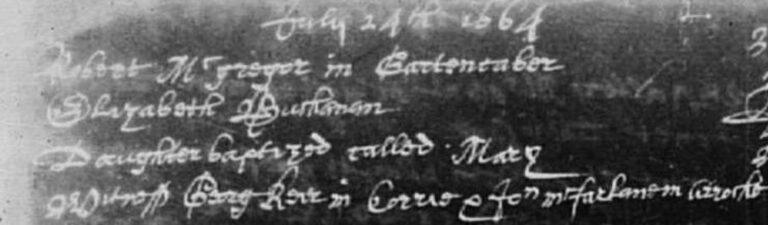
When I finally located Mary’s Old Parish Register entry, it didn’t confirm what I’d been told—it corrected it.
Mary wasn’t born in Killin. The record placed her firmly in Buchanan Parish.
That single line quietly dismantled something my family had believed for centuries, but it also did something more important: it restored detail. The register preserved what oral tradition almost always loses first—exact dates, named witnesses, and a specific place rather than a general region.
Mary’s baptism was recorded as July 24th, 1664, and the witnesses were named: George Buchanan of Corro and Jon McFarlane. Reading those names felt like stepping into a seventeenth‑century kirk, standing beside Mary’s family as the minister wrote the moment into the parish book.
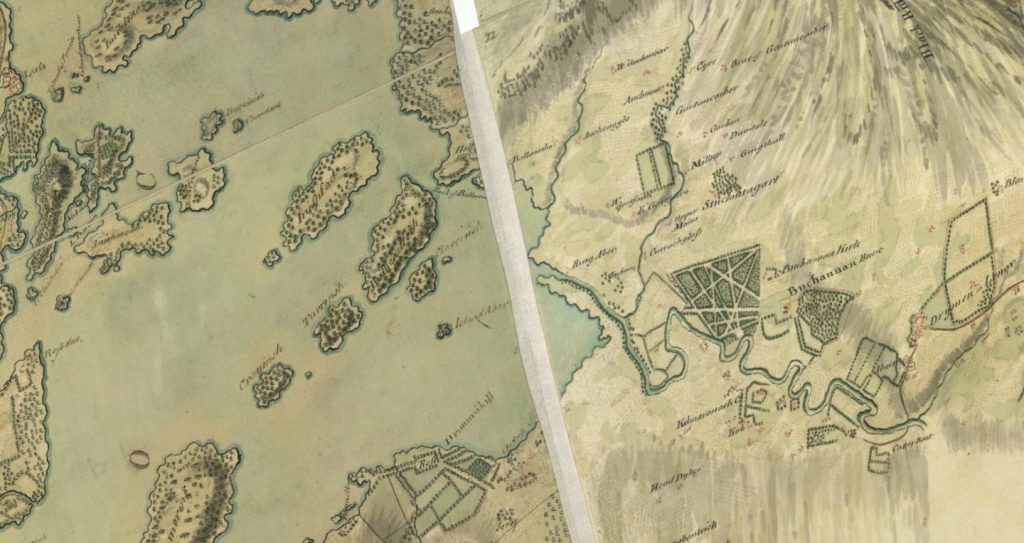
The entry also noted that Mary’s father lived in Gartentaber (sometimes rendered as Gartentobber), an older place‑name that anchored her family to a real, local landscape rather than a vague Highland backdrop.
And then came the line that changed everything:
Mary’s parents were listed as Robert McGregor and Elizabeth Buchanan.
In that moment, Mary stopped being a silhouette carried by memory and became a daughter situated in a family, in a parish, among neighbors whose lives overlapped in visible ways.
The Witnesses That Opened a Hidden Network
Witness names are never accidental. They are social markers—relatives, neighbors, patrons, or respected figures within a local kin‑network.
Seeing George Buchanan of Corro listed as a baptismal witness immediately placed Mary’s childhood within a Buchanan–MacFarlane–MacGregor world rooted along the eastern shores of Loch Lomond and its surrounding glens. This was not abstract clan identity; it was lived community.
And this is where the story needs an important update.
Elizabeth Buchanan was not simply “a Buchanan” in the broad sense of the surname. As I followed the Buchanan names appearing around Mary—through witnesses, parish clustering, and repeated family presences—it became clear that her maternal line belonged within a specific Buchanan parish network, one closely aligned with the Buchanans of Gartincaber (also spelled Gartencaiber).
This matters because Gartincaber is not a floating family name. It is a place‑anchored Buchanan identity rooted in Buchanan Parish itself. When Mary’s record places her among Buchanan witnesses and records her mother as Elizabeth Buchanan, the connection is not generic. It is local, structural, and geographic.
In other words, Mary’s Buchanan connection is not simply clan‑level. It belongs to the Buchanan Parish world that includes the Gartincaber line, a branch whose identity is inseparable from the land it occupied.
This isn’t a dramatic reinvention of the story. It’s a refinement.
From One Name to an Entire Household
Once Mary’s parents were confirmed, something else surfaced—something oral tradition had completely let go.
Mary was not an only child.
The parish registers revealed siblings whose names had vanished from family memory: John, Margrat, Jonet, Agnes, and Christen, born across nearly two decades.
Seeing their names together felt like opening a door into a house that had been closed for centuries. Oral history had preserved Mary as a single figure, but the records restored her as one child in a full household—part of a rhythm of births, baptisms, and family life that unfolded year by year.
This is one of the quiet distortions of memory: families tend to remember the ancestor who leads to them and forget the siblings who did not.
The records remember everyone.
Why the Details Faded: Proscription and Survival
Understanding why these details disappeared made Mary’s life clearer, not murkier.
Mary lived during the period when the MacGregor name was proscribed, a time when carrying that identity could bring legal and social consequences. Families adapted. They shifted between parishes. They used alternate surnames. They allowed public identity and private identity to drift apart when necessary.
Oral tradition suggested that Mary may have used the name Graham at times. Removed from context, that can sound like confusion. Placed within the realities of proscription, it sounds like strategy.
Families did not abandon who they were—they learned how to survive while remaining themselves.
Mary McGregor, Buchanan Parish — July 24th, 1664
Once Mary’s place was restored, her world became easier to imagine.
She was born in Buchanan Parish on July 24th, 1664, among wooded glens and lochside settlements shaped as much by kinship as by geography. And then another detail brought the landscape into even sharper focus:
Rob Roy MacGregor was born and baptized in that same parish in 1671.
Mary would have been about seven years old—close enough in age that they belonged to the same generational world, shaped by the same places, the same families, and the same tensions.
Whether their lives ever crossed doesn’t matter. What matters is that Mary belonged to the same real, historical environment that later produced figures we treat as legend.
She was not standing outside history. She was standing inside it.
From Record to Road Map
Finding Mary’s baptism did more than correct a place-name. It created a path into earlier generations.
Her father, Robert McGregor, emerged not as an isolated name but as part of a recognizable MacGregor constellation anchored to a specific settlement. Her mother, Elizabeth Buchanan, opened the door to an even deeper landscape—one tied to long‑standing Buchanan families rooted in Buchanan Parish, including the Gartincaber line.
Mary’s story stopped being “a MacGregor woman from somewhere near Killin” and became something far more precise:
Mary McGregor, daughter of Robert McGregor and Elizabeth Buchanan, baptized in Buchanan Parish, surrounded by Buchanan and MacFarlane witnesses, living within a tightly interwoven kin‑network shaped by land, allegiance, and survival.
Seeing the Shoreline Differently
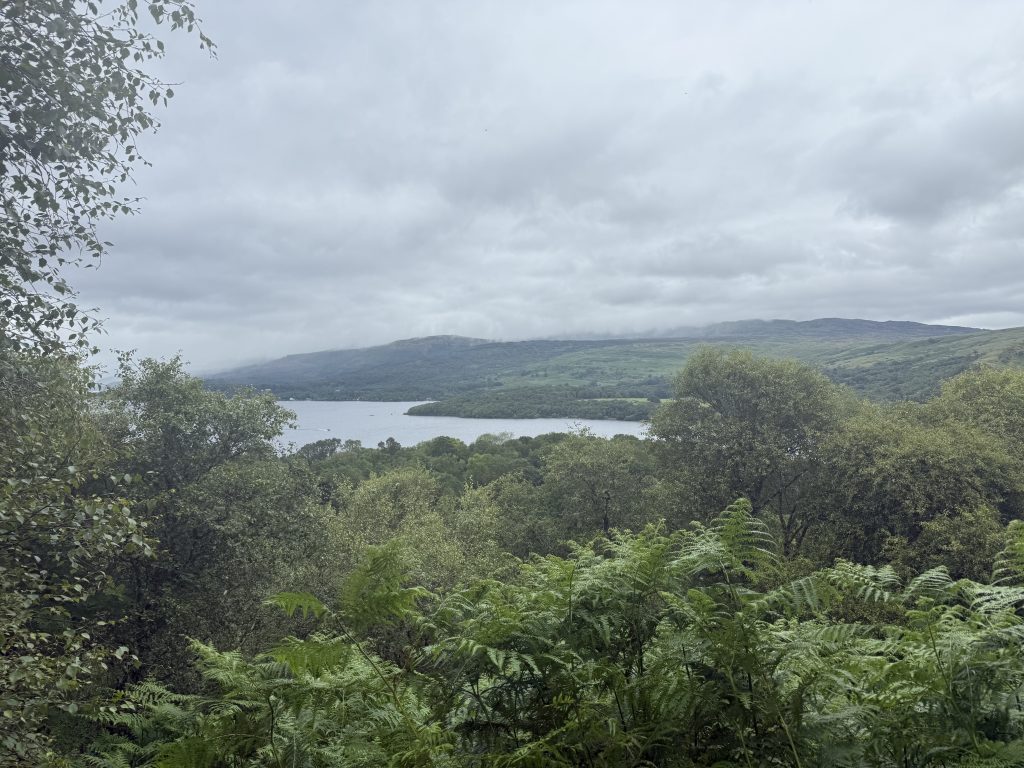
Months later, standing in present‑day Scotland on a boat out from Luss toward Inchcailloch, I felt the shift from research to recognition.
Looking across the eastern shores of Loch Lomond with this knowledge, the landscape changed. It was no longer just beautiful—it was explanatory.
From the top of Inchcailloch, just steps away from where MacGregors rest beside MacFarlanes, the landscape finally aligned with the record. I could see the Burn of Mar, trace the line of the hillside, and follow the brae to where Gartincaber once stood. In that moment, Mary’s life ceased to be an old story blurred by missing details and became something grounded and visible—a world shaped by real slopes, real water, and real places that could still be read in the land.
Realizing that Mary lived here—before Rob Roy became Rob Roy—was one of those rare genealogy moments when the past stops feeling distant and starts feeling inhabited.
What Oral History Lost—and What It Preserved
So what did oral family history lose over centuries?
It lost the exact parish.
It lost witness names and settlement detail.
It lost siblings and household shape.
And it simplified a meaningful Buchanan connection into a surname, when that connection belonged to a specific Buchanan parish network that includes the Buchanans of Gartincaber.
But oral history preserved something just as important.
It preserved belonging.
Even when details blurred, the story kept Mary within the Highland world where she truly lived. It carried the MacGregor identity through generations when bearing that name was dangerous. And it held enough truth to survive until the day a parish book could restore the rest.
What began as a search for one ancestor became the rediscovery of an entire family—and the land that shaped them.
Mary steps out of the haze of memory and into view: not just a name we repeated, but a woman who belonged to a place we can still stand in.
Where the Record Falls Silent
The record tells us much, but it does not tell us everything.
Mary McGregor’s life now stands more clearly than it did before—anchored to Buchanan Parish, placed among named parents and siblings, tied to witnesses, settlements, and a landscape that can still be read. Yet when her story reaches its end, the documents thin again. We know that Mary died in 1711, but the question of where she was laid to rest remains unanswered.
And so the search continues—not through registers alone, but through custom, memory, and place.
Inchcailloch and the Persistence of Burial Memory
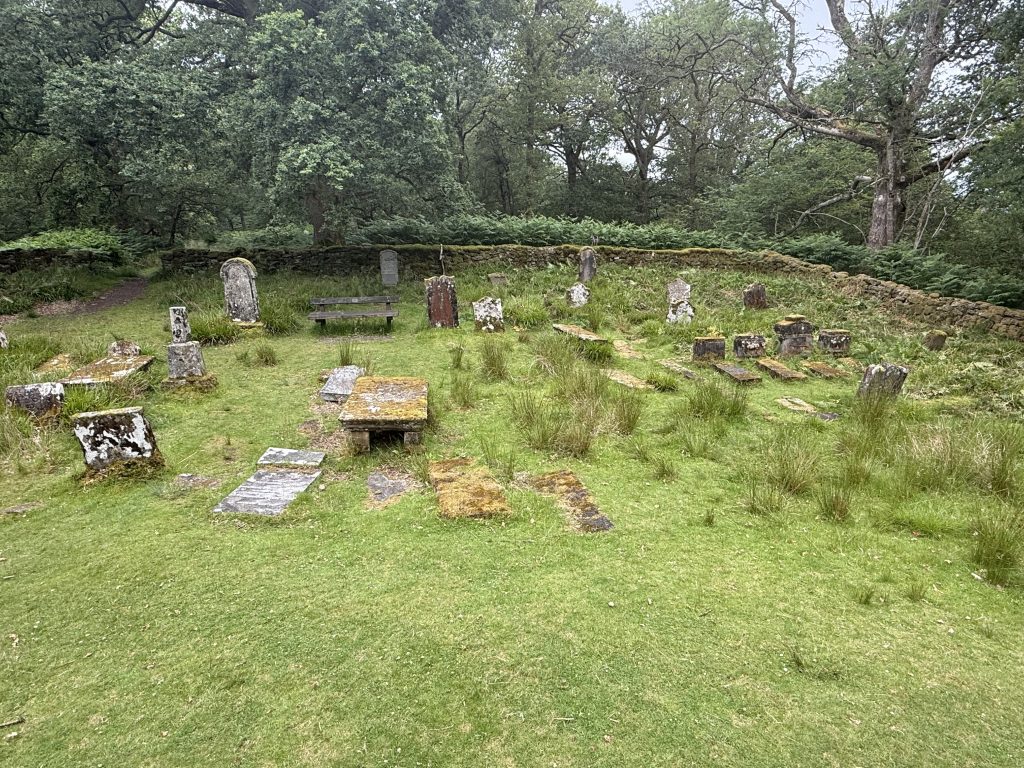
By the early seventeenth century, the local population had largely stopped using Inchcailloch as an active burial ground. By 1621, regular parish burial practice had shifted elsewhere. And yet, the island did not fall silent for everyone.
For Clan MacGregor, Inchcailloch retained a meaning that outlasted administrative change. Long after ordinary use had ceased, MacGregors continued to return to the island to bury their dead. The ground remained ancestral even when it was no longer convenient. Kinship, in this case, mattered more than regulation.
That persistence makes it plausible—though not provable—that Mary McGregor may rest there as well.
Plausibility Without Proof
There is no stone that bears Mary’s name.
No burial entry has yet surfaced to place her on the island with certainty.
No single document closes the case.
What exists instead is context.
Mary lived within a MacGregor world that demonstrably maintained burial ties to Inchcailloch beyond the point when others had moved on. Her family’s identity, shaped by proscription and adaptation, leaned heavily on tradition where written affirmation was often absent or unsafe. In such circumstances, burial choices were as much statements of belonging as they were acts of necessity.
To suggest that Mary could have been buried on Inchcailloch is not to claim that she was. It is an informed assumption—one grounded in cultural practice, geography, and continuity rather than wishful thinking.
And for now, it remains only that.
Standing With an Unanswered Question
Standing on Inchcailloch today, near where MacGregors lie beside MacFarlanes, the question feels less urgent than it once did. The island does not demand certainty. It holds space for possibility.
Mary’s life no longer depends on a burial location to be real. She has already been restored to family, place, and time. Whether or not her body rests beneath this ground, her story now belongs to the same landscape—to the burns, braes, and slopes that shaped her days and carried her people forward.
Some answers wait patiently.
Others may never arrive.
And learning the difference—between what can be proven and what can only be held with care—is part of the work of listening to the past honestly.
The Last Known MacGregor Burial on Inchcailloch
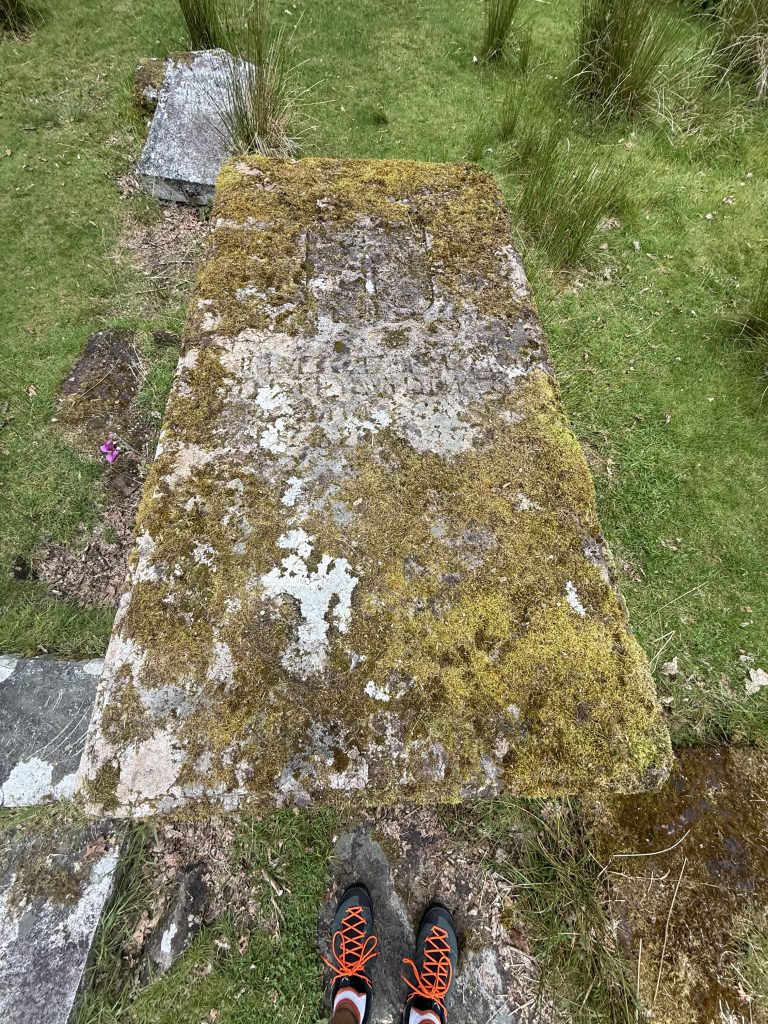
The last clearly identified and traditionally accepted MacGregor burial on Inchcailloch is that of Gregor MacGregor, 15th Chief of Clan Gregor, who died in 1693. His grave is marked by what is known as the Grey Stone of Inchcailloch, a stone that later became sacred within Clan Gregor tradition and was used as an oath‑stone in subsequent generations.
At present, there is no firm documentary or inscribed evidence that identifies a MacGregor burial on the island later than 1693.
Why 1693 Matters — and Why the Story Remains Open
Although the church on Inchcailloch ceased to function as the parish church in 1621, the burial ground itself did not close at that time. Burials continued on the island well into the modern era, long after formal parish use ended.
What changes after the late seventeenth century is visibility, not necessarily practice.
From that point forward:
- MacFarlane burials become far more numerous and identifiable
- Named MacGregor burials become scarce or absent in surviving records
- Many later graves appear to have been unmarked, weathered away, or never inscribed
- Families affected by proscription and displacement, such as the MacGregors, often left little or no formal burial documentation
This means that 1693 is the last provable MacGregor burial, not necessarily the last possible one.
What This Means for Mary McGregor (d. 1711)
Mary McGregor’s death in 1711 places her eighteen years after the burial of the 15th Chief.
Given what is known:
- Inchcailloch was the ancestral burial ground of Clan MacGregor
- MacGregors continued to use the island for burials after official parish use ended
- Clan burial customs were deeply traditional and resistant to administrative change
- Many early‑18th‑century burials, especially those of women and non‑elite individuals, were never marked or recorded
…it is entirely plausible, though not provable, that Mary McGregor may have been buried on Inchcailloch.
At the same time, there is no surviving stone, inscription, or burial record that confirms her presence there.
This places Mary precisely where my research already situates her:
within the space between documented history and inherited custom.