
Skye → Newcastle → Amsterdam → Brussels → Hamburg → Copenhagen → Oslo → Bergen → and Back
Planning a long road trip isn’t about drawing a straight line on a map. It’s about understanding where effort belongs, where to slow down, and where logistics quietly matter more than scenery. A four‑week drive from the Isle of Skye through mainland Europe and deep into Scandinavia is absolutely achievable—but only if the route is designed with intention.
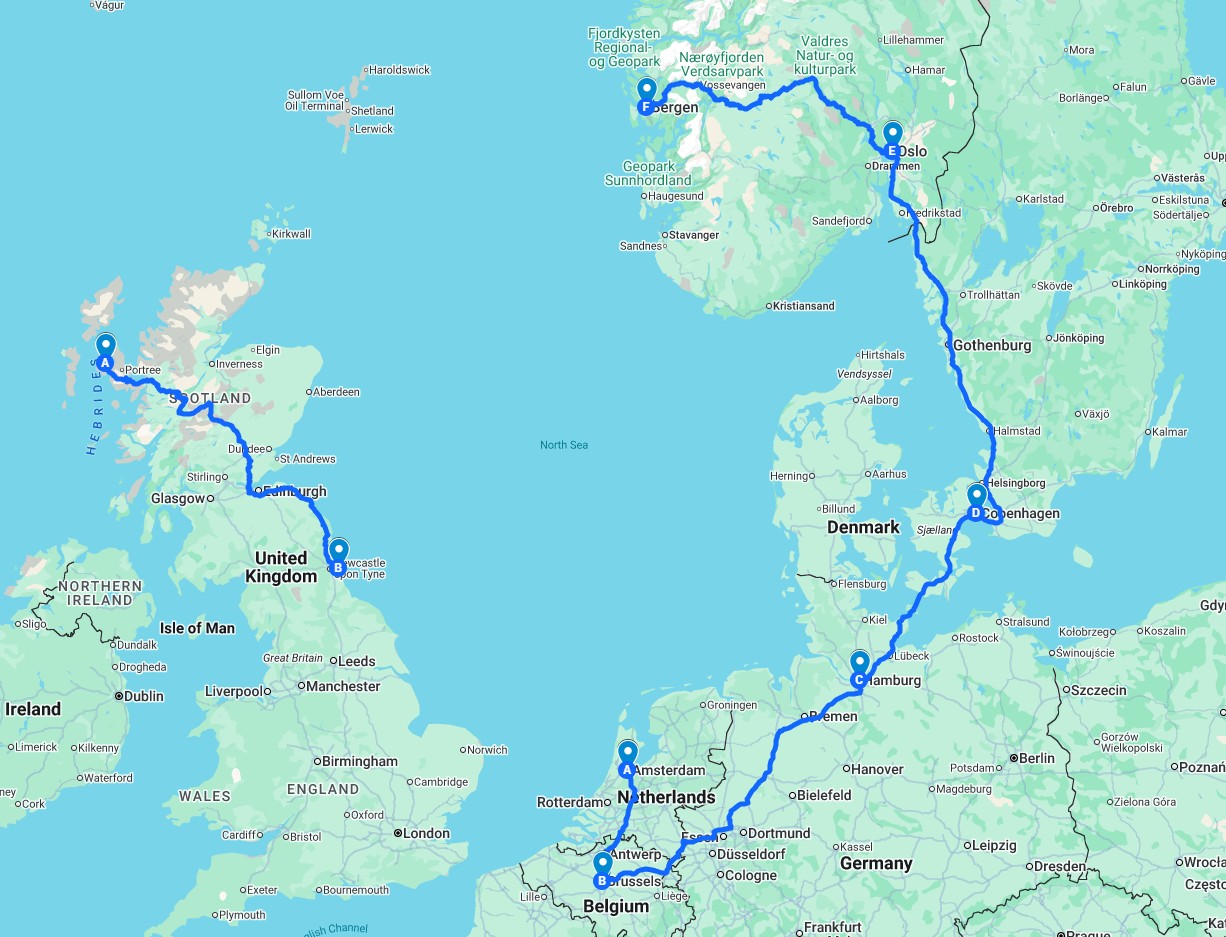
This journey begins in the far northwest of Scotland, crosses into continental Europe by ferry, works steadily eastward, then turns north into Denmark and Norway before looping back the same way. The goal isn’t speed. It’s continuity: a route that flows, respects fatigue and saves the most demanding driving for when it can be enjoyed rather than endured.
Designing the Route: Fewer Borders, Fewer Decisions
The first and most important planning decision is how to leave the UK. Driving south through England and crossing the Channel adds congestion, unpredictability, and unnecessary mileage. Instead, the route is anchored by the overnight car ferry from Newcastle to Amsterdam.
This single choice removes two long driving days and drops you directly into mainland Europe, rested and ready. It also sets the tone for the entire trip: use ferries where geography demands, not where habit suggests.
From Amsterdam, the route unfolds logically:
- West to east across continental Europe (Amsterdam, Brussels, Hamburg)
- North into Scandinavia (Copenhagen, Oslo, Bergen)
- Then a controlled return using the same corridors
Each city is visited on the outbound leg, when energy is highest. The return leg uses the same cities only as overnight anchors—familiar, efficient, and predictable.
Pacing the Journey: Experience First, Logistics Later
My four‑week window allows the trip to be divided into two distinct phases.
Outbound is for experience.
Each major city gets real time—two full days to walk, explore, and absorb. Driving days are separated by rest days. You arrive curious, not depleted.
Return is for execution.
By the time you turn south again, the emphasis shifts. Cities become staging points. Driving becomes purposeful. You already know the roads, the borders, the rhythm. The aim is calm efficiency, not discovery.
This asymmetry is deliberate. Trying to make every stop meaningful on both legs is how long trips collapse under their own weight.
📍 Trip Breakdown by Day
- Day 1
- Scotland (UK): Skye → Newcastle
- Long driving day
- Day 2
- North Sea
- Overnight ferry (no driving)
- Days 3–5
- Netherlands: Amsterdam
- Days 6–8
- Belgium: Brussels
- Days 9–11
- Germany: Hamburg
- Days 12–14
- Denmark: Copenhagen
- Days 15–18
- Norway: Oslo
- Days 19–22
- Norway: Bergen
- Days 23–28
- Return loop (overnight transit only):
- Norway
- Sweden (transit)
- Denmark (transit)
- Germany
- Netherlands
- North Sea (overnight ferry)
- Scotland (UK)
- Return loop (overnight transit only):
Fuel Strategy: Planning for Freedom, Not Necessity
Fuel planning on a trip like this is less about cost and more about optionality.
In mainland Europe, fuel is abundant. Motorways are dense, stations frequent, and operating hours generous. You can afford to be relaxed here—refuel at half a tank, stop when convenient, move on.
Scandinavia changes the rules.
Once you cross into Denmark and Sweden, and especially once you enter Norway, fuel becomes a strategic resource. Distances stretch. Roads slow. Stations thin out or close early. Long tunnels and mountain crossings remove easy exit points.
The rule becomes simple:
- Start Scandinavian driving days with a full tank
- Refuel early, not late
- If you see fuel and you’re unsure about the next stop, take it
Fuel in Norway isn’t just energy—it’s autonomy. It allows detours, weather delays, and spontaneous stops without stress.
Rest Stops: The Quiet Backbone of the Trip
Long‑distance fatigue doesn’t announce itself. It arrives gradually, disguised as confidence. Scenic roads are especially deceptive—your brain stays stimulated while your body quietly tires.
The solution isn’t discipline for its own sake; it’s rhythm.
Throughout the trip, the driving day is broken into predictable segments:
- Short stops every couple of hours to walk, hydrate, and reset
- Regular longer breaks for food and mental decompression
- A hard stop for the night that isn’t negotiated away by “just another hour”
In Norway, rest stops serve a second purpose. Scenic pull‑outs, viewpoints, and ferry crossings double as recovery time. The landscape encourages stopping—use that invitation rather than resisting it.
🚗 Total Distance — At a Glance
- Total driven miles: ~3,300–3,600 miles
- Total ferry miles: ~700–750 miles
- Grand total (road + sea): ~4,000–4,300 miles
🚗 Driven Miles (Approximate)
Outbound Driving
- Skye → Newcastle: ~360–390 miles
- Amsterdam → Brussels: ~130 miles
- Brussels → Hamburg: ~350 miles
- Hamburg → Copenhagen: ~210 miles
- Copenhagen → Oslo (via Sweden): ~380 miles
- Oslo → Bergen: ~290 miles
Outbound driving subtotal:
👉 ~1,720–1,750 miles
Return Loop Driving
(Return is slightly longer due to positioning days and route flexibility)
- Bergen → Oslo: ~290 miles
- Oslo → Southern Sweden: ~310 miles
- Southern Sweden → Denmark → Germany: ~350 miles
- Germany → Netherlands (IJmuiden area): ~300–330 miles
- Newcastle → Skye: ~360–390 miles
Return driving subtotal:
👉 ~1,600–1,700 miles
✅ Total Driven Miles
👉 ~3,300–3,600 miles
The Hardest Day: Skye to Newcastle
Every long trip has one day that carries more weight than the others. Here, it’s the opening push from Skye to Newcastle.
This is not a sightseeing day. It’s a positioning move. Single‑track Highland roads give way to faster corridors, but the mental load is real. The strategy is simple: start early, fuel early, stop more than you think you need to, and arrive with margin.
Everything after this day becomes easier. That’s the point.
Ferry Crossings: Built‑In Recovery
Ferry days aren’t dead days—they’re structural rest.
An overnight crossing resets posture, attention, and sleep. Walking decks, eating properly, and sleeping horizontally all matter more than they seem. By the time you roll off the ferry in the morning, you’re not just in a new country—you’re in a different mental state.
Treat ferries as part of the route, not interruptions to it.
The Return Loop: Familiar Roads, Clear Intent
On the return leg, the mindset changes. Cities like Oslo, Copenhagen, Hamburg, and Amsterdam are no longer destinations; they’re waypoints.
Arrive early enough to eat well. Leave early enough to drive calmly. Avoid adding “just one more stop.” The satisfaction comes from execution, not expansion.
Because the outbound leg was generous, the return can be efficient without feeling rushed.
The One Question That Keeps the Trip Smooth
Each morning, before the engine starts, there’s one quiet planning check:
Where is my first fuel stop, my first rest stop, and my hard stop for the night?
If those three points are clear, the day almost always works—regardless of traffic, weather, or mood.
Weather on the Road: What Spring Actually Feels Like on a Northbound Drive
One of the quiet truths about driving from the Isle of Skye to Scandinavia in early spring is that you don’t experience one season—you pass through several, often in the same week. This isn’t a trip where the weather settles into a pattern and stays there. Instead, it unfolds gradually, shaped by latitude, coastlines, and elevation, each region easing you forward into a different version of spring.
The key isn’t hoping for perfect weather. It’s understanding the rhythm of it.
Leaving Skye: Moody, Moving, Familiar
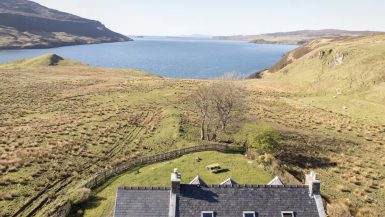
The journey begins in weather that feels entirely appropriate for the place. Skye in March or April is rarely dramatic in a single direction—it’s not winter anymore, but it hasn’t committed to spring either. Days are cool, often hovering in the forties or low fifties, with wind that reminds you the Atlantic is never far away. Rain arrives in bursts rather than downpours, and cloud sits low enough to soften the hills without hiding them entirely.
This is the kind of weather that looks better than it feels harsh. Roads are wet rather than icy. Visibility changes quickly, but rarely dangerously. You’re not fighting the elements here—you’re simply moving through them. And because the route takes you off the island quickly, Skye’s mood becomes more of a tone‑setter than a challenge.
Mainland Europe: A Noticeable Shift
The morning you roll off the ferry in the Netherlands, something changes. The air feels calmer. The light feels steadier. Spring in mainland Europe announces itself not with warmth, but with predictability.
In Amsterdam, Brussels, and Hamburg, early spring is a season of layers and short adjustments. Mornings are cool, afternoons often surprisingly mild, and rain—when it comes—tends to pass through rather than linger. April, in particular, often brings longer dry stretches, brighter skies, and that unmistakable sense of the year opening up again.
For driving, this is the easiest stretch of the trip. Roads are excellent, weather rarely interferes with plans, and you stop thinking about conditions at all. It’s the phase where the journey settles into a rhythm and the miles begin to feel effortless.
Denmark and Southern Sweden: The Air Thins and the Wind Returns
Crossing into Denmark, the climate shifts subtly but unmistakably. Temperatures drop a few degrees. Wind becomes a constant companion again. Spring here feels cleaner and sharper—less about blossoms and more about light.
Days are cool, often in the high forties or low fifties, and the wind off the water can make bridges feel more demanding than their mileage suggests. The Øresund crossing into Sweden is a moment you notice not because it’s difficult, but because the atmosphere changes. You’re no longer easing into spring—you’re approaching it cautiously.
Still, conditions are generally stable. Snow is uncommon at low elevations by April, and roads remain clear. This is the transition zone, where the trip starts to feel Nordic even before Norway officially begins.
Norway: Where Spring Is a Negotiation
Norway in early spring doesn’t pretend to be anything else. It offers light without warmth, green valleys framed by white peaks, and cities that feel ready for outdoor life while the mountains hold firmly to winter.
In Oslo and Bergen, daytime temperatures often sit in the forties and low fifties, with cool nights and frequent but manageable rain along the coast. Bergen, true to its reputation, wears moisture well—showers come and go, and the city seems built for it.
Between the cities, especially on the drive toward the mountains, winter is still very much present. Snow remains at elevation. Weather can change quickly with altitude. A clear morning can give way to sleet or snowfall by afternoon, particularly on interior routes. This isn’t unusual—it’s expected.
But this is also where the trip becomes visually extraordinary. Snow‑covered plateaus, waterfalls fed by thaw, and long, luminous evenings create a sense of scale that summer often softens. The roads demand respect, not fear. With appropriate tyres and a flexible pace, driving remains safe—but it’s never casual.
Light, More Than Temperature, Defines the Season
What you notice most as April progresses isn’t warmth—it’s daylight. Each day stretches a little longer than the last. Evenings linger. Scenic drives no longer race the sun.
This expanding light changes how the trip feels. Long days no longer feel compressed. Stops become optional rather than necessary. Norway, in particular, benefits from this; the same weather that would feel oppressive in winter feels expansive in spring simply because you can see so much more of it.
The Right Expectation
This isn’t a weather window designed for guarantees. It’s a season that rewards flexibility.
You should expect:
- Cool temperatures throughout the route
- Rain in coastal areas
- Wind in Denmark and Sweden
- Lingering winter conditions in Norwegian mountains
You should also expect:
- Far fewer crowds
- Clearer roads
- Dramatic seasonal contrast
- Some of the most striking scenery of the year
This is not a trip about chasing blue skies. It’s about moving with the landscape as it transitions—watching winter loosen its grip mile by mile.
Final Thought
If summer is when Europe shows itself off, early spring is when it feels most honest. The weather doesn’t perform; it simply exists. And when you accept that—when you pack for layers, drive with patience, and allow days to unfold as they will—the journey becomes richer for it.
This is a trip where the weather isn’t an obstacle.
It’s part of the story.