For years, my understanding of my 7th great‑grandmother, Mary McGregor, rested on oral history—names spoken across generations, softened and reshaped with time. Those stories placed her in Killin, and for a long while I accepted that as truth. Everything changed when I found her Old Parish Register record on Scotland’s People.
The record showed that Mary was born in Buchanan Parish, not Killin (Perthshire Parish), instantly reshaping what my family had believed for centuries. Even more, the entry preserved details that memory had long since let slip. It recorded the exact date of her baptism/birth —July 24th, 1664, and named the witnesses to her baptism: George Buchanan of Corro and Jon McFarlane. Reading those names felt like stepping into a 17th‑century kirk, standing beside her family as the minister wrote the moment into the parish book. The entry also noted that her father lived in Gartentaber (or Gartentobber)—likely an older name for a local glen or settlement—anchoring the family to a specific landscape that oral tradition no longer preserved.
The record identified Mary’s parents as Robert McGregor and Elizabeth Buchanan. With their names confirmed, I could finally search for—and locate—their marriage record. That one discovery transformed Mary from a shadow carried by memory into a daughter situated in a family and a place.
As I followed the trail through the registers, I discovered something else my family oral history had never passed down: Mary had siblings. The scanned digital records revealed John (born 1649), Margrat (born 1652), Jonet (born 1654), Agnes (born 1657), and Christen (born 1666)—a household unfolding across nearly two decades of baptisms. Seeing their names restored felt like unlocking a door into a home that had been closed for centuries.
Understanding why these details had faded helped me see Mary’s life more clearly. She lived through the proscription of the MacGregor name, a period when bearing that identity could bring legal and social penalties. Families like hers sometimes adopted aliases or shifted between parishes, and in Mary’s case, oral history even suggested that she used the name Graham at times. As I mapped the family connections through the records, I also discovered marriages within the wider kin network that linked directly to Clan Graham, further supporting the possibility of that alternate name appearing in her life.
Placed in its historical setting, Mary’s family sits squarely within the Buchanan–MacGregor orbit of the Lennox and Trossachs region—across Perthshire and the eastern shores of Loch Lomond—a world where these kindreds frequently intermarried and held tacks or wadsets. The naming patterns, the Buchanan witness, the residence in Gartentaber, and the geographic clustering all align with the wider Glengyle–Buchanan kin network of the late seventeenth century.
What began as a simple search for one ancestor became the rediscovery of an entire family—parents, siblings, witnesses, neighbors, and the land that shaped them. Through these records, Mary steps out of the haze of oral tradition and into view as a fully realized figure: a daughter of Buchanan Parish, baptized among Buchanans and MacFarlanes, living in a time when the MacGregor name itself was forbidden—yet still carried forward, quietly, until it reached me.
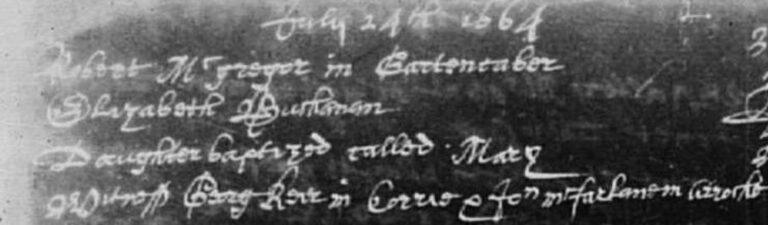
It is remarkable to reflect on the world Mary McGregor inhabited as a young girl growing up in Buchanan Parish. Born there on July 24th, 1664, she spent her early years among the wooded glens and lochside settlements of the Lennox and Trossachs. What strikes me now is realizing that Mary was living in that same parish when Rob Roy MacGregor was born and baptized there in 1671. She would have been about seven years old at the time close enough in age that they belonged to essentially the same generation, shaped by the same landscapes, the same families, and the same rhythms of Highland life. To imagine Mary as a child in Buchanan Parish walking the same paths, hearing the same clan stories, and growing up within the same cultural world that formed Rob Roy—adds a vivid human dimension to her story and anchors her firmly in the historical landscape of her time.
Uncovering Mary McGregor’s baptismal record did far more than reveal her birthdate and parish—it opened an entirely new road map into the generations that preceded her. For the first time, I had the names of her parents: Robert McGregor and Elizabeth Buchanan. With those names, the past stopped being a vague landscape built on oral tradition and became an interconnected web of relationships, places, and kinships waiting to be traced.
As I began exploring who Robert McGregor was, the records and regional patterns placed him within the familiar MacGregor world of the Lennox and Trossachs—the same Highland zone that shaped Mary’s early life. His residence at Gartentaber (or Gartentobber) anchored him geographically near families already known to be part of the Glengyle–Buchanan–MacFarlane orbit. The deeper I mapped these connections, the more Robert appeared not as an isolated entry in a parish register, but as a member of a larger kin-group tied by marriage, landholding, and loyalty to other branches of Clan Gregor. Each clue—naming patterns, proximity to known tacksmen, neighboring families acting as baptismal witnesses—drew him further into a recognizable MacGregor constellation.
Yet it was Mary’s mother, Elizabeth Buchanan, who opened the path even further back in time. Her name immediately pointed toward one of the most documented and distinguished branches of the region: the Clan Buchanan of Auchmar kin. As I traced the Buchanans appearing in the same parish, the same settlements, and even the same baptismal entries where their names appeared as witnesses, a clear pattern emerged. Elizabeth’s placement within the Buchanan families of the district was not incidental—it was structural. She belonged squarely to the kin network associated with the Auchmar line, a cadet branch rooted deeply in the lands around Buchanan, Balfron, and Drymen.
This realization reframed everything I thought I understood about Mary’s ancestry. She was not simply the daughter of a MacGregor father and Buchanan mother—she was the product of two lineages whose histories braided through centuries of alliances, marriages, and shared landscapes along the eastern shores of Loch Lomond. The Buchanans of Auchmar, with their recorded genealogies and longstanding ties to tacks and wadsets in the region, offered a doorway into generations far earlier than Mary’s own lifetime. By following Elizabeth’s kinship ties, I found myself stepping back into a world where these families held land under hereditary right, served as witnesses to each other’s marriages, and appeared repeatedly in the kirk session minutes as part of the same enduring community.
What began as a single baptismal entry became a map—one that traced Robert McGregor’s roots into the MacGregor constellations of the Trossachs and carried Elizabeth Buchanan’s ancestry into the respected lineage of the Auchmar Buchanans. Together, their union created the world Mary was born into: a crossroads of Highland families whose histories were woven long before she arrived, and whose legacies continued long after.
This new understanding has expanded not just Mary’s story, but the story of everyone who descended from her. By identifying her parents and following the paths they opened, I stepped into a deeper, older landscape—one where clan histories, glens, and generations converge to reveal the fuller tapestry of who these people truly were.
Fast forward to present day 2025 Scotland, on a boat tour to Inchcailloch from the village of Luss on the western shores of Loch Lomond, knowing the information I had discovered month earlier, I found myself looking out over the eastern shores and see the lands for for which the Old Parish Record place my 7th Great Grandmother. From the top of Inchcailloch, where Macgregor’s and MacFarlane’s rest together, I was able to view the eastern shores, looking toward the highland glens, and this still wild and rugged landscape where Rob Roy roamed and the new found knowledge that my 7th Great Grandmother roamed here before Rob Roy was pretty cool.
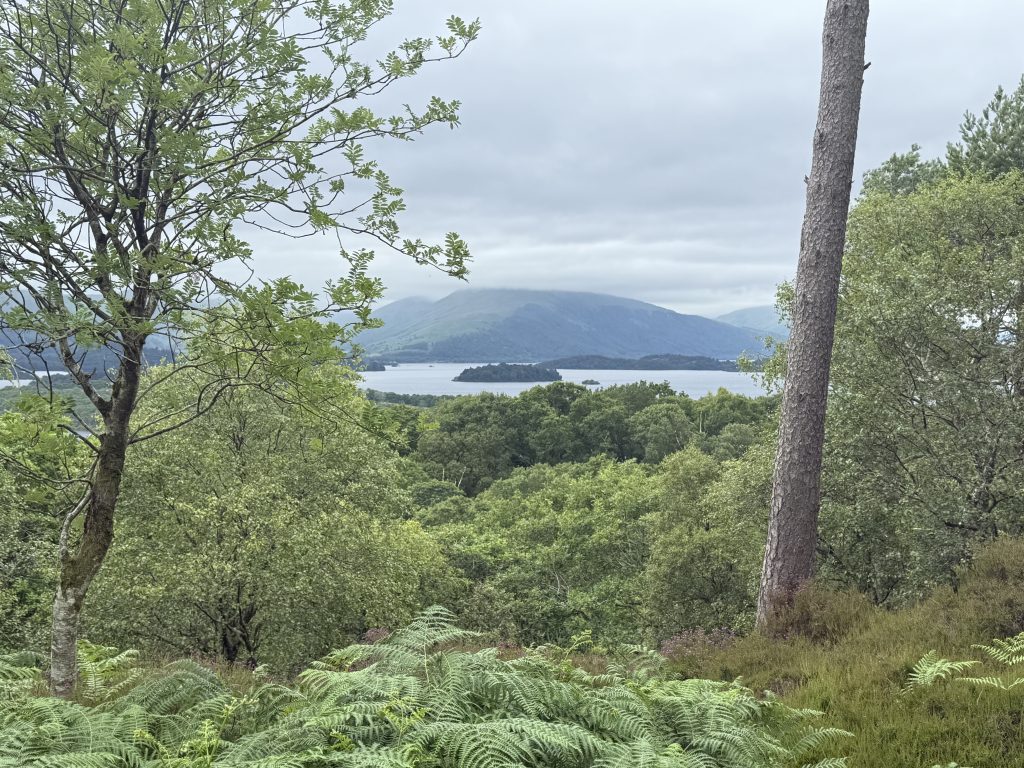
Top of Inchcailloch – looking west across Loch Lomond and the at the western shore.
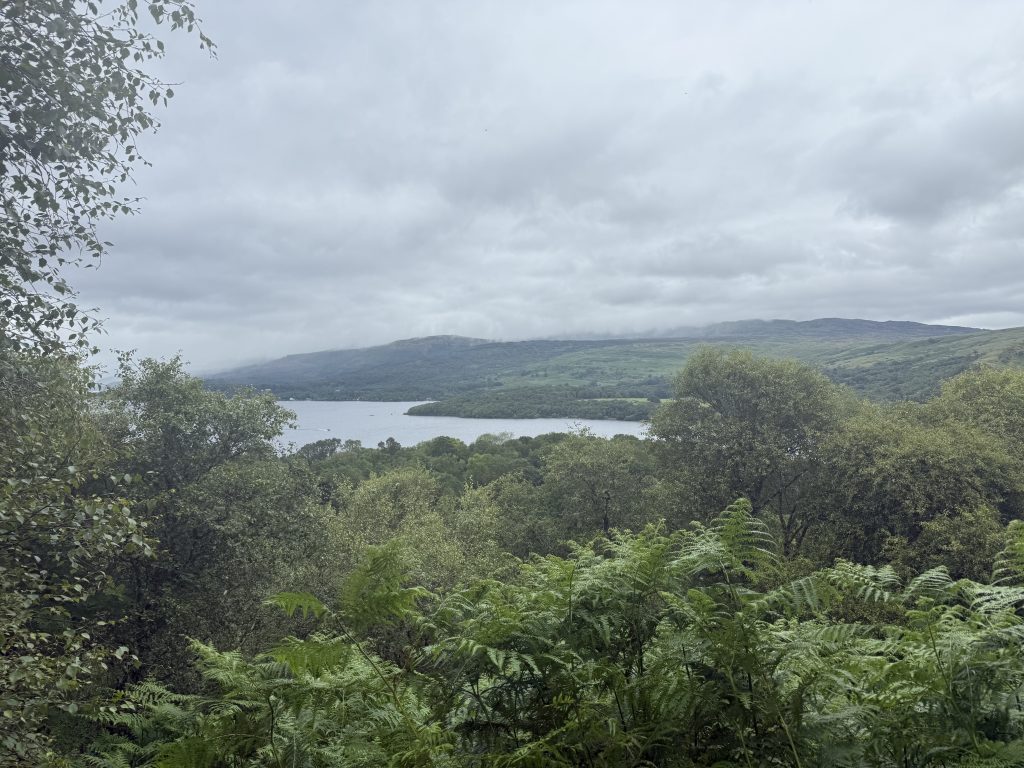
Top of Inchcailloch – Eastern Shore of Loch Lomond near Balmaha, Scotland. The glen that she lived was in the shadows of Ben Lomond, and the village of Comar, not far from Loch Arklet or Loch Katrine.